
Warns against vigilante raids, syndicate control
Staff Reporter
DIMAPUR, JUN 15 (NPN): Amid widespread confusion over the state government’s recent notification on tobacco-related products, the Confederation of Nagaland Chamber of Commerce and Industry (CNCCI) on Monday clarified that Nagaland has not imposed a blanket ban on pan masala and tobacco products, while cautioning against vigilantism, arbitrary raids and the growing influence of syndicates in the trade sector.
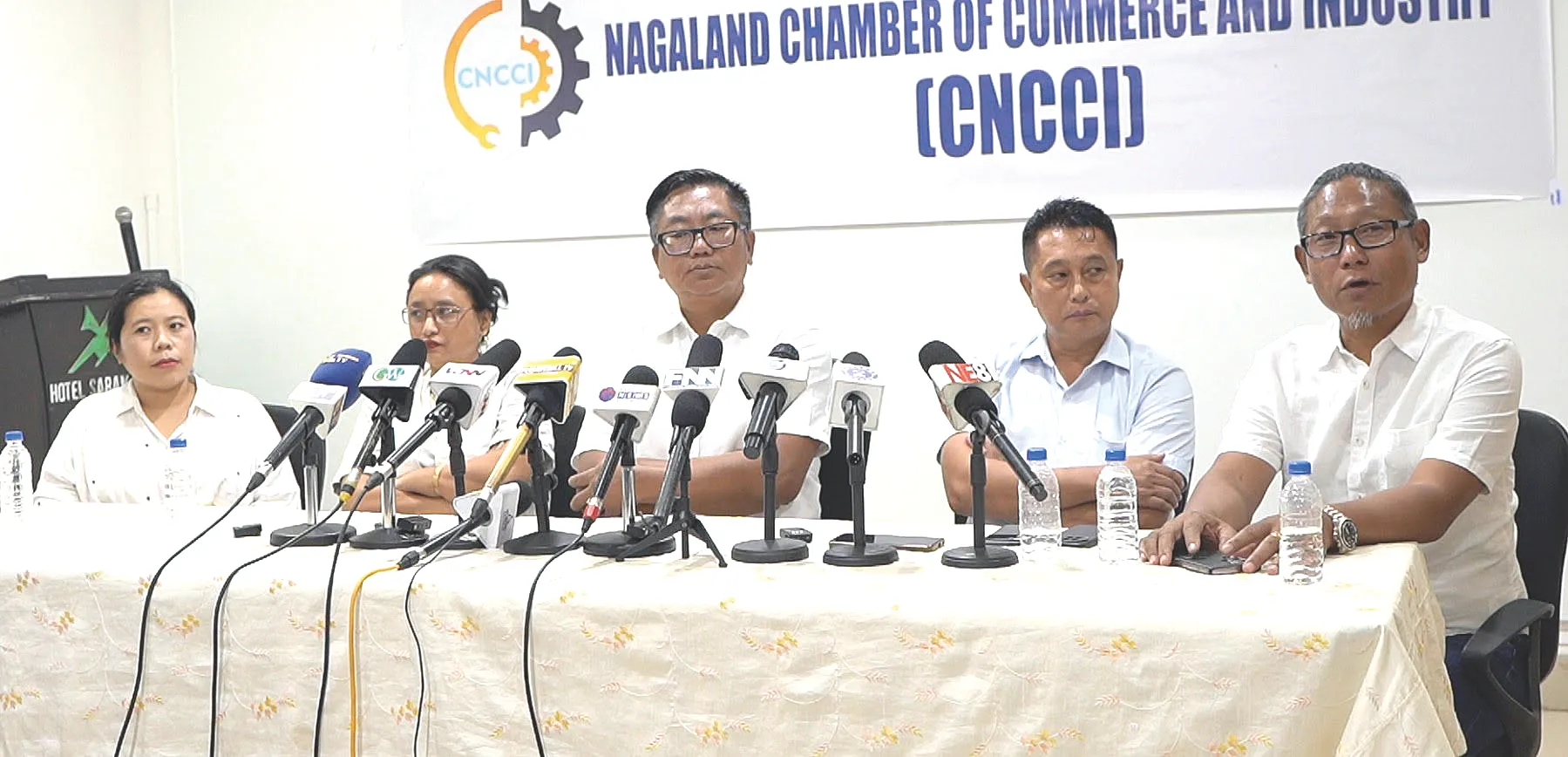
Addressing a press conference at Hotel Saramati, Dimapur, CNCCI chairperson Dr. Khekugha Muru said the organisation was compelled to intervene after confusion surrounding the notification led to panic across the state, resulting in raids, confiscation and destruction of goods, and instances of people taking the law into their own hands.
He said CNCCI neither endorses nor promotes tobacco, gutka or pan masala products, but stressed the need for proper understanding of the government order.
Muru informed that CNCCI had already held discussions with the State Food Safety Authority and senior government officials, who assured that a detailed clarification would be issued within a day or two.
According to him, the confusion arose from the provision stating that “food products containing nicotine and tobacco are banned”, which many interpreted as a complete prohibition of all pan masala products..
Explaining the legal distinction, Muru said the Food Safety and Standards Authority of India (FSSAI) Act and the Cigarettes and Other Tobacco Products Act (COTPA) were separate legislations governed by different authorities.
He maintained that several pan masala products marketed under brands such as Rajnigandha, Shikhar and Signature were manufactured without tobacco or nicotine in compliance with Supreme Court directives and were legally licensed under the FSSAI framework. “If these products were illegal, they would not have been granted FSSAI licences,” he said.
Muru clarified that the prohibition applied only to food products containing tobacco or nicotine as ingredients and did not amount to a total ban on all pan masala products.
He further stated that tobacco products continue to be legally saleable in Nagaland, provided traders possess valid licences issued by Urban Local Bodies (ULBs) and comply with provisions of COTPA, including restrictions on sales near educational institutions and to minors.
“The CNCCI is not seeking any extension or grace period because there is no total ban on these products,” he asserted.
CNCCI also appealed to student bodies, NGOs, mothers’ organisations and other civil society groups not to conduct independent raids or seize products, stressing that enforcement powers rested solely with authorised agencies such as the police, district administration and Food Safety Officers (FSOs).
While appreciating their concern over substance abuse, he warned that arbitrary enforcement could expose such groups to legal consequences. “If goods worth lakhs are confiscated and destroyed and the trader files an FIR seeking compensation, who will be responsible?” he asked.
Muru further alleged that the prevailing confusion had led to multiple agencies carrying out parallel inspections and creating difficulties for traders.
Speaking on the issue, CNCCI treasurer Kevin Yepthomi said the absence of immediate clarification from the government contributed to widespread panic and market disruption.
He claimed that fake notifications circulating on social media platforms further aggravated the situation, creating fear among traders and consumers alike.
According to Yepthomi, the panic had resulted in artificial shortages, with products normally retailing for Rs. 10 reportedly being sold for as much as Rs. 50 in some places.
He reiterated that any suspected violation should be reported to the competent authorities rather than being dealt with independently.
CNCCI also expressed serious concern over the alleged dominance of syndicates and monopolies in the tobacco and pan masala trade in Nagaland.
Describing the situation as “highly embarrassing”, Muru alleged that a handful of distributors controlled dealerships of major brands, resulting in artificial scarcity and preventing other entrepreneurs from entering the business.
He claimed that consumers were often forced to queue for long hours to purchase products due to supply restrictions imposed by syndicates.
Warning against monopolistic practices, Muru said CNCCI would not tolerate syndicate-driven control of the market and alleged that certain manufacturers were colluding with local operators to maintain exclusive dealership arrangements.
Yepthomi further alleged that a few operators monopolised the distribution of popular brands, inflating prices far beyond normal retail rates.
To address concerns over product quality and legality, the CNCCI announced that it would independently collect samples of major pan masala brands and send them for laboratory testing to determine compliance with FSSAI standards and assess whether the products were fit for human consumption.
Responding to queries on whether underground groups were involved in protecting certain syndicates, Muru said syndicates and monopolies were illegal under the law and asserted that CNCCI was prepared to pursue all available legal remedies.
“We will not hesitate to take legal action. The law is supreme, and the CNCCI will continue to oppose syndicates in every sector,” he said.
He added that the organisation had previously intervened against monopolistic practices in other sectors and would continue to work towards ensuring fair competition and equal business opportunities for local entrepreneurs across Nagaland.