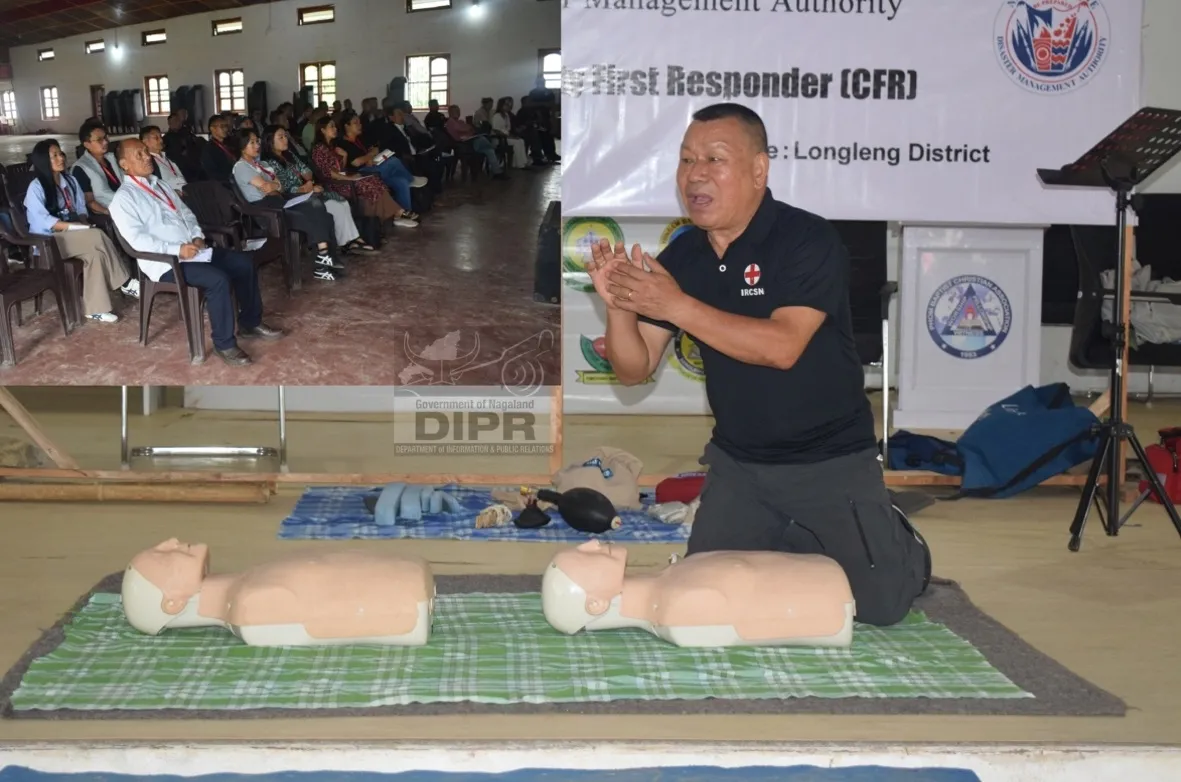
DIMAPUR: Deputy Commissioner Longleng and chairman of the Indian Red Cross Society Longleng Branch, W. Manpai Phom, has described the Community First Responder Programme as essential for the district’s disaster preparedness.
Speaking at the launch of the two‑day programme organised by the Indian Red Cross Society, Nagaland State Branch, in collaboration with the Nagaland State Disaster Management Authority (NSDMA) at the Phom Baptist Christian Association Mission Centre, Longleng, Phom emphasized the urgent need for robust preparedness to tackle unforeseen disasters.
Highlighting the district’s vulnerability, he said that while natural calamities cannot always be prevented, proactive and coordinated efforts can significantly mitigate their impact.
He noted that the initiative was long felt and well deserved by the people of Longleng, highlighting that the programme has been designed to bridge the critical gap between a crisis striking and official emergency services arriving. Stressing that local residents are invariably the first to react in emergencies, he said the programme would transform everyday residents into trained volunteers equipped with life‑saving skills such as basic first aid, search and rescue techniques, and emergency evacuation protocols.
Phom urged the public and community stakeholders to actively participate in such initiatives, reaffirming that the Red Cross Society Longleng Branch, in collaboration with disaster management authorities, will continue to roll out capacity‑building exercises, mock drills and awareness campaigns across wards and villages.
Delivering an introduction on first aid, Kholie Dolf, MC member of the Indian Red Cross Society Nagaland State Branch and master trainer, highlighted the humanitarian role of the Red Cross in delivering disaster relief, emergency aid and medical support worldwide.
He recalled the founding of the global Red Cross movement by Sir Henry Dunant in 1863 after the Battle of Solferino, and the subsequent creation of the International Federation of Red Cross and Red Crescent Societies (IFRC) following World War I.
He noted that the Indian Red Cross Society was officially formed in 1920 under the Indian Red Cross Society Act, and its grassroots presence reached Nagaland in 1982.
He stressed that the organisation operates on the seven fundamental principles of humanity, impartiality, neutrality, independence, voluntary service, unity and universality. Underscoring its resilience and modern relevance, he called upon citizens and youth to embrace voluntary service and remain ready to serve humanity at any time.
Earlier, the programme was chaired by Phillip Nyam, office secretary of IRCS Longleng Branch, with invocation prayer by Yangang Anglee, mission secretary of PBCA, and welcome address by Y.B. Angam Phom, honorary secretary of IRCS Longleng Branch.