
The Concerned Naga Forum of Nagaland (CNFN) on Wednesday asserted that the time has come to speak truthfully to the Naga people and called for decisive action to implement the two agreements already signed with the Centre, warning that continued delay was deepening confusion, division, and hardship across the State.
Addressing a press conference at Aiko Green, CNFN Advisory Council chairman and former governor and chief minister Dr. S.C. Jamir reiterated that the forum-comprising individuals not aligned to any political group but committed to public welfare-felt compelled to speak out amid growing uncertainty over Nagaland’s present and future.
Urging Nagas to move beyond the “blame game,” Jamir said the current situation was a collective outcome requiring shared responsibility. “Time to have retrospection and introspection about the various problems faced by Nagas,” he added.
He stressed that the central issue remained the non-resolution of the Naga Political Talks despite decades of negotiations. Noting that Naga Political Groups had held talks with the Government of India for over 20 years-often abroad and without objection-he said they were accepted as representatives of the Naga people at the time.
The Framework Agreement and Agreed Position, signed in the presence of the Prime Minister, Union Home Minister, and National Security Advisor, were formal and binding understandings, Jamir said. Observing that the final agreements contained no mention of sovereignty or integration, he stated the eventual solution would lie within the framework of the Indian Constitution.
Questioning the prolonged delay even after talks were declared complete, he urged the Centre to honour its commitments and called upon the State Government to assertively pursue implementation.
Providing historical context, Jamir recalled the 16-Point Agreement of 1960, which emerged from the Naga People’s Convention during intense conflict in the 1950s. He emphasized that the agreement was never intended to obstruct a final solution but to serve as an interim framework within the Indian Union.
Dr Jamir, stated that the forum’s primary objective was to carry the voice of the people to the Government of India, which as a signatory to the agreements must act with sincerity.
He asserted that the State Government must function as a genuine facilitator, representing the aspirations of the people and ensuring a time-bound solution so that Nagaland can progress in peace and harmony.
K. Therie: CNFN Advisor and former minister K. Therie asserted that the Nagaland Legislative Assembly must shoulder its constitutional and democratic responsibility, stressing that elected representatives should take the lead in resolving the protracted Naga political issue.
Therie revealed that the Prime Minister had reportedly indicated willingness to implement the signed agreements, provided the State Government extended its cooperation. “The onus now lies on the State leadership,” he said, urging the public to hold their MLAs accountable.
He questioned recent demands for a new interlocutor or fresh negotiations, calling such moves contrary to the expressed wishes of the 14 Naga tribes. Warning of growing public frustration, Therie said the forum would take its message across districts if the situation did not improve.
The CNFN, he added, remained open to engaging with all like-minded stakeholders committed to peace. He appealed for unity among Naga national workers, suggesting all factions come under a single working mechanism, emphasizing that the negotiated agreements transcended political boundaries and belonged to the Naga people.
KK Sema: Core committee member and retired commissioner and secretary K.K. Sema criticised the opacity of past negotiations and urged greater transparency from Naga Political Groups, including NSCN (I-M). Sema said demands for a separate flag and constitution have prolonged talks and questioned assertions of sovereignty, noting the Framework Agreement operates within the Indian constitutional framework. He challenged why enhancements in parliamentary representation were being sought if sovereignty had been achieved, and called for clarity on competency clauses so the public can judge proposals.
Sema insisted any political settlement must have the consent of the Naga people and warned against treating Nagaland as a resource base for Nagas outside the state. He urged citizens to reject factionalism and pledged CNFN would work with youth groups, tribal hohos, civil society and elected representatives to press for implementation.
Sema addressed criticisms that CNFN was politically motivated, rejecting claims of partisan backing and insisting the forum remains issue-based and apolitical. Sema also raised concerns over transparency in past negotiations and urged Naga Political Groups to clarify competency clauses so the public can make informed decisions.
Theja Therieh: CNFN Media convener Theja Therieh, said the forum’s core aim is to “speak the truth” and appealed to younger generations to press for answers.
Therieh traced nearly three decades of negotiations, noting the Government of India’s position that there is a single, final solution to the Naga political issue. He said ceasefire accords with various Naga Political Groups culminated in the Framework Agreement (FA) and Agreed Position (AP), both endorsed by tribal bodies and civil society. He recalled that 14 tribes had opposed a Pan Naga Hoho without integration.
Citing former interlocutor R.N. Ravi’s statement that talks concluded on October 31, 2019, Therieh argued the logical next step is implementation and questioned why a settlement has not been delivered. He placed responsibility squarely on the Government of India and warned against vested interests that might be prolonging the process.
Responding to critics who labeled CNFN’s interventions “immature,” Therieh countered that the forum is demanding enforcement of agreements already concluded, not obstructing negotiations. He warned the public would not accept indefinite delay.
While acknowledging the forum is led by elders, Therieh said CNFN will “walk the talk” by partnering with youth bodies, civil society, Tribal Hohos and elected representatives prepared to press for a time-bound solution.
Khulu: CNFN convener and retired additional chief secretary H. Khekuto Khulu informed that the forum is an informal assembly of concerned elders formed out of urgency, not an NGO or registered body.
Khulu said the Naga issue has effectively been narrowed to two core accords — the Framework Agreement (FA) and the Agreed Position (AP) — and appealed to the Government of India to bring the process to a logical conclusion. He questioned why the State Government sought resumption of political-level talks when negotiations had already been declared complete, arguing such moves undermine negotiators’ efforts and prolong uncertainty.
Highlighting the hardships faced by citizens, Khulu urged both the Centre and the State to act responsibly. He noted that Nagaland’s opposition-less government has the mandate and authority to pass an Assembly resolution pressing for implementation, should it choose to do so.
Explaining CNFN’s composition and outreach, Khulu said the forum comprises like-minded elders and is expanding its network through grassroots bodies such as the Nagaland GaonBura Federation. He acknowledged growing youth involvement, including groups like Fed Up Nagas, and stressed that a solution for Nagas in Nagaland would also benefit Nagas outside the state.
Khhulu warned against vested interests that might seek to prolong the process and reiterated that the people would not accept indefinite delay, calling for a time-bound, implementable settlement to restore peace and stability in the region.
Alemtemshi: Core committee member and retired chief secretary Alemtemshi warned that prolonged delay in resolving the Naga political issue is inflicting severe socio-economic harm, citing business closures and stalled growth that leave Nagaland lagging behind other states. He expressed alarm that intra-Naga violence has claimed more lives than clashes with Indian forces, criticized the proliferation of factions, and said continued talks without implementation only prolong suffering and serve no purpose.
Z. Lohe: Core committee member and former NLA Speaker Z Lohe warned Nagaland is “on fire” as multiple groups collect illegal taxes, imposing heavy economic burdens on citizens and causing sharp price disparities between Dimapur and neighbouring areas. He accused the State Government of failing to protect indigenous interests and urged it to use its mandate to press New Delhi for a resolution. Lohe called for decisive action to halt extortion and restore economic stability.
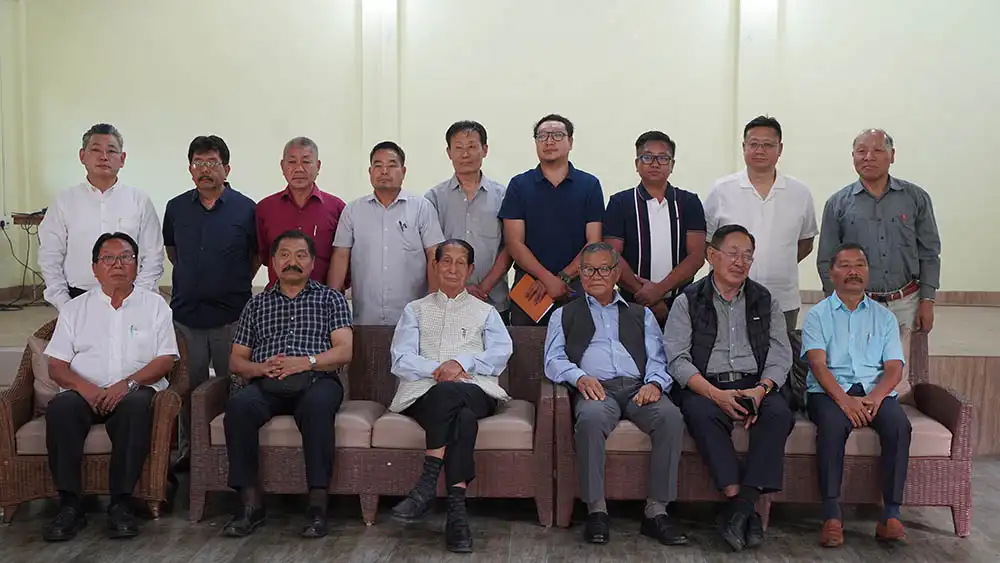
Concerned Naga Forum of Nagaland for truth on Naga solution
Staff ReporterDIMAPUR, MAR 25