
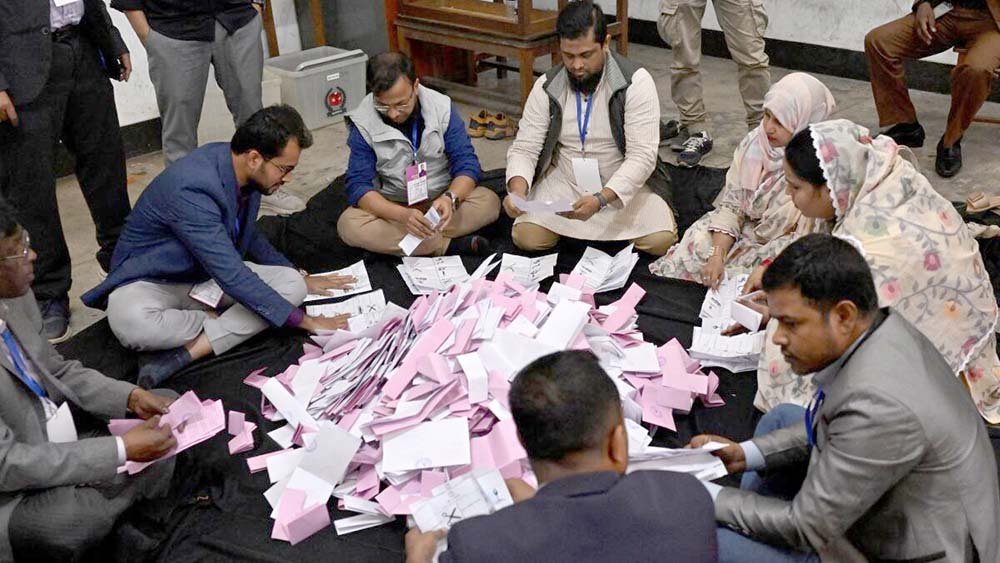
The counting of votes was underway on Thursday after Bangladeshis cast ballots in the crucial general elections to elect a new government to replace the interim administration, which took charge after the collapse of the Awami League regime in August 2024.
The voting for the 13th parliamentary elections was held along with a referendum on the implementation of a complex 84-point reform package, known as the July National Charter.
The counting of votes began after voting concluded at 4:30 pm (local time). However, in places where voters are in line inside the polling station, voting will continue until they vote.
“The first significant results may be available overnight,” an election commission spokesman said. The election is considered a direct contest between the Bangladesh Nationalist Party (BNP) and its once ally Jamaat-e-Islami, in the absence of ousted prime minister Sheikh Hasina’s now disbanded Awami League.
Chief Adviser Muhammad Yunus’ interim government last year disbanded the Awami League and barred it from contesting the polls.
Nearly 127 million voters were registered to cast their ballots, including five million first-time voters, across 42,779 polling centres in 299 out of 300 constituencies nationwide. The election in one constituency was cancelled due to the death of a candidate.
Election Commission Senior Secretary Akhtar Ahmed said around 48 per cent voter turnout was recorded till 2 pm nationwide, state-run BSS news agency reported.
Soon after voting concluded, Chief Adviser Yunus thanked people for their participation in the general elections and the referendum.
“I call upon political parties and candidates to uphold democratic decency, tolerance and mutual respect even after the final results are announced. Differences of opinion will exist, but in the national interest, we must remain united,” he said.
“We will move forward collectively toward building an accountable, inclusive and justice-based state,” he added. “Let’s work together in this journey to strengthen democracy.”
Yunus earlier described the elections and the referendum as a historic opportunity to build a “new Bangladesh.”
“We got an opportunity at every step to build a new Bangladesh. Let’s celebrate the birthday of Bangladesh today. Let the whole nation celebrate the festival throughout the day,” he said.
Earlier, top leaders of both BNP and Jamaat raised fears of manipulation and said that they will accept the results of the elections if they are held in a “free, fair, impartial manner.”
Tarique Rahman, who cast his vote at the Gulshan Model School and College centre in Dhaka’s upscale Gulshan area, said he was “confident” his party would regain power after over 15 years of political wilderness, but demanded the results be timely released.
“If the election is held in a free, fair, impartial manner and without controversy, then why shouldn’t we accept it? We will accept it. However, of course, there is one condition that the election must be impartial and peaceful,” the 60-year-old leader said.
Shafiqur Rahman, the chief of right-wing Jamaat-e-Islami which is leading an 11-party alliance, said his party would accept the election results if the polls were held in a “free and neutral manner”.
“We want the results that will come through a fair process. If the vote is free and impartial, we will accept the outcome. Others must also accept it. That is the beauty of democracy. This is what we want,” he said.
He alleged that attempts were made to cast fake votes in different parts of the country, adding that in several places their polling agents were attacked and wounded.
Both BNP and Jamaat have asked their party workers to stay at polling stations until the results are in.
The Election Commission made elaborate security arrangements for the elections, deploying nearly 1 million security personnel — the largest-ever in the country’s electoral history.
Nearly 900,000 law enforcement personnel were deployed to enforce the security vigil to prevent violence and maintain order during the voting. Authorities deployed Armoured Personnel Carriers and Rapid Action Teams across key areas of the capital.
For the first time, drones and body-worn cameras were used for election security.
There were reports of electoral violence in some places.
In Gopalganj, three persons, including a 13-year-old girl, were injured in an alleged hand bomb attack at a polling station, BDnews24 reported.
In a separate incident, a series of hand bomb explosions have taken place outside a polling station in the Munshiganj-3 constituency, temporarily disrupting voting.
Also, a BNP leader died during an altercation with Jamaat-e-Islami activists outside a polling centre in Khulna.
A total of 1,755 candidates from 50 political parties and 273 independents are contesting the election. The BNP has fielded the highest number of 291 candidates. There are 83 female candidates.
Some 55,454 observers from 81 local organisations have monitored the elections, while the number of foreign poll monitors was 394.
Of the international observers, 80 represent various international organisations, while the rest come from different countries, including independent European observers.
Three persons were arrested on allegations of distributing ballot paper photocopies among activists of a party at Kalai area of northwestern Joypurhat, Ittefaq newspaper reported.
The Daily Star reported “ballot stuffing allegations spark clash between Jamaat and BNP activists” in northeastern Sylhet’s Balaganj subdistrict, where a local Jamaat leader and several others entered a polling centre at around midnight when BNP activists rushed in, resulting in scuffles requiring security interventions.
In Dhaka, police arrested a Jamaat leader for buying votes while crude bombs were exploded near seven polling centres in southwestern Gopalganj hours before voting.
Hasina slams B’desh elections
Bangladesh’s deposed prime minister Sheikh Hasina on Thursday called the general elections being held by the interim government “a well-planned farce” and demanded holding of “free, fair and inclusive elections under a neutral caretaker government”.
For the first time in 30 years, the boat, the Awami League’s electoral symbol, did not appear on the ballot paper in the election, the first since the ouster of Hasina in massive nationwide protests in August 2024.
Hasina, 78, who has been staying in India after she fled Bangladesh, said the elections being held under the interim government of Muhammad Yunus was essentially “a well-planned farce”.
“The people’s voting rights, democratic values, and the spirit of the Constitution were completely disregarded in this deceptive, voterless election conducted without the Awami League,” she wrote on her party’s social media.
“From the evening of 11 February, this farce began with seizure of polling centres, gunfire, vote-buying, distribution of money, stamping of ballots, and agents signing result sheets,” she alleged.
Hasina claimed that by the morning of February 12, “voter turnout was negligible in most polling centres nationwide, and in many centres across the capital and other areas, there were no voters at all”.
“According to the Election Commission’s briefing, by 11 am — just three and a half hours into voting — only 14.96 per cent of eligible voters had participated,” she said.
This extremely low turnout clearly shows that the Awami League–free election was widely rejected by the people, Hasina said.
Hasina said in the preceding days, “continuous attacks, arrests, intimidation, and fear were inflicted on Awami League voters, supporters, well-wishers, and minority communities”.
“Even so, despite all threats and harassment, people rejected this fraudulent election, leaving most polling centres effectively empty,” she claimed.
The former premier also alleged that “abnormal increases in voter numbers were observed in voter lists, especially in Dhaka city, which raises serious questions and is highly suspicious”.
The Awami League demanded the cancellation of this “voter-less, illegal, and unconstitutional election”.
The party called for the resignation of Yunus and demanded the release of all “political prisoners, including teachers, journalists, and intellectuals, and withdrawal of all false cases”.
The party also demanded the revocation of the suspension on Awami League activities.
It called for holding of “free, fair, and inclusive elections under a neutral caretaker government”.
Following the July 2024 mass uprising that led to the removal of the Awami League from power, the interim government imposed a ban on all activities of the party on May 12 last year.
Soon afterwards, the Election Commission suspended the party’s registration.
The government has said the ban will remain in place until trials at the International Crimes Tribunal are completed.
As a result, the party, which governed Bangladesh for more than two decades across six separate terms, has been barred from contesting the election.