
DIMAPUR, JUL 17 (NPN): Thousands of people gathered at New Medziphema Village, Dzümha Rü Bridge Junction, on Friday to participate in a massive peace rally organised by the Chakhroma Public Organisation (CPO). The rally was held to protest what the organisation described as the government’s failure to acknowledge traditional landowners and its inaction over the long-standing Maova village issue.
The programme was chaired by CPO president Zhato Kimho, while the invocation was delivered by Rev. Fr. Sibi Mathew, Parish Priest of St. Francis De Sales Church, Medziphema.
Addressing the gathering, Kimho emphasised that the movement was not against the Kuki community, whom he described as “brothers and sisters.” He clarified that the rally was centred on justice and recognition of the rights of traditional landowners.
However, he alleged that certain Kuki groups were attempting to create divisions among Nagas. He appealed to Naga political groups not to provide shelter or military training to such groups, warning that these actions could later be used against the Naga community.
Kimho further claimed that several Kuki villages had been recognised by the government on Chakhroma ancestral land without the consent of traditional landowners. Referring to Article 371A of the Constitution, he argued that the customary rights, culture, and land of indigenous Nagas are constitutionally protected. He urged the Nagaland government to review and de-recognise villages allegedly recognised without approval from landowners.
He also accused the Maova Village Council of attempting to stop the rally by approaching the state administration. According to him, the council was portraying itself as a victim while trying to divide Naga communities. Drawing parallels with incidents in neighbouring Manipur, he warned that similar attempts had been made to create divisions among Naga tribes and appealed for unity.
Kimho noted that the CPO had exercised restraint since the February 13 incident, hoping for a peaceful resolution. Despite this, the organisation continued to face allegations and complaints. He urged the government to take note of the concerns raised by the rally and act on the issue.
He also appealed to the Government of India, the Army, and paramilitary forces to respect Naga rights and cautioned against actions that could disturb peaceful coexistence. Stressing that “Nagas are Nagas” regardless of where they reside, he called for unity among all Naga communities.
CPO vice president Sebastian Zumvü provided a detailed account of the dispute. He said British records from 1850 recognised Tsuüma village in the area before its temporary relocation due to an epidemic. When villagers returned, they found their ancestral lands occupied by Maova settlers, who had allegedly been permitted to settle by Punglwa village and initially paid annual rent.
Zumvü explained that a traditional settlement in 1973 transferred ownership of the land to Tsuüma, making Maova tenants obligated to pay annual tax. However, he alleged that Maova refused to honour this directive.
He highlighted that successive administrative authorities– including EACs Medziphema in 1979 and 1980, ADC Peren in 1981, SDO (Civil) Medziphema in 2001, and DC Dimapur in 2010– consistently upheld Tsuüma’s landownership and directed Maova to pay annual tax. Yet, these orders were never effectively implemented due to repeated legal challenges and government inaction.
Zumvü also referred to subsequent orders, including a 2021 Medziphema Dobashi Court directive restraining Maova Village Council from enforcing resolutions affecting landowners, and later instructions from the Chümoukedima district administration. He alleged that these too remained unimplemented.
He criticised the hereditary kingship system allegedly practised in Maova village, saying it violated Angami customary law, Article 371A, and the Nagaland Village and Area Councils Act, 1978.
Zumvü recalled how the dispute between Tsuüma and Punglwa villages was settled in 1973 at Gaili village, where Tsuüma took a customary oath accepted by both parties. Ownership of the land where Maova is situated was passed to Tsuüma. However, Maova’s failure to pay annual tax led to the matter reaching the Guwahati High Court. In 1981, the court directed ADC Peren to review the dispute, resulting in a 15-page judgment in favour of Tsuüma.
Angami Women Organisation president Neithono Sothu expressed solidarity with the CPO, stating that Angami women stood firmly behind efforts to safeguard ancestral land and customary rights. She appealed to women to promote restraint, dialogue, and reconciliation, while urging Kuki women to respect Naga customs and traditions.
Chakhroma Youth Organisation president Medochüzo Medoze said the youth had exercised restraint at the request of their leaders despite growing frustration over government inaction. He warned that their patience was “running out” and urged authorities to resolve the issue without delay. He asserted that the youth would continue to safeguard their traditions and ancestral land, adding that prolonged inaction could undermine public confidence in the government.
Angami Public Organisation president Thejao Vihienuo reminded that Kukis had historically been accommodated by Nagas to settle peacefully. He called upon them to reciprocate by respecting indigenous landowners’ rights. Referring to constitutional safeguards such as Article 371A and the Bengal Eastern Frontier Regulation, 1873, he stressed that these protections were intended for indigenous Nagas. He urged the government to ensure that traditional rights were upheld and reiterated that the APO sought peaceful coexistence based on mutual respect.
Kimho thanked the thousands who attended in solidarity with the Chakhroma people and urged the community to continue supporting one another. The rally underscored the determination of the Chakhroma people to defend their ancestral land and customary rights, while calling on the government to act decisively on the longstanding Maova dispute.
The rally concluded with a strong message of unity and determination. Speakers emphasised that the protest was not directed against any community but was a demand for recognition of traditional landownership and enforcement of government decisions.
At the rally, organisers circulated an official communication outlining Maova Village Council’s past and recent positions. According to the document, Maova refused to pay land tax to Tsüuma Village in 2010 and rejected a CPO-mediated settlement after the 2009 clashes. The CPO alleged that Maova recently tried to prevent the rally by writing to police and district officials, filed criminal cases against the Chakhroma Youth Organisation, and relied on legal battles instead of traditional dispute resolution. It also referred to a historical communication by the Kuki Union seeking arms for defence camps, which organisers claimed reflected militarisation.
Representatives from the Zeliangrong Youth Front Nagaland, Zeme Council Nagaland, and the Poumai community expressed solidarity with the CPO’s demand for recognition of traditional landowners’ rights.
Following the programme, participants marched peacefully to the office of the ADC, Medziphema and submitted a representation to the state government.
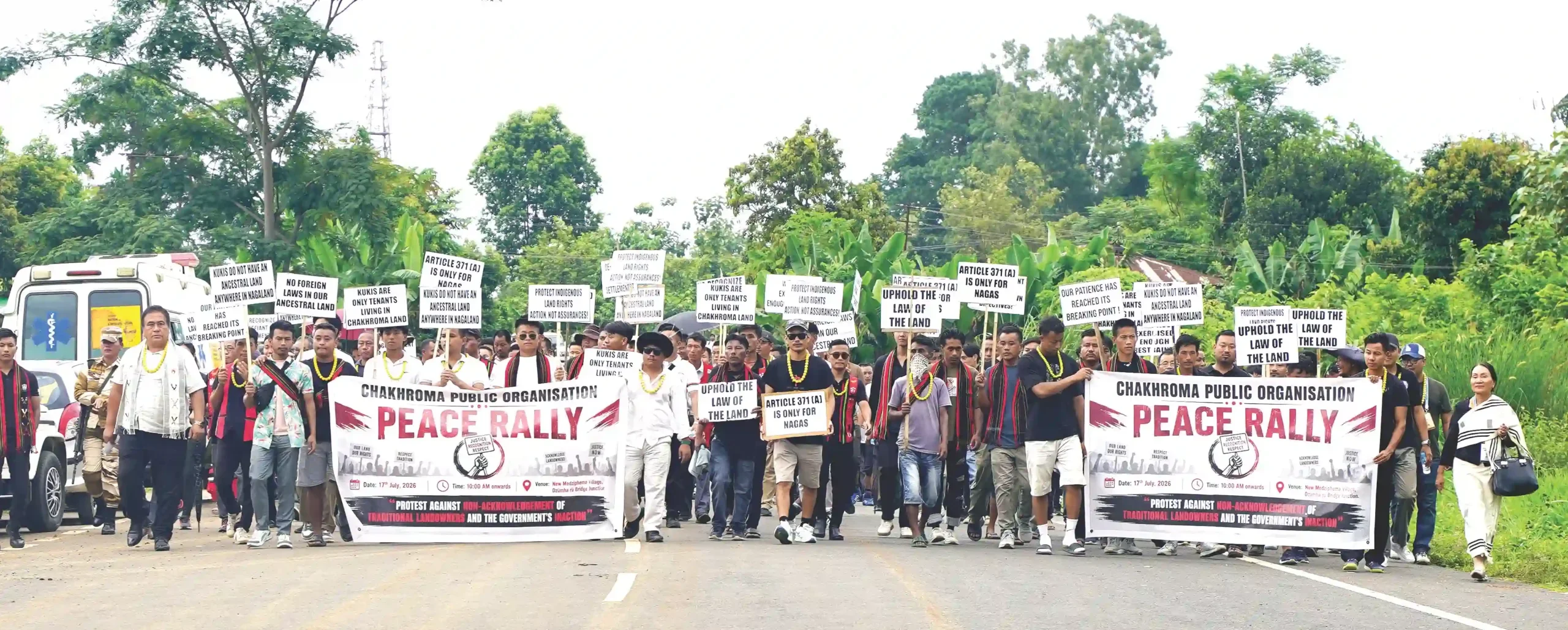
CPO rally highlights govt inaction in Maova issue
Staff Reporter