
Staff Reporter
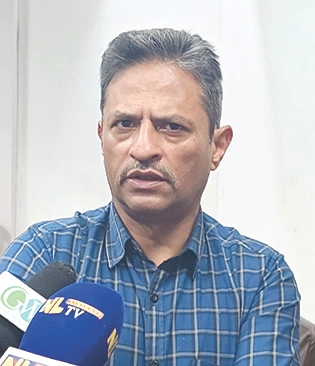
DIMAPUR, SEP 29 (NPN): Nagaland Director General of Police (DGP) Rupin Sharma said the police department would consider setting up a higher-level Special Investigation Team (SIT) to probe liquor trafficking across the State following reported deaths suspected to be linked to spurious liquor in Mokokchung and Tuensang.
Speaking to the media, Sharma said separate SITs had been constituted in Mokokchung and Tuensang, while no separate team had so far been constituted at the Police Headquarters (PHQ) level. He said the issue had assumed wider significance following the seizure of around 7,700 bottles of liquor in Kohima. Sharma said the three cases in Mokokchung, Tuensang and Kohima could be examined together to determine whether a higher-level probe was required to investigate liquor trafficking from various perspectives. “No decision as yet has been taken, but we will consider it,” Sharma said.
On criticism that SITs in Nagaland had often failed to produce results, Sharma said the State’s Criminal Investigation Department (CID) was comparatively small and lacked the resources and investigators available to Crime Branch-CID units in other States.
He said Nagaland had traditionally constituted SITs by drawing officers from different police units. However, such officers continued to perform their regular duties while handling SIT responsibilities, resulting in a situation where they were “riding two boats”. Sharma said the police were working to strengthen the CID to enable more focused investigations.
Police, excise need better coordination: On enforcement of Nagaland Liquor Total Prohibition (NLTP) Act, DGP said there was no dispute between the police and Excise Department, dismissing reports of friction between the two agencies.
However, he acknowledged scope for better coordination, particularly regarding bonded warehouses and liquor-related enforcement.
Sharma said police were not involved in issuing bonded warehouse licences and were not aware of the details of such licences. He said the department would look into the matter.
ADGP Sandeep M. Tamgadge explained that under the NLTP Act, the competent authority for implementation was the Director of Prohibition, who is also the Excise Commissioner. Police station officers-in-charge (OCs), however, had been delegated the powers of Prohibition Officers.
He said police could search vehicles and premises, seize items and detain individuals, but an arrest could only be made after registration of an FIR.
Tamgadge said police could not register a suo motu FIR under the NLTP Act. The suo motu FIRs registered in Tuensang and Mokokchung were related to deaths and were not registered under the NLTP Act.
He said if police found liquor stored in a building or vehicle, an FIR could only be registered on the basis of a written complaint from an Excise official. He termed this a legal issue that had been brought to the attention of the government.
Deaths suspected, forensic evidence awaited: On the reported deaths linked to spurious liquor, Tamgadge said police had registered two suo motu cases in Tuensang and Mokokchung.
He said no post-mortem had been conducted on any of the deceased in Tuensang, while post-mortems had been conducted on four persons in Mokokchung.
Tamgadge stressed that the deaths were, at this stage, only suspected to be linked to spurious liquor and required scientific evidence to establish the cause.
He said seized liquor samples had been sent to CFSL Dimapur and CFSL Guwahati to establish whether the liquor was spurious.
According to Tamgadge, investigators had identified places outside Nagaland where the liquor was allegedly procured and purchased. However, he said concrete evidence was required to proceed with the investigation through the legal process.
Police modernisation: On police modernisation, Sharma said Nagaland Police had adequate arms and ammunition at present, while further procurement would depend on operational requirements.
He said the department had procured various equipment, including metal detectors, door-frame metal detectors, deep-search metal detectors, forensic equipment, systems for analysing Call Detail Records (CDRs), and tools for extracting data from mobile phones and stolen mobile phones.
Sharma said investigation was a relatively new discipline in Nagaland Police and that the State was gradually building its capabilities.
Regarding the Forensic Science Laboratory (FSL), Sharma said there were plans to improve forensic capabilities. He said Nagaland had around 1,300 FIRs registered and that procurement of high-end equipment had to be based on practical requirements.
Tamgadge said the Government of India-funded police modernisation scheme covered eligible components such as mobility, arms and ammunition and information technology, while personal items such as name plates and uniform accessories were not covered.
He also said the State Government had this year issued a notification creating a separate Directorate of Forensic Sciences under the Home Department, making it an independent directorate rather than part of the police department.
He said Nagaland Police had already procured nearly 12 mobile forensic vans for the districts, along with instruments for DNA and narcotics analysis, and expressed confidence that forensic capabilities would improve further with the creation of the independent directorate.