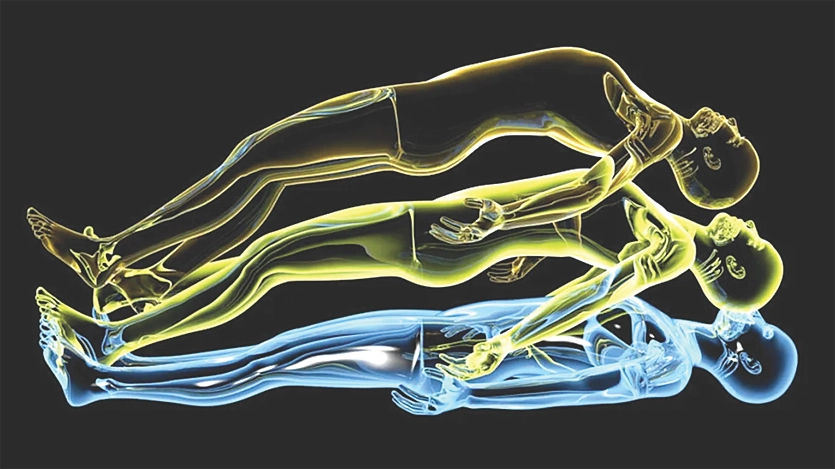
The question sounds simple until we ask what “you” actually means. Your DNA existed in biological pieces before conception, your body developed before birth, and your brain began learning while you were still in the womb. But none of those facts proves that your personal consciousness, identity or memories existed before your biological life began.
That distinction has kept the question alive across neuroscience, philosophy and religion. Some traditions teach that human existence begins with conception or birth, while others describe souls, reincarnation or some form of existence before earthly life.
Science can investigate fetal learning, brain development and unusual claims of memories from before birth or previous lives. What it cannot currently do is demonstrate that a person’s conscious self existed independently before the development of that person’s brain.
Parts of what became you existed long before you were born
Biologically, you did not appear from nothing on the day you were born. Half of your nuclear DNA came from an egg and half from a sperm, and those reproductive cells were produced by living organisms whose biological histories extend backward through generations.
Your genetic information therefore has a history much older than your individual body. Individual variants in your DNA can be inherited through parents, grandparents and ancestors who lived long before you.
But inherited information is not the same as personal existence. You may inherit eye color, metabolic characteristics or aspects of temperament without having personally experienced your ancestors’ lives.
This creates the first important distinction: some of the information used to build you existed earlier, but science does not therefore conclude that you existed as the same conscious individual.
Takeaway: Your biological ingredients clearly existed before your conception, but that is different from showing that your personal identity existed. Genetics can establish continuity between generations without demonstrating pre-birth consciousness.
Your brain began developing long before birth
If personal experience depends on the brain, then the development of the nervous system becomes central to the question. The human brain begins forming during pregnancy and changes enormously before a baby takes its first breath.
Neurons develop, migrate and begin establishing networks while the fetus remains in the uterus. Sensory systems also become increasingly responsive as pregnancy progresses.
A 2026 systematic review examining fetal brain function found measurable responses to sensory stimulation during later pregnancy, including auditory and visual responses.
That means birth itself is not the instant at which every form of brain processing suddenly begins. Significant neural development has already occurred before delivery.
Still, showing that a fetus processes information does not show that the same person existed before conception. It pushes the story of individual development backward into pregnancy, not beyond the beginning of the developing organism.
Babies may begin learning before they are born
One of the most interesting findings in developmental science is that fetal brains appear capable of certain forms of learning and memory. Newborns can respond differently to sounds and sensory patterns they were exposed to during pregnancy.
Research has examined fetal habituation, conditioning and recognition of repeated sounds. A recent review describes evidence for learning and memory developing across fetal and neonatal life.
This kind of memory is very different from remembering a birthday party or recalling your own name. It involves relatively basic forms of learning, such as becoming familiar with repeated sensory information.
Still, it demonstrates that the human story does not begin psychologically at birth. Some information can already influence the developing brain before the baby enters the outside world.
(Yahoo News)