
Nzano Humtsoe
DIMAPUR, JUL 12 (NPN): The Dimapur Municipal Council’s (DMC) waste segregation programme has highlighted a major challenge beyond infrastructure and funding– poor civic participation.
Despite recording significant success during a pilot project in parts of Ward 11 in 2024, inconsistent public cooperation, coupled with financial constraints, manpower shortages and inadequate infrastructure, prevented the initiative from expanding across the municipality, prompting DMC to relaunch the programme with a revised strategy this year.
In an exclusive interaction with Nagaland Post, DMC Waste Management consultant Adrian Mahung said the municipality had demonstrated that scientific waste segregation was achievable, but sustaining the initiative on a larger scale proved difficult because of administrative and public participation challenges.
Mahung said DMC launched its first pilot project in February 2024 in Ward 11, covering Riverbelt Colony and Duncan Colony. While Riverbelt Colony achieved nearly 100 per cent waste segregation within two months due to strong leadership and active participation by residents, several other localities in the same ward struggled to achieve even 60 per cent segregation after eight months.
According to him, the contrasting outcomes were largely due to varying levels of community participation. He said committed colony leaders and community mobilisers played a crucial role in ensuring that households consistently segregated waste at source.
“The initiative was heavily dependent on information and awareness provided by community leaders,” he said.
However, the momentum generated during the initial phase was short-lived. Mahung said the programme lost priority following changes in the municipality’s administrative setup after the induction of elected councillors. He also pointed out that the composting facility was not ready when segregated waste collection began.
Besides, the project relied on specially trained contractual workers instead of regular DMC sanitation staff. Financial constraints eventually forced the municipality to discontinue the initiative before it could be expanded to other wards.
Mahung said DMC revived the programme in 2026 as part of preparations for implementing the Dumpsite Remediation Action Plan (DRAP) under the Swachh Bharat Mission for Urban Local Bodies.
Drawing lessons from the first pilot project, DMC has introduced several changes to improve implementation. One of the key features is the appointment of community mobilisers from within the colonies themselves to create greater ownership and accountability.
He said the mobilisers would receive a token honorarium, funded either by colony councils or through shared arrangements with DMC, to ensure sustained public engagement and regular monitoring.
The municipality has also established a clearer chain of command involving sanitation workers, drivers and community mobilisers to improve coordination and eliminate confusion experienced during the earlier pilot.
Mahung observed that public participation differed significantly from one locality to another. While colonies with active leadership achieved high compliance, larger and more diverse localities found it difficult to maintain regular segregation practices.
He also said differences in lifestyles and daily routines among communities affected implementation, as waste collection schedules suitable for one locality often proved inconvenient for another.
Despite waste segregation becoming mandatory under the Solid Waste Management Rules, 2026, from April 1, Mahung admitted that DMC was not yet in a position to enforce the rules across all 23 wards.
He cited lack of funds, inadequate mechanised equipment and insufficient processing infrastructure as major constraints, adding that the municipality was currently focusing on Information, Education and Communication (IEC) campaigns to encourage voluntary compliance.
At present, only one colony is practising complete door-to-door segregated waste collection.
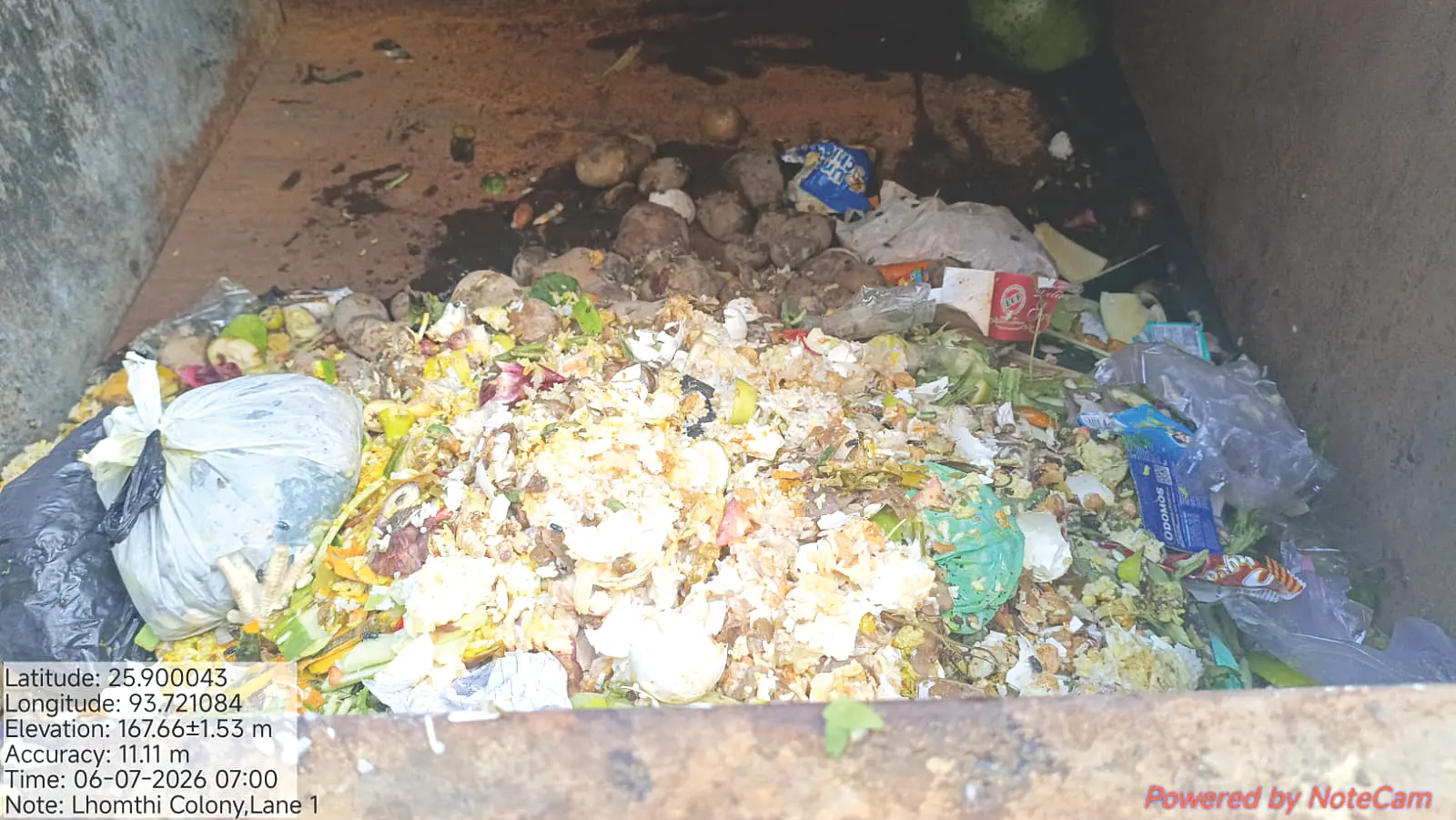
Mahung also disclosed that DMC’s composting infrastructure remained grossly underutilised. Although the municipality has established 12 compost beds capable of processing several tonnes of biodegradable waste, they cannot operate at full capacity because a significant portion of the collected waste continues to be mixed instead of being segregated at source.
“The waste cannot be composted effectively because a certain percentage of mixed waste is still being collected,” he said.
Asked why the programme had not expanded over the past two years, Mahung cited financial constraints, manpower shortages, logistical challenges and inconsistent public participation.
Looking ahead, he suggested establishing a dedicated waste management cell within the DMC sanitation branch to oversee an end-to-end waste management system.
He also recommended integrating self-help groups, youth organisations and authorised recyclers into the waste management process to separately handle biodegradable, recyclable and residual waste, saying such a model would ensure continuity while significantly reducing the volume of waste reaching the municipal dumpsite.
On the progress of the ongoing Ward 15 pilot under the Dimapur Waste Segregation and Management initiative, Mahung said the programme, which was flagged off by DMC chairperson Hukheto Yepthomi on World Environment Day, had begun showing encouraging results despite being in its initial stage.
He said DMC had initially earmarked two vehicles for the pilot. However, only one vehicle was currently in operation as it was sufficient to cover all targeted households in Ward 15.
“One vehicle is presently covering 100 per cent of the targeted households under the pilot, so the second vehicle is being kept in reserve,” he said.
Reviewing the progress, Mahung said public understanding of scientific waste segregation was gradually improving, although there remained considerable scope for improvement.
He said community mobilisers, who are responsible for educating residents and monitoring segregation practices, had become increasingly active over the past week, resulting in noticeable improvements in the quality of segregated waste being collected.
Mahung noted that some households continued to mix small plastic items such as food wrappers and sweet wrappers with biodegradable waste because many residents were still unaware that such materials had to be segregated separately.
Based on the progress so far, he estimated the success rate of the Ward 15 pilot at around 60 per cent and expressed confidence that the figure would improve as awareness campaigns continued.
He also cited socio-cultural differences in daily routines as one of the operational challenges affecting waste collection, noting that while many Naga households were ready to hand over segregated waste early in the morning, some other communities started their day later, requiring collection teams to wait longer.
Despite these initial challenges, Mahung said compliance had steadily improved over the past week and expressed confidence that the pilot would continue to gain momentum through sustained awareness campaigns and active community participation.
He added that DMC had selected two pilot areas under the renewed initiative and, once the Ward 15 model became self-sustaining without intensive monitoring, the programme would be expanded to Ward 3 before being rolled out to other parts of the municipality.