
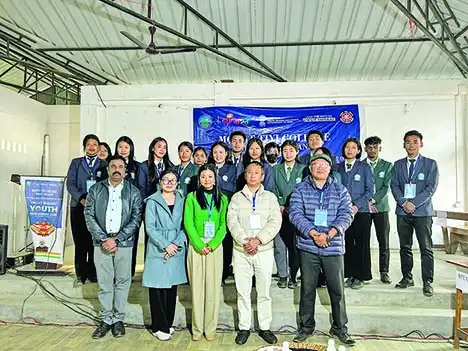
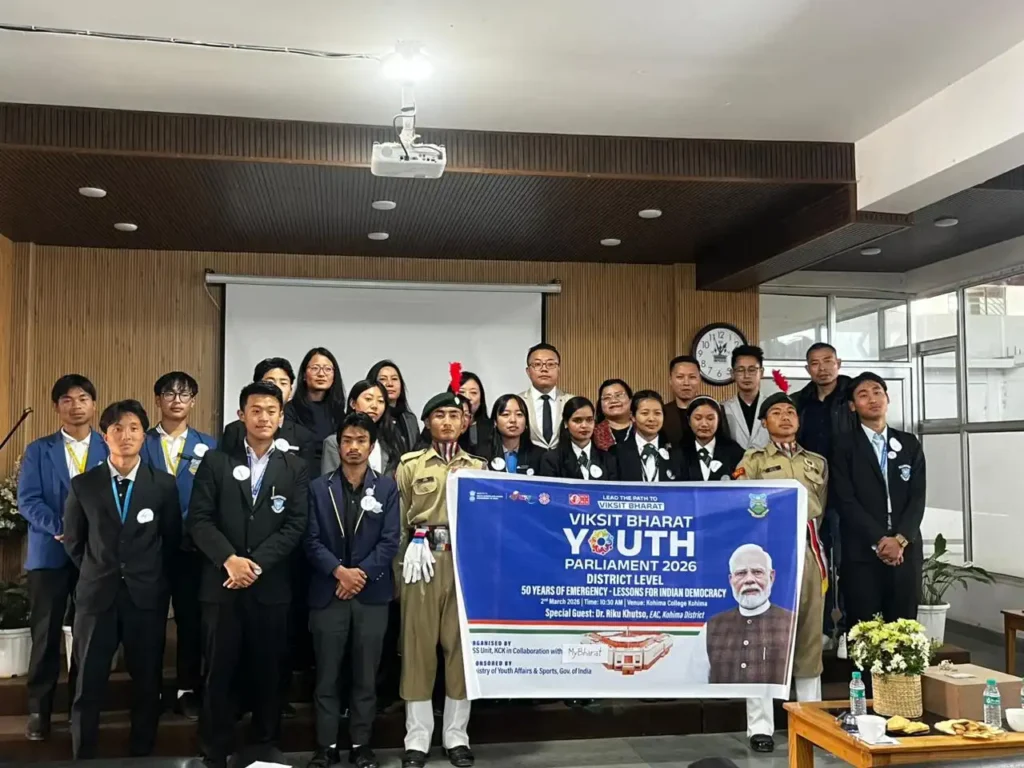
District-Level Viksit Bharat Youth Parliament (VBYP) 2026 was held at Mount Tiyi College, Wokha, on March 2, and at Kohima College, Kohima, on February 28, under the theme “50 Years of Emergency – Lessons of Indian Democracy.”
AT Wokha, the programme was graced by Additional Deputy Commissioner (ADC) of Wokha, Renbomo Ezung, as special invitee, while the session was chaired by VBYP 2026 nodal officer, Ekonbeni M. Tsanglo.
A total of nine participants took part in the debate, comprising four members from the ruling side, four from the opposition, and one Speaker. The session provided students with practical exposure to democratic processes and legislative functioning.
Addressing the gathering, ADC Renbomo Ezung said the Youth Parliament was conducted to equip students with knowledge, awareness and leadership skills, as the government places strong faith in the youth. He described the event as a valuable opportunity for students to voice their concerns and perspectives so that their district and state do not lag behind in national progress. Speaking on the theme, he urged the youth to safeguard constitutional and democratic values, stressing that such debates help develop critical thinking and articulate meaningful ideas for nation-building.
Delivering the welcome address, vice principal of Mount Tiyi College, Dr. Khyopenthung Tsopoe, said the VBYP provides a formal platform for young people to express their views and actively participate in shaping the nation’s future. He added that the exercise helps students learn parliamentary procedures and understand their roles as responsible stakeholders in democracy.
During the debate, the ruling side argued that the Emergency period brought discipline and helped control inflation, describing it as a constitutional decision under Article 352 of the Constitution. The opposition, however, termed the Emergency as one of the darkest phases in post-independence history, citing curtailment of fundamental rights, suppression of press freedom and imprisonment of opposition leaders.
At the conclusion, five winners were selected to represent the district at the State-Level Youth Parliament. Mhabeni Ezung secured first position, followed by Chanchibeni Ngullie in second and Orenvungi Khuvung in third, while Shyerhunle Seb and Grace Ngullie received consolation prizes.
The programme concluded with emphasis on the Youth Parliament as a dynamic platform empowering young voices to contribute meaningfully to the vision of a developed India.
KOHIMA: At Kohima, the event was organised by the NSS unit of Kohima College in collaboration with My Bharat, Kohima, and sponsored by the Ministry of Youth Affairs and Sports, Government of India.
The programme was chaired by Abeni Zuchamo, associate professor in the Department of History and NSS programme officer at Kohima College. Dr. Riku Khutso, EAC Kohima, attended as special guest. In his address, Dr. Khutso described the Youth Parliament as a crucial process in building leadership for a developed India, stressing that the national vision of Viksit Bharat 2047 hinges on creating a generation of young leaders. He cautioned against the prevailing “performative culture” in Naga society, urging youth to cultivate critical thinking instead. “Develop a critical mind, understand things around you, and learn to filter information,” he advised.
13 students from Alder College, Baptist College, Kohima College and St. Joseph College participated in the competition, presenting perspectives on the Emergency and its implications for contemporary democracy.
At the conclusion, five winners were selected to represent the district at the State-Level Youth Parliament. They were: Kepozo Kapuh (St. Joseph’s College, Jakhama); Kibangheung I. Mbung (St. Joseph’s College, Jakhama); Kethoneinuo Vimero (St. Joseph’s College, Jakhama); Müdovelü Keyho (Don Bosco College, Kohima) and Lenvishe (Kohima College, Kohima).