
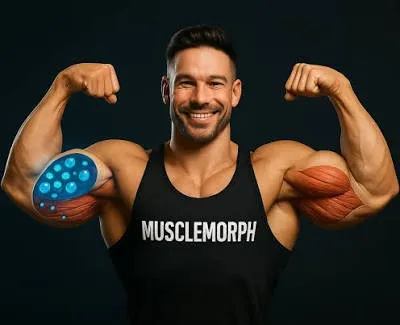
Creatine is one of the most talked-about supplements in fitness — and also one of the most misunderstood. Walk into any gym and you will hear two opposite claims with equal confidence: that creatine builds muscle, and that it only makes you look bigger by holding water. So which is true?
The honest answer involves both — and understanding the difference is what separates people who use creatine effectively from people who quit it after a month, confused about what it actually did.
Let us break it down properly.
The Short Answer
Yes — creatine increases muscle size. But it does so through two distinct mechanisms that operate on completely different timelines, and conflating them is the source of most of the confusion.
The first mechanism is fast and partly cosmetic. The second is slow and genuinely structural. Both are real. Only one of them is what people usually mean by “building muscle.”
Mechanism One: Cell Volumisation (The Fast Change)
When you start taking creatine, your muscles begin storing more of it — specifically as creatine phosphate. Creatine is osmotically active, which means it pulls water into the muscle cell along with it.
The result is an increase in intracellular water — water inside the muscle fibre, not under the skin. This makes the muscle look fuller and slightly larger within the first one to two weeks of consistent supplementation.
This is where the “it’s just water” criticism comes from — and it is partly fair. This initial size increase is largely fluid. But two things are worth understanding here.
First, this is intramuscular water, not the bloated, puffy water retention that sits subcutaneously. It makes muscles look fuller, not softer.
Second — and this is the part critics miss — cell volumisation is not cosmetically irrelevant. A well-hydrated muscle cell is associated with an environment more favourable to protein synthesis. In other words, the “water” phase may actually help set the stage for the real muscle growth that follows.
Mechanism Two: Genuine Muscle Growth (The Slow Change)
This is the mechanism that actually matters for long-term size — and it has nothing to do with water.
Creatine does not build muscle directly. It builds muscle indirectly, by improving the quality of your training. Here is the chain:
Creatine phosphate rapidly regenerates ATP — the energy your muscles burn during intense effort. With more creatine stored, you regenerate ATP faster between contractions. That means you can do more reps before failure, lift slightly heavier, and sustain higher training volume session after session.
More volume and more intensity, applied consistently over months, is one of the strongest drivers of hypertrophy — the actual structural growth of muscle fibres.
So creatine’s real contribution to muscle size is this: it lets you train harder than you otherwise could, and harder training — over time — builds more muscle. The growth is earned in the gym. Creatine just raises the ceiling on what your gym sessions can produce. (PTI)
This is why the research is so consistent. Across decades of studies, people who supplement with creatine while training gain more lean muscle mass than people who do the same training without it. Not because of magic — because of accumulated training quality.
Why the Form of Creatine Matters Here
Most of the research above was conducted using Creatine Monohydrate — the most studied form, and the foundation of any serious creatine product. But how much creatine actually reaches your muscle depends heavily on absorption, and this is where formulation makes a practical difference.
Standard monohydrate absorbs incompletely for many people. A portion sits in the gut, draws in water, and causes the bloating that leads people to quit — which is counterproductive when the goal is consistent, long-term use.
This is why some newer formulas combine multiple forms of creatine to address absorption and performance together. Prorganiq Advanced Creatine, one of the best creatine supplements in India, combines three clinically studied forms — Monohydrate, HCL, and Nitrate — in a single formula.
The Monohydrate provides the proven foundation for muscle growth; the HCL form is significantly more soluble, improving absorption and reducing bloating; and the Nitrate form supports blood flow and nutrient delivery to the muscle during training. The logic is straightforward — better absorption and better blood flow mean more of the creatine you take actually contributes to the training quality that drives muscle growth.