
Staff Reporter
DIMAPUR, SEP 12 (NPN): Former Nagaland chief minister and veteran Congress leader Dr. S.C. Jamir has urged the Rashtriya Swayamsevak Sangh (RSS) to use its influence with the BJP-led central government to expedite a settlement of the long-pending Naga political issue, warning that public hope was steadily fading after more than two decades of negotiations.
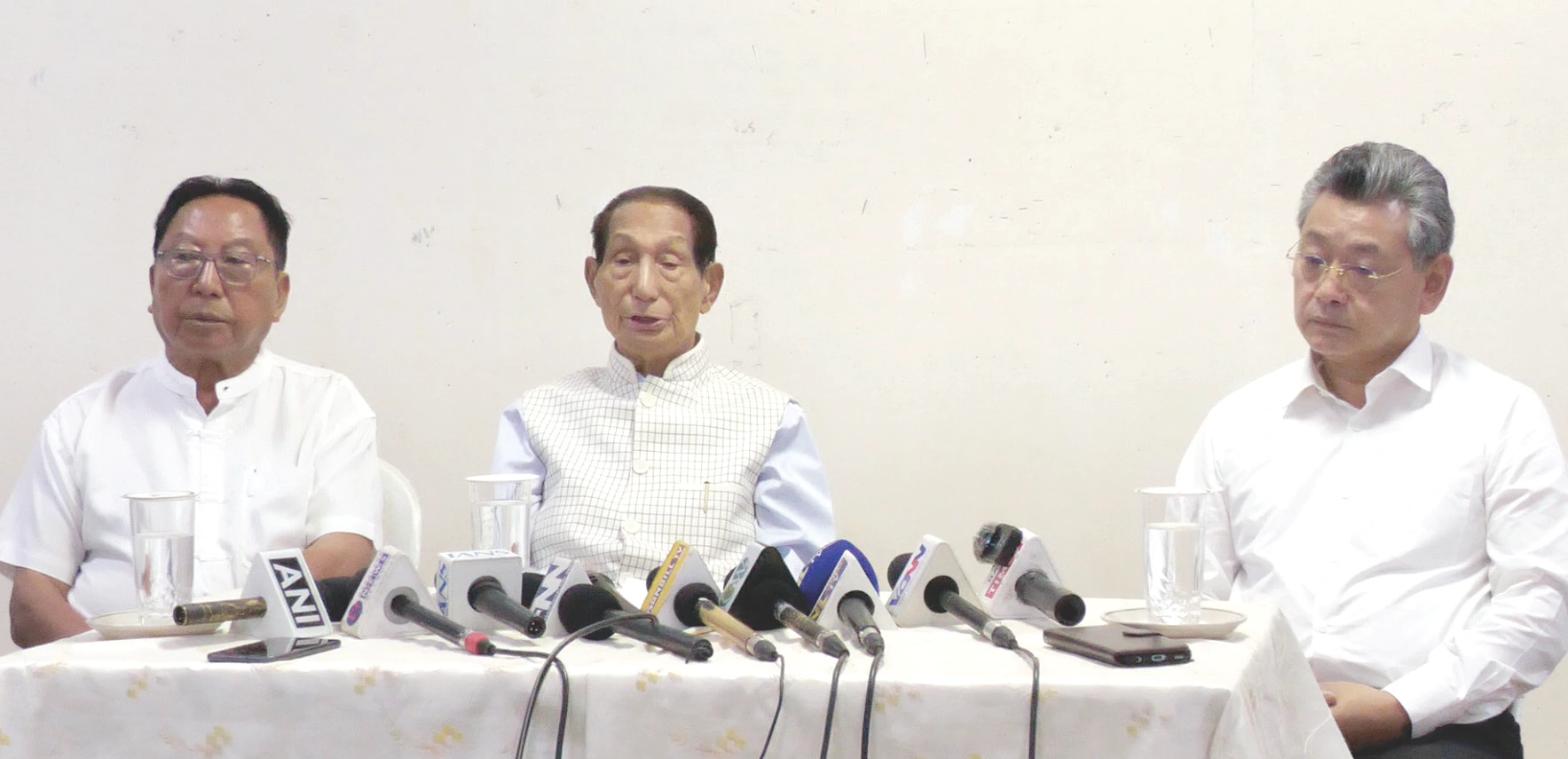
Addressing a press conference at Hotel Saramati here on Friday, Jamir said he had recently met RSS chief Mohan Bhagwat to clear what he described as “confusion” surrounding the RSS, the BJP and the Naga political question, and to explore every possible avenue for an early resolution.
“Today, the BJP government moves because of RSS. Even though we are shouting, they are not listening. So I said, why not you also shout so that they can also listen?” Jamir told reporters when asked why he had approached a socio-religious organisation on a matter he regarded as fundamentally political.
He said Bhagwat had listened to his concerns and indicated that he would return to Delhi and meet the relevant authorities.
Jamir said the Naga political issue had reached a critical stage. He maintained that multiplication of factions and parallel authorities had contributed to a near-collapse of governance.
Where once there had been only the Naga National Council, the post-ceasefire period had seen the emergence of “36 or 37” factions, all claiming to represent a single Naga political aspiration while demanding sovereignty. “That means there are 37 Nagalands today. And is it a reality or a joke? Yes, it is a tamasha,” he remarked.
He alleged that the proliferation of factions had led to widespread extortion and the creation of parallel systems of authority, particularly in Dimapur. “Some are constitutional, some are extra-constitutional. And these authorities are functioning at the whims and fancies of the factions. And what is their modus operandi? Only extortion, extortion, extortion,” he said.
Jamir contended that the situation had rendered the state government “helpless.” Underground groups were allegedly issuing directives, summoning people, holding courts and interfering in economic activities. “When there is extortion, they are helpless.
When notice is given even to close shops, the government cannot do anything. When there is taxation according to percentages, they are collecting. Then where is the governance then?” he asked.
He called for a “total overhaul” of the governance system, pointing to the inability of officials to act against underground groups because of pressure from various quarters.
He added prolonged negotiations had also diminished public enthusiasm for the Naga political process. Jamir said considerable hope had accompanied the signing of the Framework Agreement more than a decade earlier, yet a final settlement remained elusive.
“People’s hope against hope in the Government of India is waning, losing. And the relevance of this is also now fading away, because of only multiplication of these factions,” he said.
Jamir urged the Centre to make its position clear and bring the process to a conclusion before public confidence was completely lost.
On the question of integration in the context of the Framework Agreement, he argued that the pact was a framework within which the details of a settlement were to be worked out.
Drawing a parallel with the 16-Point Agreement, he noted that several demands had been accommodated after the creation of Nagaland state, including a separate governor and High Court and the formation of the Naga Regiment.
Asked about his decision to meet Bhagwat and other BJP leaders despite his long association with the Congress, Jamir insisted he had not approached them on party lines. “I’m a Congressman. I’m a Naga. I have not gone there on party lines. I have gone there for Nagas, not for party,” he said.
Responding to speculation that he was leaning towards the BJP, he said he held no obligation to any political party and was free to meet anyone in the interest of the Naga people. “My obligation is towards the Naga people and God,” he declared, adding that he could meet Communists, the BJP, the RSS, the BSP or anyone else because he was a “free and independent man.”
He stressed that meeting the RSS did not compromise his identity as a Naga, a Congressman or a Christian.
One of the principal issues he raised with Bhagwat, Jamir said, concerned the meaning of being an Indian and the need to preserve India’s “unity in diversity.”
He asserted that India’s strength lay in its capacity to accommodate diverse cultures, languages, religions, food habits, traditional attire and geographical identities while retaining a sense of national oneness. “If there is only one stick to beat everybody, then how can India survive?” he asked, emphasising that every community should be allowed to function according to its own culture and traditions so long as it did not disturb others.
He added that survival of humanity depended on respect for the cultures, customs and religions of different communities. Jamir said India’s historical strength had been its ability to synthesise different cultures and ideas. He said the challenge before the country was to develop “Indianness” as a foundation upon which the nation could continue to be built while preserving its diversity.
“Nagas were called head hunters, but today we are not head hunters. We are equal participants in the building of this great country,” he said.
Jamir also conveyed concerns about the protection of religious and cultural practices, asserting that Nagaland’s Christian character needed to be clearly understood in the context of Article 371(A).
Referring to the constitutional protection of Naga social and religious practices, he said that in Nagaland “religious practices” included Christian practices.
He cited the participation of people of different faiths in one another’s festivals as an example of the state’s understanding of secularism. “During Durga Puja, I think Nagas take as much or more interest than Hindus. In Christmas, apart from Christians, the Hindus, Muslims, and other communities, they also take interest,” he said.
He insisted Christians and other minorities should not face discrimination anywhere in India, and being Christian did not make anyone “less Indian.”
On the Foreign Contribution (Regulation) Amendment Bill, Jamir said he was opposed to the legislation and suggested that Nagaland and Meghalaya should consider passing resolutions against it.
He questioned the rationale for restricting foreign assistance to institutions working in education, healthcare and community welfare, arguing that such support had contributed to the development of important institutions.
Meanwhile, Jamir appealed to all Nagaland legislators to remain true to the oath of allegiance they had taken under the Constitution. Recalling his own tenure as chief minister, he said underground groups had once asked him to boycott elections, but he had refused, citing the oath he had taken in the name of God. “I have taken an oath of allegiance in the name of God. So I will not cheat God,” he recalled. He said elected representatives who had taken a similar oath should remain honest to their constitutional allegiance.