
Correspondent
KOHIMA, AUG 22 (NPN): Advisor for School Education, Dr. Kekhrielhoulie Yhome, outlined the government’s plans to transform Nagaland’s education system, highlighting initiatives in curriculum reform, digital education, teacher recruitment, school restructuring and governance.
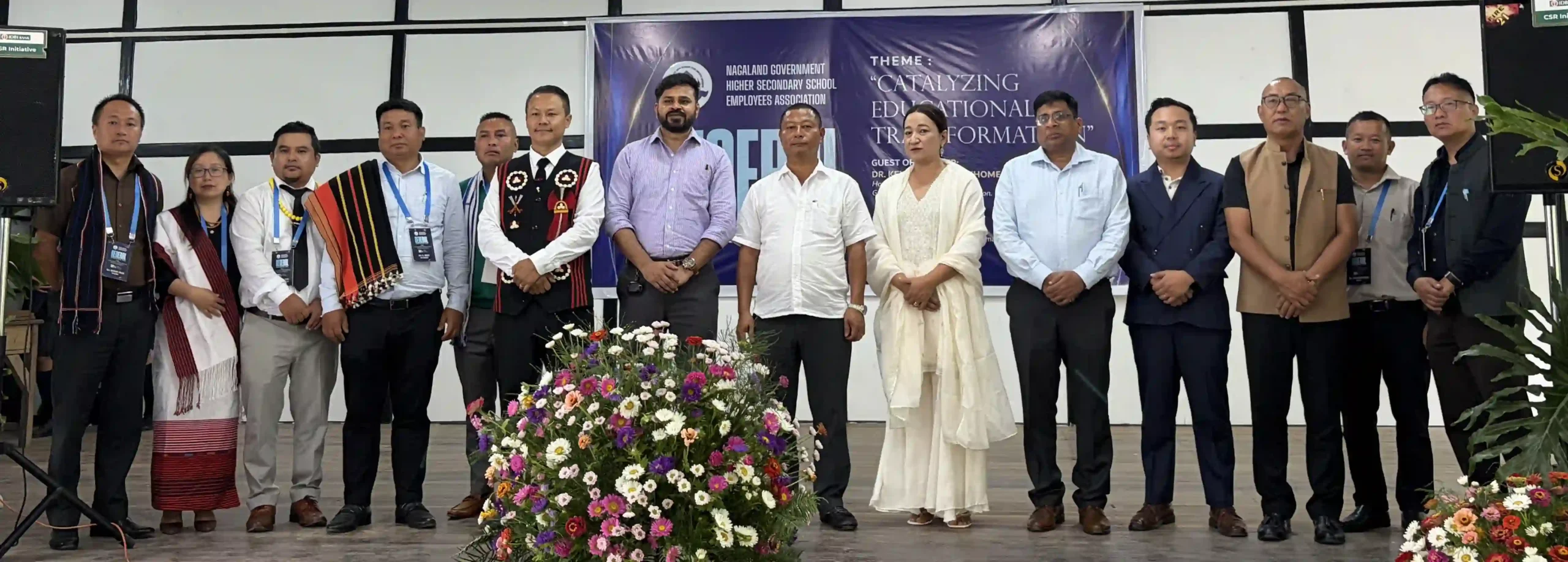
Speaking at the general conference of the Nagaland Government Higher Secondary School Employees’ Association (NGHSSEA) held at Rüzhükhrie Government Higher Secondary School, Kohima, under the theme “Catalysing Educational Transformation,” Yhome said the department is partnering with organisations through CSR support for project based learning in Kiphire and Dimapur.
He added that Dream a Dream is supporting socio emotional learning and curriculum development, while Saturday Art Class is being implemented across the state.
He said the department is working on a three pillar approach to rebuild the school ecosystem-infrastructure, governance and human resource management, and restructuring of the school system and curriculum. On curriculum reform, Yhome said focus areas include art, creativity, socio emotional learning, STEM and digital education. He noted that Saturday Art Class is using AI applications in animation, videography, gaming and content creation.
Yhome announced that the government is expected to sign an MoU worth Rs. 10 crore with Google to strengthen digital and STEM preparedness in government schools.
He also highlighted collaboration with Yamaha International, under which recorder based music education has been introduced on a pilot basis in Dimapur and Kohima, with plans for expansion.
He stressed the importance of internationally recognised qualifications to provide greater mobility for Naga students.
On language education, Yhome emphasised strengthening Naga languages and mother tongue instruction. He said the Nagaland Curriculum Framework is nearly ready and the department is working with Nagaland University on diploma, postgraduate diploma and certificate courses for language teachers.
He added that AI could help develop textbooks and document traditional stories more quickly.
On teacher recruitment, Yhome said 70 postgraduate teachers are expected to join after NPSC examinations and interviews, with another 30 positions being added. He clarified that graduate and primary teachers have not been recruited due to surplus personnel, while shortages remain in Mathematics, Science and postgraduate teaching.
He said data has been gathered to close and amalgamate schools, with plans to make more higher secondary schools composite. Of the 57 higher secondary schools, only 21 are currently composite.
He noted that composite schools attract better enrolment and assure parents of continuity in education. In rural areas, some schools may be downgraded, with networks reshaped according to geographical needs after stakeholder consultations.
On enrolment, Yhome said the state recorded 6,475 students across three higher secondary streams in 2025, with enrolment this year down by 481 students.
In Kohima, joint entrance admissions were introduced among higher secondary schools, mapping government and private schools geographically to determine feeder school patterns, which improved enrolment in schools such as Jotsoma and Viswema.
He urged principals to study feeder school ecosystems, noting that some government schools have low enrolment up to Class 10 but sharp increases in Class 11. Regulations, he said, would be introduced to address such practices.
On service matters, Yhome acknowledged stagnation among postgraduate teachers and other cadres due to promotion bottlenecks, court cases and service rules. He urged NGHSSEA to engage with the secondary teachers’ association to discuss division of posts and promotion issues.
He also said six districts remain without District Education Officers due to instructions from P&AR and Finance departments, and alternatives are being explored.
Yhome assured that the senior principal system would be reviewed and decisions taken through consultation.
He also spoke of strengthening the Directorate by training younger officers. He acknowledged past mistakes and called for patience and collective responsibility to correct the system.
The presidential address was delivered by Yekavi Swu, president NGHSSEA.
The programme was chaired by Dr. Visielie, vice president NGHSSEA, while Zhaviu Pienyu, associate pastor, Global Missions, C.R. Mission Church, Kohima, delivered the invocation.
Dr. Meno Thorie, information and publicity secretary, presented the NGHSSEA report, while the NGHSSEA Statistical Report 2026 was launched during the programme. Rembio Yanthan, joint secretary, delivered the vote of thanks.