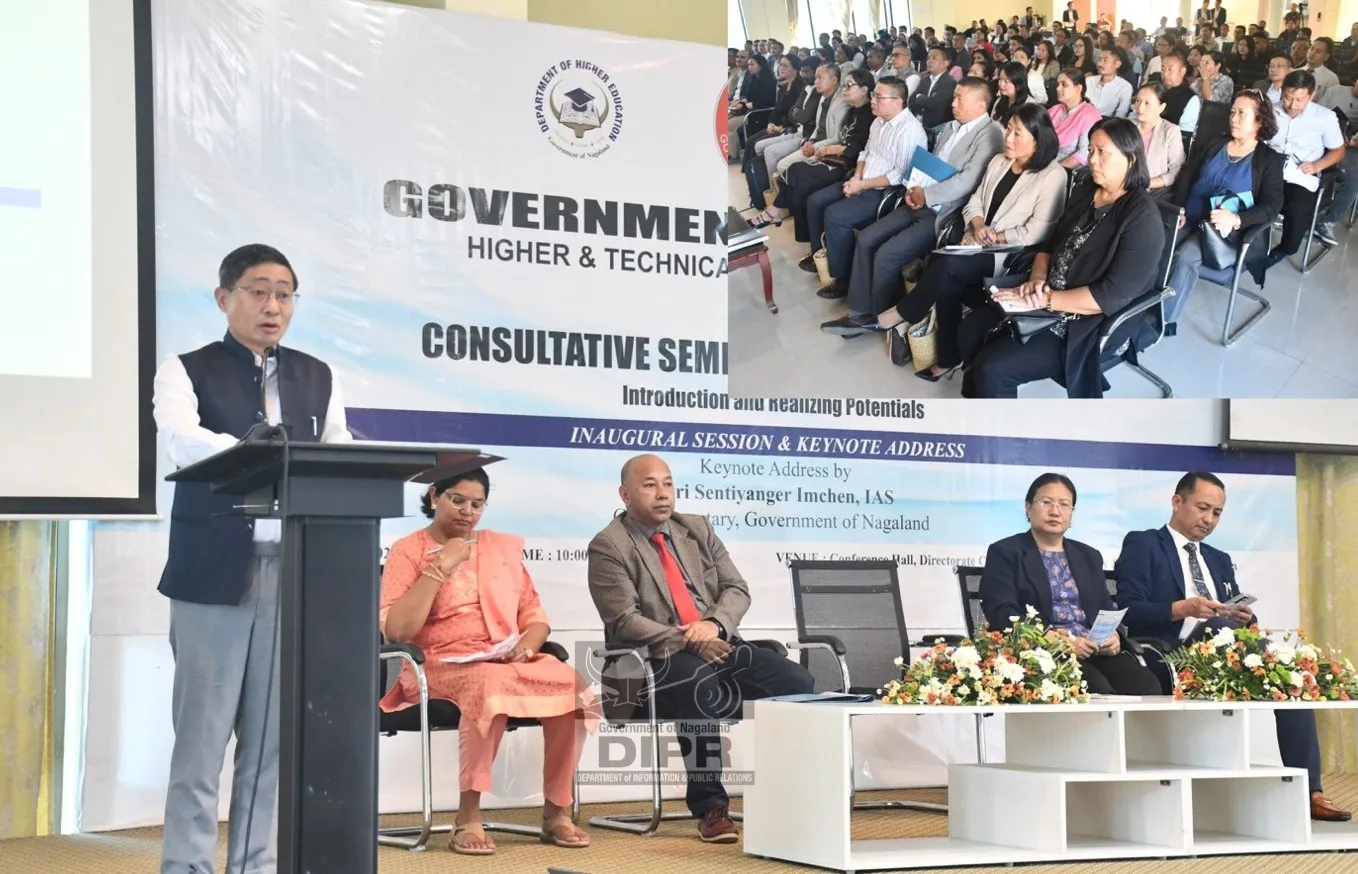
DIMAPUR: Chief Secretary Sentiyanger Imchen Friday stressed the need for Nagaland’s educational institutions to align academic programmes with emerging technologies and industry demands, saying the state must bridge the widening skills gap to address rising unemployment among its youth.
Speaking at a one-day consultative seminar on “Emerging Trends: Introduction and Realising Potential”, organised by the Department of Higher & Technical Education at the Conference Hall of the Department of Information Technology & Communication, Imchen said the education sector was undergoing its most significant transformation since the Industrial Revolution, driven by technological advancements and evolving economic demands.
He noted that global drivers such as technological disruption, climate change, demographic changes and the green transition were reshaping higher and technical education. According to him, leading institutions such as IITs, NITs and IIMs were increasingly preparing graduates for high-growth sectors and emerging technological domains.
Imchen observed that for decades education systems had placed greater emphasis on academic qualifications while vocational and technical pathways were often viewed as secondary. This imbalance, he said, had resulted in a situation where many graduates possessed theoretical knowledge but lacked the practical skills required by employers, leading to a significant skills gap.
Highlighting emerging trends in higher education, he said technology-driven disciplines, sustainability-focused programmes and interdisciplinary professional courses were becoming increasingly prominent. Courses in Artificial Intelligence (AI), Data Science, Cybersecurity, Digital and Forensic Sciences, FinTech and Digital Marketing were expanding rapidly, while programmes in renewable energy and sustainability were emerging in response to global industry requirements.
He said India’s leading institutions were incorporating these disciplines into mainstream academic structures to respond effectively to technological advancements and evolving labour-market demands.
Imchen further observed that education and employment shared a dynamic relationship in which educational institutions develop human capital while industries determine the demand for skills. He pointed out that education alone does not automatically guarantee employment if academic outputs remain disconnected from market requirements.
Referring to global employment trends, he said future job growth would increasingly centre around AI, automation, digital technologies and sustainability-oriented skills. Areas such as machine learning, data analytics, cybersecurity, information security and network management would witness growing demand in the coming years. Speaking on Nagaland’s employment scenario, Imchen said the state had traditionally placed a premium on education, with many families investing heavily in their children’s studies primarily to secure government employment. However, he observed that government jobs were limited and could no longer absorb the growing number of job seekers.
He pointed out that a large percentage of Nagaland’s population lacked formal vocational and technical education, creating a mismatch between academic learning and job-market requirements. The situation, he said, called for urgent reforms in the education sector and greater emphasis on practical skills development.
On the way forward, Imchen welcomed Nagaland University’s decision to introduce AI components into postgraduate and Ph.D. programmes and urged private universities, colleges and technical institutions to follow suit by incorporating emerging and industry-relevant disciplines into their curricula.
He also called on institutions to establish specialised departments and explore innovative approaches such as faculty-sharing arrangements, institutional collaborations, industry partnerships and hybrid learning models to overcome infrastructure and faculty constraints.
Expressing hope that the seminar would trigger a paradigm shift in the state’s education system, he urged universities, colleges and polytechnics to review existing curricula, strengthen research, innovation and entrepreneurship, and introduce future-oriented programmes that improve employability.
In her welcome address, Higher & Technical Education secretary Sarita Yadav stressed the importance of keeping pace with emerging technologies, changing industry requirements and evolving career opportunities. She said the seminar would provide a platform for knowledge-sharing and informed academic planning.
Delivering the special address, Pro Vice-Chancellor, Nagaland University, Medziphema Campus, Prof. Dipak Sinha, highlighted the importance of emerging courses and said curriculum updates were essential to meet changing technological and market demands.
He informed that Nagaland University had already begun introducing AI-related courses and advocated short-term certificate programmes in areas with employment potential. He also encouraged institutions to utilise the SWAYAM online learning platform and emphasised the importance of entrepreneurship, industry exposure and career guidance. The seminar also featured technical sessions on green and renewable energy, agriculture and allied sectors, AI, machine learning, IoT, smart technologies, cybersecurity, medical science technologies and emerging pedagogies in arts and commerce.
The programme concluded with remarks and an action plan presented by the Additional Secretary and Ex-officio Director of the Higher Education Department.