
As part of academic and extracurricular activities, educational institutions and other organisations organised various programmes for the students, faculties and staff.
Interaction on science education for students
DIMAPUR: An interaction programme on Science Education for Higher Secondary Students of Dimapur district was held at the school auditorium of Greenwood School on Monday.
The program, organized in commemoration of Nagaland Board of School Education (NBSE) Golden Jubilee Year, was aimed to encourage and promote the study of science at higher education levels.
Approximately 600 students, predominantly from the 12th standard, attended the session representing Greenwood School, Government Higher Secondary School, Rincho Academy, Little Star Higher Secondary School, St. Paul Higher Secondary School, MGM Higher Secondary School, Don Bosco Higher Secondary School, and St. John Higher Secondary School.
Dean of Academics Affairs at IIT Kanpur, Professor Shalabh, led the session as the resource person. In his opening remarks, Professor Shalabh emphasized that decision-making hinges on making the right choices at the right time. He cited the example of Covid-19 to underscore the importance of science education, noting its crucial role in societal progress.
He cautioned against excessive reliance on publicity and media-based information regarding the status and ranking of IITs, highlighting that infrastructure and facilities were largely comparable across institutions.
Professor Shalabh emphasized that IIT Kanpur was dedicated to train students in scientific thinking and reasoning.
Professor Shalabh’s presentation covered various aspects, beginning with the significance of science education in fostering scientific reasoning and problem-solving skills and delved into the history of IITs.
He also highlighted the IIT Kanpur Indo American Program (KIAP), emphasizing its focus on innovation-driven education and research integration. He also introduced SATHEE (Self-Assessment, Test, and Help for Entrance Exams), a Ministry of Education initiative offering free coaching accessible through its portal SATHEE via SWAYAM PRABHA.
NBSE secretary, Rangumbuing Nsarangbe moderated the session which culminated with question and answer session.
Meanwhile, the interaction program for Principals and Science Teachers of Mon, Peren, Dimapur and Chumoukedima districts will be held at Holy Cross Higher Secondary School, Dimapur on April 30 and on May 2, 2024 in Kohima.
(Staff Reporter)
BCK conducts ‘research colloquium’
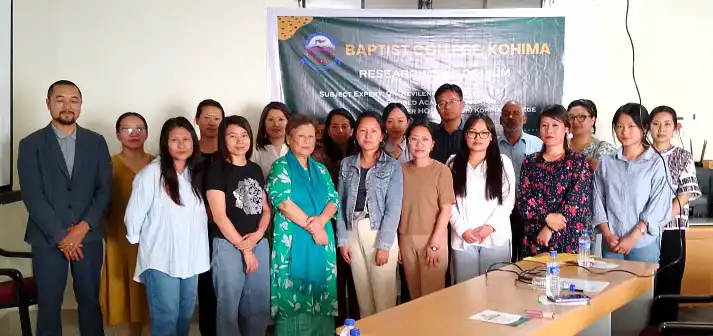
BAPTIST COLLEGE: Research Development Cell of Baptist College, Kohima organized a “Research Colloquium” for the department of English on April 29 at the IQAC Room.
Dr. Enünü Sale and Dr. Sentinaro, Asst. Professors, Department of English were the paper presenters. Dr. Kevileno Sakhrie, retired academic and educator, former HoD (English), Kohima College was the subject expert.
In the technical session, the paper titled “The Hornbill in Naga Folktales” was presented by Dr. Sale, where she spoke on the importance of the Great Indian Hornbill in Naga culture and the significance of the Great Indian Hornbill in the context of the Angami, Zeliang, Ao and Lotha communities.
The paper titled “Clay and Quill: Exploring Pottery and Literature as Dual Expressions of Human Experience in Temsula Ao’s The Pot Maker” was presented by Dr. Sentinaro. She spoke on the interrelations between pottery and literature, which inspires each other with various expressions in the context of cultural symbolism. She spoke on the significance of pottery making among the women folks in Changki village, under Mokokchung district.
Dr. Sakhrie commented on the greater purpose of folktale by encouraging the younger generation and others to preserve their culture and identity. Earlier, Dr. Kewepfuzu Lohe, interim principal, Baptist College delivered the welcome address. Dr. Khobu Tsolo, member, RDC, Baptist College was the moderator of the technical session and the concluding remark was delivered by Dr. Mhabeni Ezung, Asst. Professor, Department of History.
Sazolie College holds FDP

SAZOLIE COLLEGE: Sazolie College organised a Faculty Development Program (FDP), with an aimed to enhance the capabilities of the faculty through insightful discussion and knowledge-sharing sessions for teaching and non-teaching staff of Sazolie College on April 27.
The event was graced by Madras Christian College principal Dr. Paul Wilson, and MCC Prof. Suri as esteemed guests.
Dr. Wilson addressed various topics including quality assurance, innovation, networking, and the imperative need for career planning and fundraising and emphasized the crucial facets to ensure the development and advancement of the college.
Highlighting MCC’s commitment to corporate social responsibility, apart from academic excellence, Dr. Wilson underscored the significance of civic engagement and community services to prepare and equip students with social intelligence for personal and professional development and growth and provided suggestions on how Sazolie College can enhance its community services to make a better impact.
The two esteemed guest also signed a Memorandum of Understanding (MoU) during their visit. Principal of Sazolie College Dr. Gopal Chetri, chaired the program by giving a short presentation on the institution’s infrastructure, facilities, and existing challenges.
Faculty Development Program concluded with a renewed sense of purpose and commitment towards elevating educational quality and fostering holistic development at Sazolie College.
Interactive session on stress management
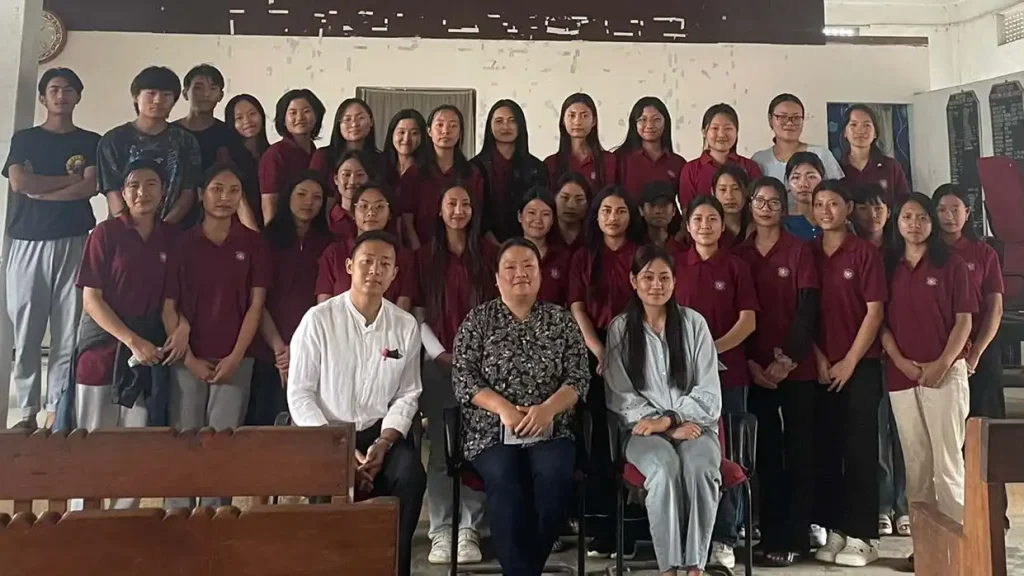
CRIMHRC: Carl Rogers Institute of Mental Health and Research Centre, (CRIMHRC) held an interactive session on stress & stress management with the NSS unit of Kohima Science College, Jotsoma.
At the event, CRIMHRC chairman, Kezhazolie Cornelius Mere, spoke on how, as a human everyone go through different types of stressors, and how important it was for everyone to need positive stressors and identify the negatively.
He also stressed on how the young Nagas both students and youths were becoming victims of negative stressors and were not able to find the right coping mechanism to deal their stressors. Stress management activities were also conducted including how to deal with academic stressors and study skills. Moarenla Longkumer NSS, KSCJ, NSS special camp led the session and delivered vote of thanks.
Khezhakeno Students Union organises workshop on career guidance
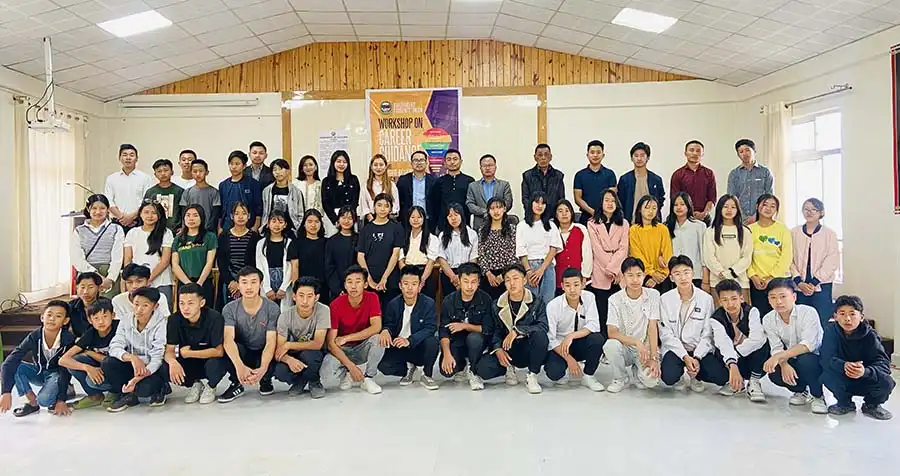
Khezhakeno Students Union: In a bid to empower students with the necessary tools for career planning, the Khezhakeno Students Union (KSU) organized a comprehensive workshop at the Village Council Hall, Khezhakeno on April 27.
The event, chaired by Krovieo Koza, commenced with an invocation by Rev. C. Ngochinyi Koza.
In his opening address, KSU president, Pfücülhu Kevie congratulated the successful HSLC and HSSLC students and delivered words of encouragement.
He also emphasized the importance of the workshop in helping students identify their strengths, weaknesses, and interests to navigate their career paths effectively.
Resource person Er. Daniel Kevie, Executive Engineer PWD, Pfutsero, shared insights into the notable improvements in the performance of government schools in recent years. Er. Kevie also emphasized the significance of resilience and ambition in achieving success.
He also encouraged the students to remain steadfast in their pursuits and underscored the accessibility of resources such as the internet, which can aid students in augmenting their learning experiences.
Another resource person, Er. Mechietsho Koza, EAC Chuchuyimlang, shared valuable insights on career choices beyond conventional paths. He urged students to consider professional courses and entrepreneurship, highlighting the changing dynamics of career pursuits.
With a focus on professional courses and entrepreneurship, Er. Koza highlighted the evolving landscape of career opportunities and encouraged the students to explore both conventional and unconventional avenues with confidence.
The workshop concluded with a sense of empowerment and enlightenment among participants, equipped with invaluable insights to chart their future endeavours.
International seminar on ‘Equity and Inclusivity in School Education’

BCTE and SCHE: Two-day international seminar on “Equity and Inclusivity in School Education with Reference to NEP 2020” jointly organised by Bosco College of Teacher Education (BCTE) and Salesian College of Higher Education (SCHE), Dimapur, and sponsored by the ICSSR New Delhi concluded on April 27.
The seminar was aimed at fostering discussions among educators, researchers, policymakers, and teacher trainees on crucial aspects of inclusivity and equity in line with the National Education Policy (NEP) 2020.
Comprising of an inaugural session, a plenary session, four technical sessions, and a valedictory program, the seminar attracted diverse audience of delegates, faculty members, research scholars and teacher trainees.
The seminar commenced with the inaugural session chaired by Athunglo Humtsoe, Assistant Professor Bosco College and invocation by Rhian H Zhimo, fourth-semester student.
Dr. Fr. Jose Joseph Sabu, Principal of Bosco College of Teacher Education, delivered welcome address.
The inaugural address was delivered by Prof. Buno Liegise, Professor & Head, Dept. of Education, Nagaland University, Kohima Campus, Meriema, Kohima.
Prof. Liegise highlighted the importance of equity and inclusivity in education and its alignment with the objectives of NEP 2020. She further emphasised the need to help students to develop critical thinking and divergent thinking.
Professor G.N. Tiwari, Professor and Head of the Department of Teacher Education at Nagaland University’s Kohima Campus in Meriema, illustrated the concept of inclusion during his exhortation.
Professor (Dr.) Sr. Marion Mathew C.J, Professor and Dean, Allahabad School of Education, Prayagraj (Allahabad) SHUATS, UP, delivered the keynote address centered on the theme “ Harmony in Diversity: Crafting an Inclusive Tapestry of Education with NEP 2020.”
Dr. Sr. Marion Mathew offered a comprehensive overview of NEP 2020, giving attendees a broad perspective on its implications. Drawing from her wealth of experience in the field, she provided valuable insights into the challenges and opportunities associated with achieving equity and inclusivity in school education.
Dr. Esaya Britto Raphael, Head of the Teaching and Learning Unit at the English Language Institute, Jazan University, Kingdom of Saudi Arabia, led the plenary session via video conference as the international speaker. He shared insights on “Facilitating Skill Development and Best Practices in Classroom,” stressing its relevance in the 21st century and advocating for equity and inclusivity in education.
On the second day, at the technical sessions, over 40 research papers were presented.
Prof. (Dr.) Sr. Marion Mathew C.J, lauded the seminar’s collaborative efforts and its role in promoting equity and inclusivity in education. She urged participants to continue advocating marginalized communities, emphasizing the power of collective action in effecting meaningful change.