
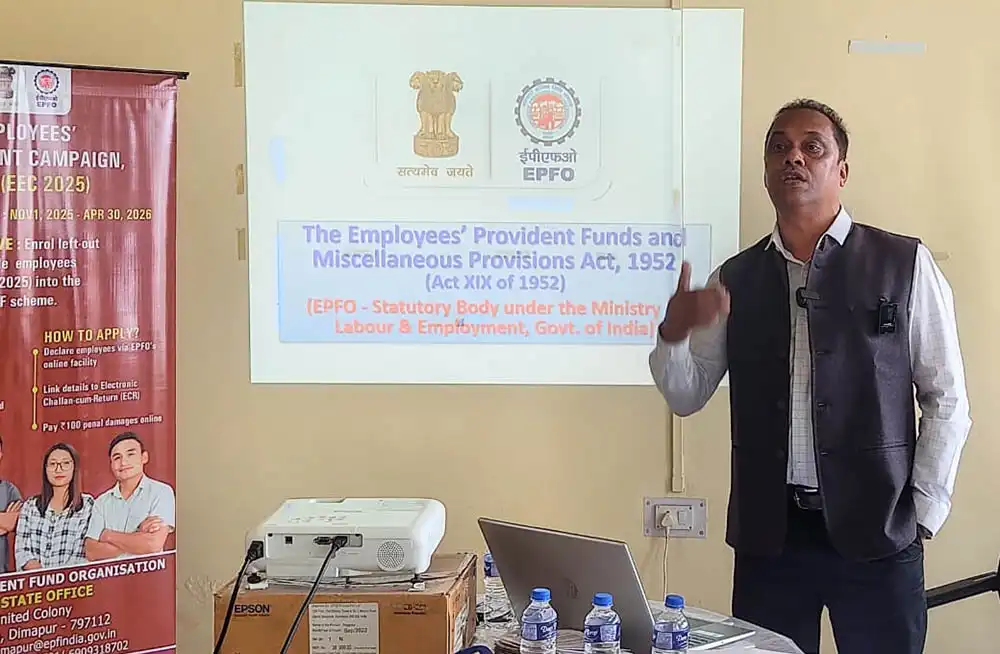
An awareness programme on Employees’ Provident Fund (EPF) was held on Tuesday at the Office of the Assistant Labour Commissioner, Dimapur, in association with the Employees’ Provident Fund Organisation (EPFO), Ministry of Labour & Employment, Government of India.
The session was conducted by Regional P.F Commissioner, Special State Office Dimapur, Samuel Das, and attended by employees and employers from media establishments in both print and electronic sectors.
Addressing the gathering, Das explained the Employees’ Provident Funds and Miscellaneous Provisions Act, 1952, under which EPFO functions as a statutory body. He highlighted the three schemes under the Act—Employees’ Provident Fund Scheme, 1952; Employees’ Pension Scheme, 1995; and Employees’ Deposit Linked Insurance Scheme, 1976—detailing contributions, benefits, and eligibility.
He informed that the Provident Fund Scheme requires a 12% contribution from employees and 3.67% from employers, with benefits including reimbursement on resignation, retirement, death, or disability, along with interest on monthly balances. The Pension Scheme, funded by 8.33% employer contribution and 1.16% from the Government of India, provides monthly pensions to members, spouses, children, nominees, and dependent parents.
The Deposit Linked Insurance Scheme, with a 0.5% employer contribution, offers insurance coverage ranging from Rs. 50,000 to Rs. 7 lakh to nominees.
Das also spoke on the Pradhan Mantri Viksit Bharat Rozgar Yojana (PM-VBRY), launched in August 2025, which provides incentives up to Rs. 15,000 for first-time employees through Direct Benefit Transfer, and monthly incentives between Rs. 1,000 and Rs. 3,000 for employers per new hire. The initiative, aimed at generating 3.5 crore jobs between 2025 and 2027, has already benefited around 6 lakh first-time employees and 79,098 establishments.
Highlighting liberalized provisions for partial withdrawal from EPF effective November 1, 2025, Das said members may withdraw for illness, education, marriage, housing, or in special circumstances such as natural calamities, unemployment, or epidemics. Withdrawals are permitted after 12 months of membership, with auto settlement of claims introduced for ease.
He further emphasized that EPF services are now fully online, ensuring faster delivery, transparency, and efficiency. The Employee Enrolment Scheme 2025, effective November 1, 2025, was also explained, encouraging employers to voluntarily declare and enroll eligible employees who had not been registered with the Fund between July 2017 and October 2025. In such cases, employees’ share of contribution is waived, while employers pay only a nominal penal damage of Rs. 100.
The programme underscored the duties of both employers and employees, including enrollment, compliance, activation of Universal Account Numbers (UAN), and filing of e-nominations. It concluded with emphasis on the importance of EPF schemes in ensuring social security and financial stability for the workforce, while promoting digital compliance and transparency.