
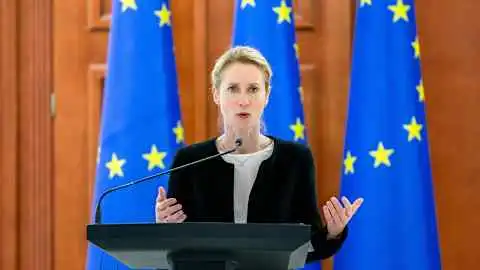
European leaders scrambled to protect their citizens in the Middle East and figure out how to respond to US and Israeli strikes on Iran on Saturday, amid fast-moving developments on the ground.
Germany is holding an emergency meeting on Saturday to discuss the situation in Iran. The European Union is evacuating some staff from the region.
The US and Israel launched a major attack on targets across Iran, and US President Donald Trump called on the Iranian people to “take over your government” — an extraordinary appeal that suggested they could be seeking to end the country’s theocracy after decades of tensions.
It was unclear whether US allies were given any advance warning of the attacks. The German government said it was only given notice of the attacks on Saturday morning. France’s junior defence minister said France knew something would happen, but didn’t know when.
Responding to the attack, the European Union’s top diplomat called the conflict in the Middle East “perilous” and said she was working with Israeli and Arab officials to pursue a negotiated peace.
“Iran’s regime has killed thousands. Its ballistic missile and nuclear programmemes, along with support for terror groups, pose a serious threat to global security,” said Kaja Kallas, foreign policy chief of the 27-nation bloc, in a post on social media.
“The EU is also coordinating closely with Arab partners to explore diplomatic paths.”
She said the EU was evacuating some staff in the region while keeping in place a maritime mission in the Red Sea. The EU recently put fresh sanctions on Iran and its leading figures, which prompted retaliatory sanctions by Tehran.
The German government said it was monitoring the situation in Iran, Israel and the wider Middle East region after being informed about the Israeli strikes on Saturday morning.
The German government’s crisis management team is scheduled to meet at noon to discuss the situation in Iran.
Chancellor Friedrich Merz was already consulting with ministers in charge of security and with European partners.
The German government urged German citizens in Iran, Israel, and the wider region to sign up for the official registration system for citizens abroad and follow the instructions of the local authorities regarding the necessary measures for their own protection.
France, whose military has bases and a regular presence in the Mideast, is calling on French citizens in the region to exercise extreme caution.
“A military escalation is underway. … It’s not the time for negotiations, we are in a situation of war,” junior Defence Minister Alice Rufo told France-2 television Saturday, comparing the situation to what happened last June.
“Our priority is the protection of our citizens and the protection of our forces in the region,” she said.
Asked if French forces were involved in the US and Israeli strikes or targeted in retaliatory strikes, French military spokesperson Col. Guillaume Vernet said Saturday: “The French armed forces continuously adapt their posture to threats and implement measures to ensure the surveillance and protection of military installations where French soldiers are deployed.”
He would not elaborate.
“Our military presence guarantees France’s independent assessment of the situation,” he told the AP.
Italy’s government urged Italians to exercise the utmost caution and follow instructions provided by its embassies in the region. Prime Minister Giorgia Meloni’s office said the prime minister would be in contact with the region’s allies and leaders within the next few hours to “support any initiative that may lead to a de-escalation of tensions.”
“Italy reiterates its support to the Iranian civilian population, who courageously continue to demand respect for their civil and political rights,” Meloni’s office said.
Switzerland called for full respect of international law and urged “all parties to exercise maximum restraint, protect civilians and civilian infrastructure.”
SUB HEAD
Attack on Iran disrupts flights across Middle East and beyond
London, Feb 28 (AP): The US and Israel’s attack on Iran disrupted flights across the region and beyond.
The United Arab Emirates, home to both the long-haul carriers Emirates and Etihad, and Israel closed their airspace on Saturday. Qatar Airways Group said it has temporarily cancelled flights to and from Doha because Qatari airspace also was closed.
Planes that were en route to Israel were rerouted to other airports, and passengers who were at Ben Gurion International Airport awaiting flights were shuttled back.
Emirates said several of its flights were affected by the UAE airspace closure and urged passengers to check their flight status online. The carrier is based at Dubai International Airport, the busiest hub for international travel.
Dutch airline KLM had already announced earlier in the week that it was suspending flights to and from Tel Aviv starting Sunday.
Virgin Atlantic cancelled its flight from Heathrow Airport in London to Dubai and said it would avoid flying over Iraq, meaning flights to and from India, the Maldives, Dubai and Riyadh could take slightly longer.
The airline already was not flying over Iran. Virgin Atlantic said all flights would carry appropriate fuel in case they need to reroute on short notice.
Turkish Airlines said on X that flights to Lebanon, Syria, Iraq, Iran and Jordan will be suspended until Monday and flights to Qatar, Kuwait, Bahrain, the United Arab Emirates and Oman would be suspended on Saturday.
The airline said additional cancellations may be announced.