
The first North East Festival of Rice– “Grains of Heritage” commenced on Thursday at Agri Expo, Chümoukedima, with Advisor for Agriculture, Mhathung Yanthan, declaring the regional festival open.
Organised by the Indian National Trust for Art and Cultural Heritage (INTACH) Nagaland Chapter, the three-day regional event brings together farmers, researchers, institutions, and cultural groups from across the Northeastern states to celebrate rice as a shared agricultural, cultural, and ecological heritage.
In his inaugural address, Yanthan described the festival as historic—not only as the first of its kind, but for placing rice at the heart of Northeast identity. “For the people of the North East, rice is not just an agricultural commodity. Rice is life, rice is culture, rice is identity,” he said.
He noted presence of rice in every life stage from birth to marriage, festivals to harvest celebrations.
Recalling his early support when approached with the idea in 2019, Yanthan praised INTACH Nagaland for its vision and conviction.
He highlighted the region’s status as a global biodiversity hotspot, home to an extraordinary diversity of indigenous and heirloom rice varieties.
In Nagaland alone, he said over 200 landraces have been identified, each adapted over centuries to specific micro-climates, terrains, and cultural needs. He, however, cautioned that many varieties were degenerating or at risk of loss.
Yanthan stressed that these traditional seeds represented generations of farmer knowledge and stewardship, describing farmers as the “true knowledge holders.”
Amid growing threats from climate change—erratic rainfall, floods, droughts, and pests—the advisor noted that many traditional varieties already possessed valuable traits like flood tolerance, drought resistance, and low-input adaptability.
He called for targeted improvement of long-duration varieties into shorter-duration, high-yielding, and climate-resilient strains to ensure economic viability and reduced risk for farmers.
Emphasising sustainability as a lived ancestral practice rather than a modern policy term, Yanthan pointed out that rice cultivation supported entire ecosystems of livelihoods, including farmers, artisans, weavers, and traders.
He said protecting rice meant protecting rural economies.
He urged greater youth involvement, encouraging students to value seeds, soil, and water to become responsible scientists, policymakers, and entrepreneurs.
Yanthan also informed the gathering that Nagaland has framed a new Agriculture Policy 2024–2025, and the state looks forward to active participation by scientists and researchers in its implementation.
Earlier, the programme began with a symbolic sowing of rice seeds, followed by an invocation by
Ao Baptist Church, Diphupar Pastor, Rev. Lipok Jamir.
Welcome address was delivered by State Convener, INTACH Nagaland Chapter, Padmashree Sentila T. Yanger, while short speeches were also delivered by Director, ICAR Umiam, Dr. Sandeep Ghatak; Director, ICAR ATARI, Umiam, Dr. A.K. Mohanty; Director, Department of Agriculture, Sanuzo Nienu, and Director, NEZCC, Ministry of Culture & Sangeet Natak Akademi Awardee, Dr. Prashanna Gogoi. Vote of thanks was proposed by Co-Convener, INTACH Nagaland Chapter, Mefutiba Longkumer.
The inaugural ceremony concluded with a cultural mélange presented by NEZCC.
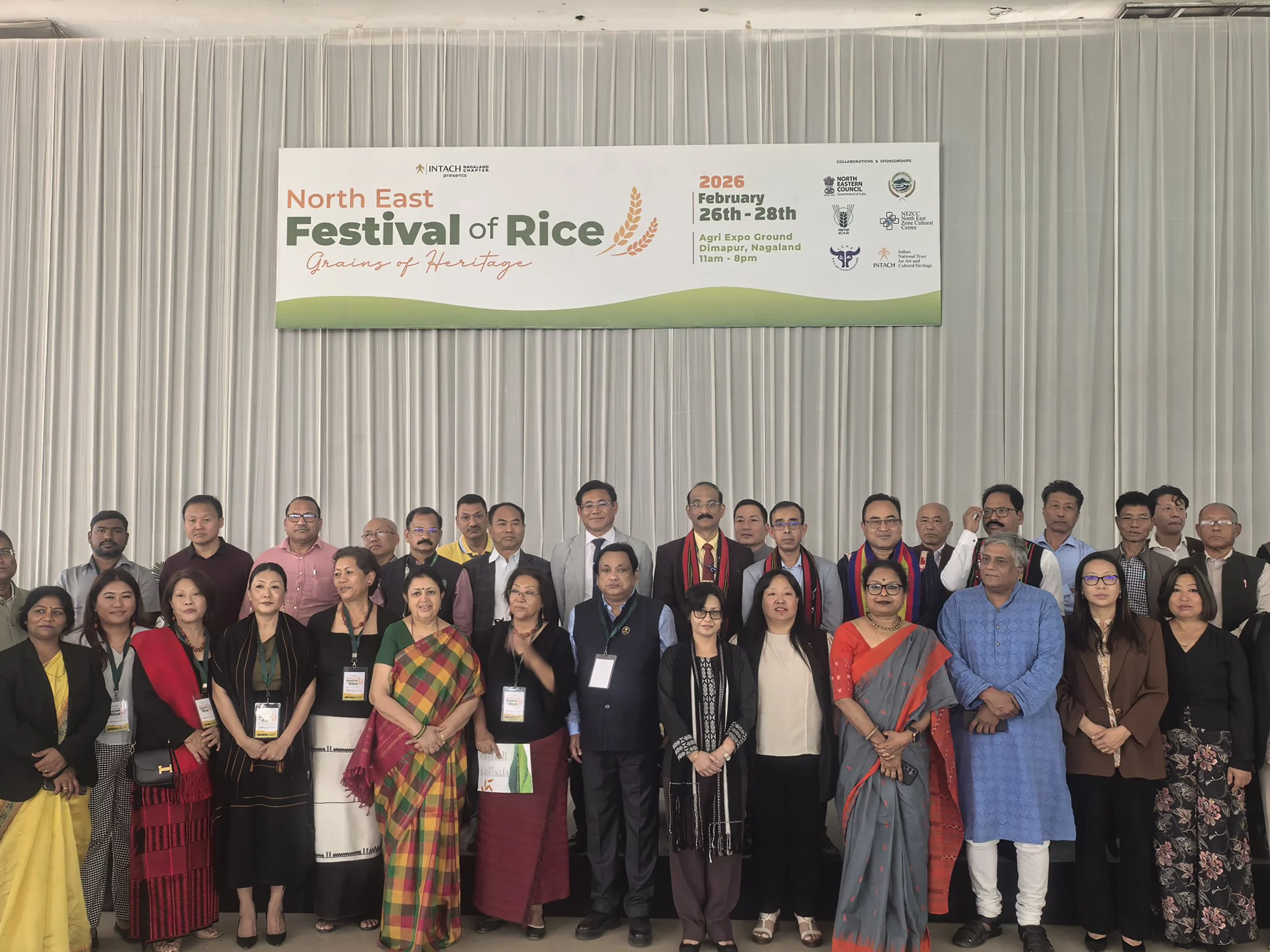
First North East Festival of Rice commences at Agri Expo
Staff ReporterDIMAPUR, FEB 26 (NPN):