
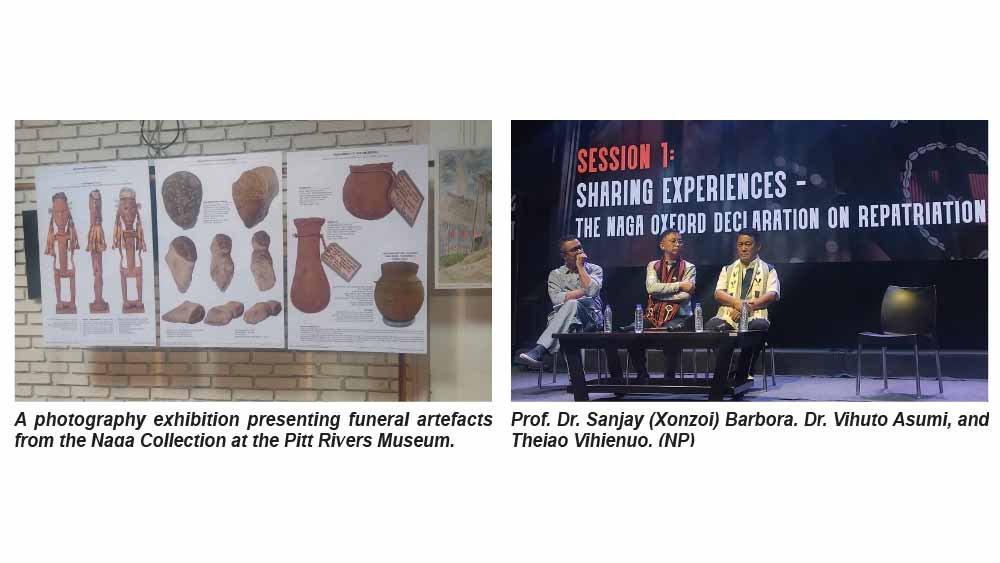
Forum for Naga Reconciliation–Recover Restore and Decolonise (FNR-RRaD) convened its 2nd annual September Dialogue under the theme “Reflection on Naga Repatriation and Ways Forward” at The Lighthouse Church, Dimapur. The event featured a photography exhibition showcasing funeral artefacts from the Naga collection at the Pitt Rivers Museum (PRM), Oxford, which was inaugurated with a prayer led by FNR Convenor, Rev. Dr. Wati Aier.
The first session titled “Sharing Experiences – The Naga Oxford Declaration on Repatriation” saw key contributions from Angami Public Organisation (APO) president, Thejao Vihienuo; Sumi Hoho (SH) president, Dr. Vihuto Asumi; and Prof. Dr. Sanjay (Xonzoi) Barbora of the University of California, Santa Cruz.
Addressing the gathering, Vihienuo recalled the moment FNR informed tribal leaders about ancestral remains held at PRM. He expressed deep concern over the colonial practice of displaying human remains as trophies and emphasized that repatriation must be accompanied by regret and apology for historical injustices. He proposed that the remains be laid to rest at a common site with state involvement, and a monument be erected to symbolize Naga unity—a suggestion that received unanimous support from younger tribal leaders.
Vihienuo further acknowledged the collaborative efforts between FNR-RRaD and PRM, describing the Oxford Declaration as a historic milestone born of collective reflection. He urged all Nagas to support the journey of bringing their ancestors home with dignity and unity.
SH president, Dr. Vihuto Asumi, described the visit to PRM as a pilgrimage and a solemn encounter with ancestral silence. He reflected on the dual legacy of the British encounter—education and Christianity on one hand, and division, exploitation, and betrayal on the other. He emphasized that repatriation is not a favour but a moral imperative, and called for unity beyond tribal and political lines.
Dr. Asumi outlined five key steps for moving forward: ensuring an inclusive and transparent process; engaging youth as active participants; transforming documentation into educational tools; facilitating holistic healing through rituals; and fostering global solidarity with other Indigenous communities. He described the Oxford Declaration as a covenant with both history and the future, urging all Nagas to walk together in reconciliation and renewal.
University of California, Santa Cruz, Prof. Dr. Sanjay (Xonzoi) Barbora, reflecting on his visit to Oxford with the Naga delegation, described the moment as deeply emotional and symbolic. Dressed in traditional attire, the delegation walked through Oxford to the Pitt Rivers Museum (PRM), drawing attention from locals and tourists. Inside the museum, they corrected colonial misrepresentations and shared the cultural significance of Naga artefacts. Dr. Barbora commended the humility of museum staff and emphasized that colonial narratives could be dismantled through respectful dialogue and truth-telling.
He noted that the delegation’s commitment to repatriation was rooted in dignity and foresight, and praised their decision to forgive colonial authorities while acknowledging the sincere efforts of their descendants. He called the visit a model of collective healing through shared experience and mutual respect.
The second session, “Building Naga Solidarity for Repatriation and Healing,” was facilitated by FNR Convenor, Rev. Dr. Wati Aier, and RRaD Coordinator, Rev. Dr. Ellen Konyak Jamir. Rev. Dr. Jamir read aloud the Naga Oxford Declaration on Repatriation, inviting tribal hohos present to endorse the statement. Signatures were appended by Mao Hoho Dimapur, Chakhesang Public Organisation, South Naga Union of Nagaland, and Western Yimkhiung Hoho, with verbal endorsements from Rengma and Pochury tribal hohos.
In his closing remarks, Dr. Aküm Longchari emphasized the importance of memory and urged a shift from victimhood to survivorship. He encouraged intergenerational dialogue and stressed that healing must be both internal and external. He called on youth to document their experiences truthfully and highlighted the role of educational institutions, particularly Patkai Christian College, in advancing decolonisation and reconciliation.
The third session, “Naga Tribe Leaders Reflect on their PRM Visit and the Naga Collection,” was moderated by Prof. Dr. Dolly Kikon and featured reflections from tribal representatives including Phom Peoples’ Council, Tongror Luden Ao Senden, Tangkhul Naga Long, Sumi Hoho, Khiamniungan Tribal Council, and Konyak Union.
The fourth and final session, “Naga Repatriation, Healing and Decolonisation: Some Ways Forward,” was led by Prof. Dr. Dolly Kikon and the RRaD team. Earlier, the event opened with remarks by Rev. Dr. Ellen Konyak Jamir, a prayer of blessing by Pastor Wabang Longchari, and the RRaD anthem performed by musicians.
Earlier in the day, the first session of the September Dialogue was chaired by Recover Restore and Decolonise (RRaD) Coordinator, Rev. Dr. Ellen Konyak Jamir, who also delivered the opening remarks. A prayer of blessing was offered by Pastor Wabang Longchari of The Lighthouse Church, followed by the rendition of the RRaD Anthem by a team of musicians. The sessions featured interactive exchanges, allowing participants to engage meaningfully with the themes of repatriation, healing, and decolonisation.
The September Dialogue concluded with renewed commitment to bring ancestral remains home, foster unity across tribes, and build a future rooted in truth, dignity, and reconciliation.
FNR-RRaD holds 2nd annual September Dialogue on Naga Repatriation and Healing
Staff ReporterDIMAPUR, SEP 6 (NPN)