
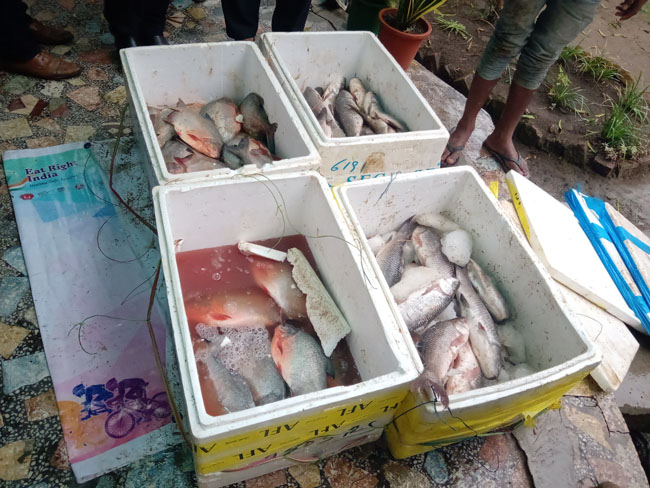
Return of formalin-injected fish to the market – in Kohima on February 23 and Dimapur on Wednesday – has once again exposed the lack of an adequate apparatus in Dimapur to check inflow of adulterated and spurious food items into the State.
In what seems to be a repeat of last year’s June episode, three different breeds of fish – rahu, pankaj and pomfret – weighing 200 kg were confiscated from both wholesalers and retailers in New Market and disposed of at Dimapur Municipal Council (DMC) dumping site in Sunrise Colony on Wednesday.
Close on the heels of the crackdown in Kohima and upon a directive issued by higher authorities, the samples were collected from New Market by food safety officer (FSO) Samuel Zehol on February 23. These were then sent to State Public Health Laboratory (SPHL) in Kohima the next day for tests, whose results were given the following day confirming fears of formalin-laced fish being sold in the market again.
Earlier, a brief meeting was held in the presence of chief medical officer (CMO) Vikato Kinimi where Samuel Zehol and other officials from the district administration pointed out various loopholes that needed to be plugged.
240 kg fish disposed of at Zunheboto: Approximately 240 kg of different varieties of fish sold in violation of government notification and Food Safety & Standard Act, 2006 was seized and disposed of at Zunheboto Town Council dumping site in the presence of Zunheboto deputy commissioner Shanavas C and additional deputy commissioner Ajit K Ranjan.
The action followed receipt of positive results from tests conducted on fish samples sent to SPHL, Kohima from the district. The fish samples were collected by a joint inspection team headed by Zunheboto CMO-cum-designated officer Dr CW Tungoe and included deputy CMO Dr K Akaho Sema and FSO. They were assisted by the district administration and police. This was stated in a press release by Shekho Sophie, district media officer, Zunheboto CMO office.
Observations made by officials: It was observed that though Dimapur was the gateway through which fish and other consignments entered the State, the districts did not have a laboratory to check formalin presence in fish and conduct other tests. Nagaland currently has SPHL only in Kohima and a mobile laboratory, which too is generally stationed in Kohima, although Dimapur is the main gateway for entry of food items into the State and has a greater need for a mobile laboratory.
Secondly, though there is a veterinary quarantine department in the State collecting entry fees, it is not adequately equipped to check if livestock entering the State is safe for consumption.
The meeting also considered initiating more stringent checks at entry points before food items are cleared for entry into the State. Unfortunately, Dimapur does not even have a proper food testing laboratory to begin with.
The CMO also called for an inter-State meeting with representatives from Andhra Pradesh from where fish is mainly imported and work out a modality to ensure that fish entering the State is formalin-free.
The formalin saga began on June 25 last year when samples of six different breeds of fish tested positive for the toxic chemical used in preservation of dead bodies. In the ensuing months till October, fish markets in various districts wore a deserted look due to the blanket ban on fish treated with formalin.
Finally, on October 17 last year, fish traders heaved a sigh of relief when a truck laden with a consignment of fish from Andhra Pradesh was taken for inspection to DDSC stadium, before being cleared for sale in the market.
The FSO told Nagaland Post that after the consignment was cleared for sale in October 2018, more checks were carried out in the ensuing months that led to discovery of fish free from formalin. The latest test conducted on February 13 this year during a food mela held at Super Market also gave a negative result.
Vikato Kinimi suspected that the fish suppliers might have started using formalin as the days are getting warmer now with the summer approaching. He called for a collaborative effort from the medical and veterinary departments and district administration in checking adulterated and harmful food items, while also urging local fish vendors to take up fish farming on a larger scale to reduce dependency on other States.