A potentially huge underground reservoir of freshwater beneath the Great Salt Lake is coming into sharper focus with a new study that used airborne electromagnetic (AEM) surveys to X-ray geologic structures under Farmington Bay and Antelope Island off the lake’s southeastern shore.
An analysis of this data by University of Utah geophysicists shows that freshwater saturates the sediments beneath the lake’s hypersaline surface to depths of 3 to 4 kilometers, or about 10,000 to 13,000 feet. The helicopter-borne geophysical survey was conducted last year after Utah scientists documented freshwater welling up under pressure at several spots on the lake’s exposed playa in Farmington Bay, manifesting as strange phragmites-choked mounds.
The study demonstrated for the first time the ability of AEM methods to detect freshwater underneath the thin layer of conductive salt water at the surface of the Great Salt Lake, according to lead author Michael Zhdanov. His team also characterized the spatial extent of the freshwater reservoir beneath Farmington Bay and studied the potential depth of freshwater-saturated sediments by delineating the basement structure.
“We were able to answer the question of how deep is this potential reservoir, and what is its spatial extent beneath the eastern lake margin. If you know how deep, you know how wide, you know the porous space, you can calculate the potential freshwater volume,” said Zhdanov, a distinguished professor of geology & geophysics and director of the Consortium for Electromagnetic Modeling and Inversion, or CEMI.
The results appear in the journal Scientific Reports. This study is part of a larger research project led by the U’s Department of Geology & Geophysics to understand the groundwater beneath Great Salt Lake, the largest terminal lake in the Western Hemisphere.
Overseen by some of the geology department’s most senior faculty and their graduate students, this effort has already resulted in two other important papers, with more to follow.
The evidence produced in this new study suggests that freshwater is entering the subsurface toward the lake’s interior, not its periphery as would be expected, according to hydrologist Bill Johnson, a co-author on all the Great Salt Lake groundwater papers.
“The unexpected part of this wasn’t the salt lens that we see near the surface across the playa. It’s that the freshwater underneath it extends so far in towards the interior of the lake and possibly under the entire lake. We don’t know,” Johnson said on a recent appearance on KPCW’s Cool Science Radio show.
“What we would normally expect as hydrologists is that that brine would occupy the entire volume underneath that lake. It’s denser than the freshwater. You’d expect the freshwater from the mountains to come in somewhere at the periphery. But we find it’s coming in towards the interior. And there’s what appears to be deep volume of this freshwater coming in underneath that saline lens.”
These studies were triggered by the appearance in recent years of circular mounds, each 50 to 100 meters in diameter and covered with 15-foot-tall thickets of reeds, on the dried-out bed of Farmington Bay. The lake’s declining water levels have exposed 800 square miles of Lake Playa, which is now becoming a major source of dust pollution blowing into Utah’s population centers.
Johnson, a professor of geology and geophysics, wants to explore whether the artesian groundwater could be safely tapped to mitigate the dust which contains toxic metals.
“There are beneficial effects of this groundwater that we need to understand before we go extracting more of it. A first-order objective is to understand whether we could use this freshwater to wet dust hotspots and douse them in a meaningful way without perturbing the freshwater system too much,” Johnson said.
“To me, that’s a primary objective because it’s very practical and it’s unlikely we’ll be able to fill Farmington Bay and other parts of the playa enough to avoid some dust spots appearing at the higher elevations. This would be a great way to get at that.”
Johnson and his Utah colleagues, including Mike Thorne and Kip Solomon, are seeking funding to expand the groundwater studies to cover a much larger portion of the lake.
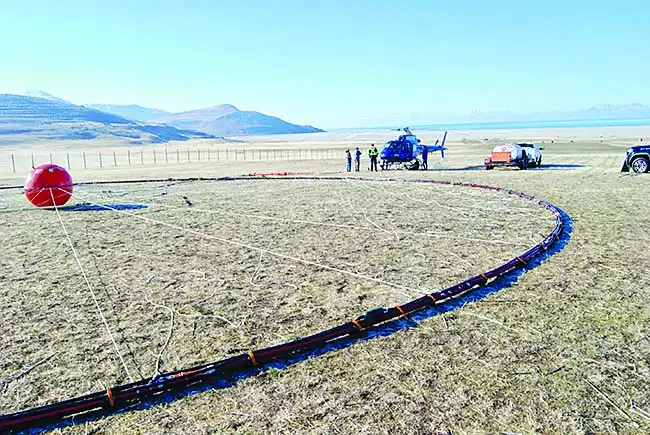
This latest paper measured electrical resistivity to a depth of about 100 meters via airborne electromagnetic surveys to discern freshwater from brine, which is far more electrically conductive. To see if this could be done, Johnson and Zhdanov hired a geophysical crew from Canada to fly electromagnetic equipment dangled under a helicopter in February 2025. The helicopter flew 10 east-west survey lines spanning Farmington Bay and across the northern portion of Antelope Island, for a total of 154 miles.
(Phys Org)