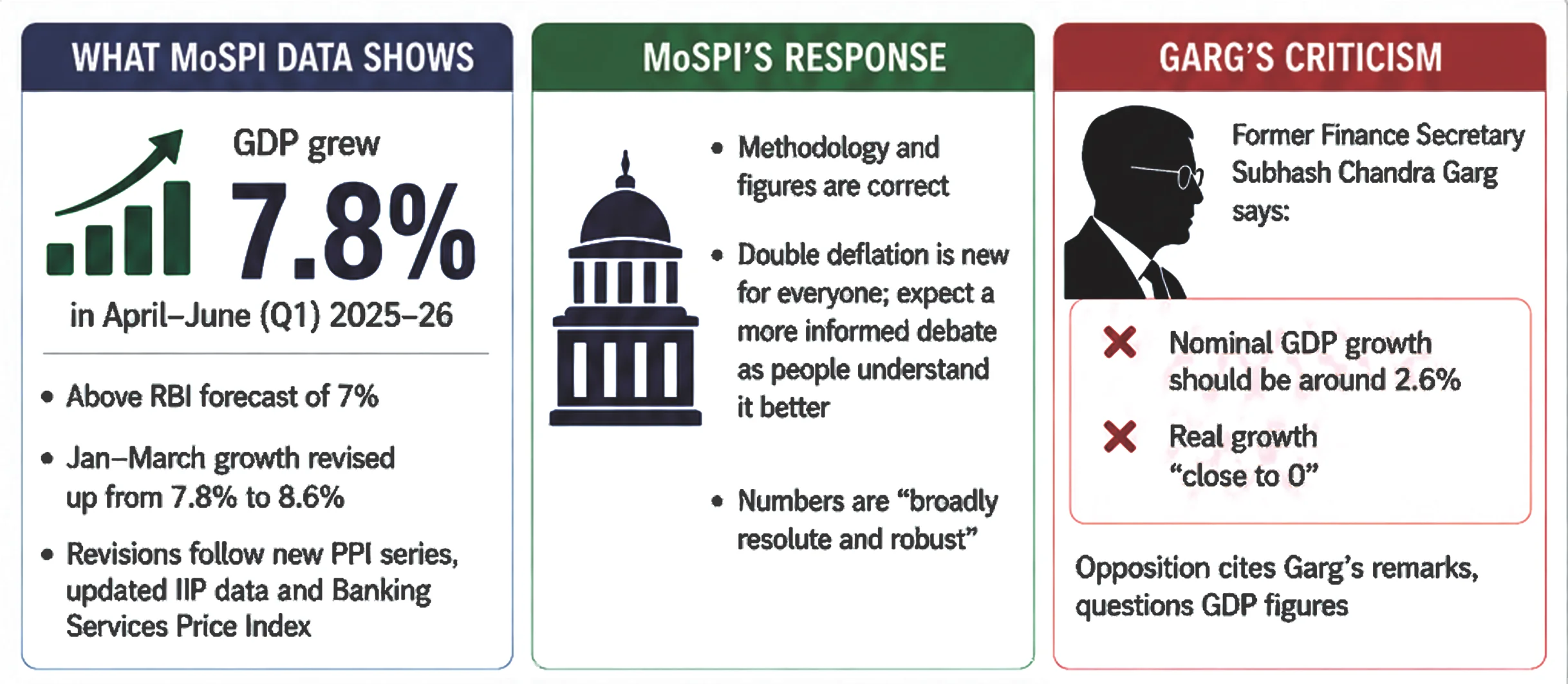
NEW DELHI, SEP 2 (AGENCIES): Ministry of Statistics and Programme Implementation (MoSPI) on Wednesday defended India’s 7.8% GDP growth in the April-June quarter, asserting that the methodology and figures were correct, while former finance secretary Subhash Chandra Garg questioned the data, arguing that nominal GDP growth should be around 2.6% and real growth “close to 0”.
The contrasting positions have triggered a debate over the new methodology used to calculate India’s GDP, particularly the adoption of double deflation across sectors and the use of the new Producer Price Index (PPI).
MoSPI secretary Saurabh Garg said he expected a “more informed debate” once economists and others became more familiar with the new methodology.
MoSPI data released on Monday showed GDP grew 7.8% in April-June, significantly above the Reserve Bank of India’s 7% forecast and higher than most economists had expected. The growth rate for January-March was also revised upwards from 7.8% to 8.6%. The revisions followed the introduction of the new PPI series, updated Index of Industrial Production (IIP) data and the Banking Services Price Index released earlier this year.
Some economists, former bureaucrats and politicians have questioned the figures, particularly the method used to calculate real manufacturing Gross Value Added (GVA). Garg, meanwhile, has criticised the data more sharply, saying nominal GDP growth in April-June should be 2.6% and real growth “close to 0”.
Speaking to reporters, MoSPI secretary said the double-deflation method was “new for everyone”.
“So, the lack of familiarity was there all round, whether it is within the statistical community or the economist community. But I am sure as people get used to the double deflation methodology, as they understand it better, there will be a more informed debate,” he said.
GVA is calculated by subtracting the value of inputs used by a sector from the value of its output. To arrive at real GVA, output and input values are adjusted separately for changes in prices. This process is known as double deflation.
Under the earlier GDP series, agriculture and mining and quarrying were the main sectors where double deflation was used.
For other sectors, input and output values were generally deflated using the same measure, based on indicators such as the Wholesale Price Index and Consumer Price Index.
MoSPI said this could be problematic when input and output prices move at different rates. The new GDP series, with 2022-23 as the base year, applies double deflation across sectors. The use of the new PPI has also contributed to revisions in earlier estimates.
According to MoSPI, the PPI provides more than 300 deflators for different components of GDP, compared with around 180 under the previous series. The ministry said this would allow real values to be calculated more accurately. MoSPI also issued additional information specifically addressing the criticism that the new series had artificially increased the latest growth rate.
It said the April-June 2025 nominal GDP estimate was revised from Rs 86.05 lakh crore under the old series to Rs 80 lakh crore under the new series because of successive revisions arising from the change in base year, improved data sources and methodologies, and updated indicators.
MoSPI said it was therefore “incorrect to interpret the difference as a deliberate downward revision” of last year’s GDP to mechanically raise the current year’s growth rate. It also said GDP values from different series cannot be directly compared to calculate growth rates.
Changing the base year and updating methodologies are standard international practices. India generally revises its major economic indicators every five years. The CPI and IIP series have also been updated this year, while new indicators such as the PPI have been introduced.
MoSPI secretary said the first-quarter figures were based on data points available in the public domain and pointed to strong growth in several service sectors and manufacturing.
“The kind of growth rate we have seen in certain service sectors is up to 24%,” he said.
On revisions to previous GDP estimates, MoSPI secretary said there was no consistent pattern of upward revisions, with some quarters revised upwards and others downwards. Annual growth estimates for 2023-24, 2024-25 and 2025-26 were revised upwards by only 10 basis points each, to 7.3%, 7.2% and 7.8%, respectively.
He said this indicated that the numbers were “broadly resolute and robust”.
Asked about possible revisions to the 7.8% growth estimate for the first quarter of 2026-27, the secretary said he did not want to speculate, though substantial changes were not expected.
He explained that quarterly estimates are based on hundreds of indicators, while annual estimates use actual data. These indicators include crop production, cement production, finished steel consumption and commercial vehicle sales.
Quarterly GDP estimates follow a “benchmark-indicator approach”, in which movements in high-frequency indicators guide quarterly estimates. Annual estimates are subsequently based on actual output and data.
Meanwhile, former finance secretary Subhash Chandra Garg’s criticism has been cited by opponents of the government in questioning the latest GDP figures.
Economist and former Chief Economic Adviser Kaushik Basu said on social media platform X that although he had not studied the figures sufficiently to take a position, the best analysis he had heard was that of Subhash Garg, who, he said, knew the statistics “extremely well” as a former finance secretary.
The Congress also cited Garg’s television interview while questioning the GDP figures, posting on X: “7.8% GDP Growth in Fudged Data, 2.6% in Reality”.
Subhash Chandra Garg served as Economic Affairs Secretary in the Ministry of Finance until July 2019 and became Finance Secretary in the final months of his tenure. He was transferred to the Ministry of Power in July 2019 and subsequently took voluntary retirement.