
South Korean trade officials scrambled Saturday to assess the impact of a US Supreme Court ruling to invalidate some Trump administration tariffs, as business and governments around the world pored over the possible fallout from moves in Washington on the global economy.
The emergency meeting announced by the Trade Ministry in Seoul came as officials from South Korea to South America and beyond acknowledged tariffs would remain on some specific exports to the US, like automobiles and steel, that aren’t affected by the US high court decision.
It marked yet another swoon in the US tariff posture since President Donald Trump returned to office 13 months ago, upending dozens of trading relationships with the world’s biggest economy.
In Paris, French President Emmanuel Macron hailed the checks and balances in the United States, praising the “rule of law” during a visit to a Paris agricultural fair: “It’s a good thing to have powers and counter-powers in democracies. We should welcome that.”
But he cautioned against any triumphalism.
Officials were going over the language of bilateral or multilateral deals struck with the US in recent months, even as they braced for new swings. Trump said Friday he plans new 10 per cent global tariffs, under different rules.
“I note that President Trump, a few hours ago, said he had reworked some measures to introduce new tariffs, more limited ones, but applying to everyone,” Macron said. “So we’ll look closely at the exact consequences, what can be done, and we will adapt.”
Businesses brace south of the border — and beyond
Alluding to the new 10 per cent tariff threat, Sergio Bermúdez, head of an industrial parks company in Ciudad Juárez, Mexico, along the Texas border, said Trump “says a lot of things, and many of them aren’t true. All of the businesses I know are analysing, trying to figure out how it’s going to affect them.”
The impact could be felt especially in Juarez: Much of its economy depends on factories producing goods to export to consumers in the US, the result of decades of free trade between the US and Mexico.
The policy swoons in the United States over the last year have made many global business leaders cautious, as they struggle to forecast and see investment take a hit.
Economy Secretary Marcelo Ebrard on Friday said Mexico was watching the tariffs with a “cool head,” noting that 85 per cent of Mexico’s exports face no tariff, largely because of the United States-Mexico-Canada agreement. He plans a trip to the US to meet with economic officials next week.
CEO Alan Russell of Tecma, which helps American businesses set up operations in Mexico, has seen his job grow increasingly complicated over the past year — his company’s workload has surged as much as fourfold as it grapples with new import requirements. He worries the US moves will only make things more difficult.
“We wake up every day with new challenges. That word ‘uncertainty’ has been the greatest enemy,” said Russell, who is American. “The difficult part has been not being clear what the rules are today or what they’re going to be tomorrow.”
Looking for a piece of possible tariff refunds
Some US importers who paid what may turn out to be excess tariffs are looking for possible refunds — likely a very complex process — and some foreign companies may want to get their piece, too.
Bernd Lange, chairman of the European Parliament’s trade committee, insisted on Deutschland radio that excess tariffs “must be refunded.” He estimates German companies or their US importers alone overpaid more than 100 billion euros (USD 118 billion).
Swissmem, a top technology industry association in Switzerland, hailed a “good decision” from the Supreme Court, writing on X that its exports to the US fell 18 per cent in the fourth quarter alone — a period when Switzerland was facing much higher US tariffs than most neighbouring countries in Europe.
“The high tariffs have severely damaged the tech industry,” Swissmem President Martin Hirzel said on X, while acknowledging the dust is far from settled. “However, today’s ruling doesn’t win anything yet.”
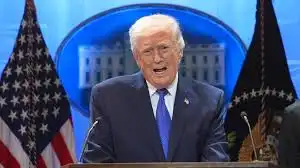
Global leaders, businesses pore over fallout of more US tariff swoons
Seoul, Feb 21 (AP):