
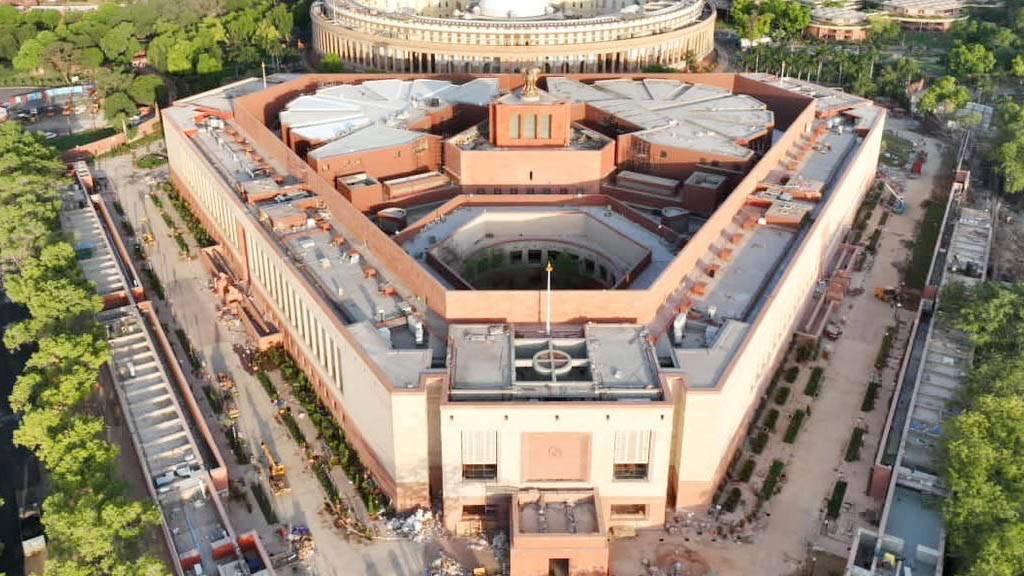
815 seats for states, 35 for UTs; rollout based on 2011 Census
The Union government will introduce bills on Thursday to increase the strength of the Lok Sabha to 850 from 543. Of these, 815 seats will be from the states and 35 from the Union Territories.
While 543 MPs are currently elected to the House, the Constitution formally caps the strength of the Lok Sabha at 550.
Although speculation about the amendment to the law had been rife in political circles for the past two weeks, copies of the draft legislation were shared with MPs for the first time on Tuesday. Parliament will reconvene for three days starting Thursday.
The process of fixing the boundaries of electoral constituencies is called delimitation. Article 82 of the Constitution states that after every census is completed, the allocation of Lok Sabha seats to each state must be adjusted based on changes in its population.
The current composition of the Lok Sabha is based on the 1971 Census. According to the 84th Amendment Act of 2001, constituency boundaries were frozen until the first census after 2026.
The census, which began on April 1, is expected to conclude in 2027.
The bill that will be introduced in Parliament proposes to amend Article 82 of the Constitution to remove the entire proviso. The proposed amendment aims to delink the quota’s implementation from the 2027 Census and instead base it on the 2011 Census, enabling its rollout before the 2029 general elections.
In its statement explaining the bill’s objectives, the government said that while freezing the seats on the basis of population in the 1971 census served an important policy purpose, “the country’s demographic profile has since undergone substantial changes” as reflected in the latest census.
It also cited “significant inter-state and intra-state population shifts, rapid urbanisation and migration, and disproportionate growth in certain regions, resulting in wide disparities in the population and the constituencies”.
The amendments will also operationalise the 33% quota for women in the Lok Sabha and state Assemblies under the 2023 Women’s Reservation Act “through delimitation exercise to be undertaken on the basis of the population figures of the latest published census”, the government said. The latest published census was in 2011.
It said that the next census and the delimitation exercise after that “will take considerable time and thus, delay the effective and dedicated participation of women in our democratic polity”.
On April 2, the Union government announced that the Budget Session of Parliament would be extended and that the Houses would reconvene on April 16 for three days. The government subsequently said that Parliament will consider amendments to the 2023 Women’s Reservation Act and hinted that delimitation could also be on the agenda.
The 2023 Act reserves 33% of the seats in the Lok Sabha and state Assemblies for women. However, the reservations will be effective only after a census is conducted, followed by a delimitation exercise.
Southern states, which have a slower population growth rate, have repeatedly expressed concern that population-based delimitation could give an undue advantage to northern and central states in the Lok Sabha, as the proportion of seats in the North would be higher.