
Correspondent
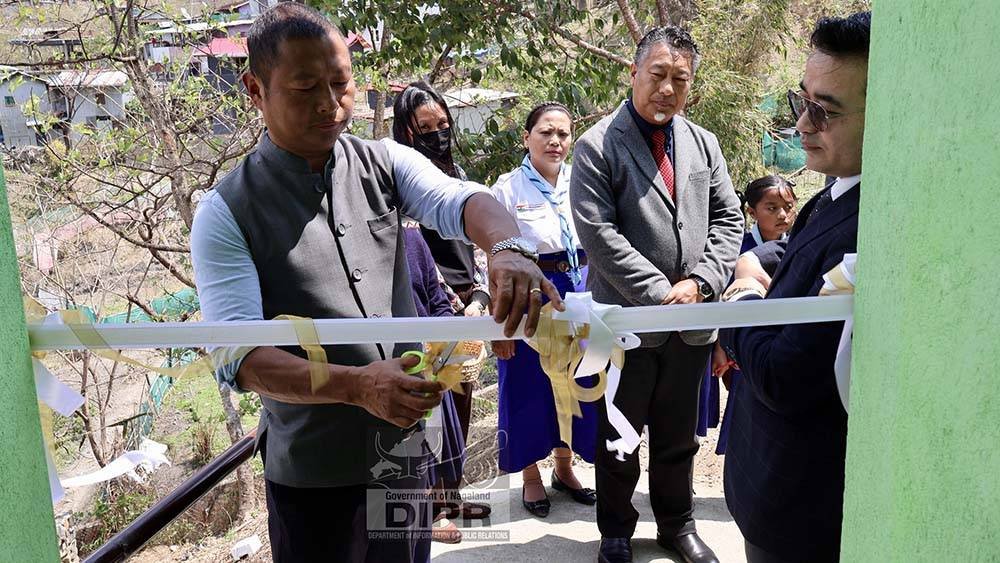
A major step towards strengthening government school infrastructure was marked with the inauguration of several new facilities at PM SHRI Government High School (GHS), New Market, Kohima, on Wednesday. The newly inaugurated facilities included an Atal Tinkering Lab, Science Lab, ICT/Computer Lab, Library Room, and Vocational Lab.
Advisor for School Education and SCERT, Kekhrielhoulie Yhome, delivered an extensive and candid address during the inauguration programme, stressing the importance of community participation, systemic reform, and rebuilding trust in government schools.
Speaking at the programme, Yhome highlighted the collective effort behind the establishment of the school infrastructure, stating that the 24,000-square-foot plot was purchased by the community at a cost of Rs 5.5 lakh. He said he has been encouraging the community to acquire more land if possible, adding that contributions may be needed from all stakeholders, including the state government. He also underscored the need for an approach road and urged the community to actively participate in its development.
Acknowledging the efforts of the school administration, Yhome saluted the leadership of the headmaster, along with 33 teachers and 3 MTS staff, who are currently managing the school and training around 301 students. He noted that the school has been appearing for matriculation examinations since it was upgraded to a high school in 2016. This year, around 24 to 26 students are expected to appear for matriculation, while Class 9 presently has around 60 students across sections.
Reflecting on enrolment trends, Yhome said the school had recorded a peak of 246 students in 2023, after which the numbers declined. However, this year saw 60 new admissions, including 19 students who shifted from private schools. He also cited a similar example from a recently inaugurated high school in Pesuchah, where 64 new admissions were recorded, including 34 students from private institutions. He expressed encouragement over such trends, particularly in urban community schools catering to working-class populations, noting that these schools contribute significantly despite limitations such as land constraints.
He stated that the education system is currently being re-evaluated, admitting that its design has been flawed. As part of the reform process, the government is redesigning the broader school ecosystem, covering both government and private institutions.
He pointed out that many private schools also lack adequate infrastructure and said that government schools, despite their shortcomings, are often comparable or even better in several respects.
In this regard, Yhome announced the establishment of the Nagaland School Standards Authority, which will introduce decisive measures to regulate and maintain standards across all schools. He explained that the redesigned system will be based on three pillars — infrastructure, governance, and curriculum and pedagogy.
He informed that teachers are now required to undergo a minimum of 50 hours of professional training, particularly in leadership development, under the newly established School Leadership Academy.
He said the training has been made mandatory and warned that those who fail to comply may face stagnation in their careers. He added that more reforms would be introduced in the coming years to restore public trust in government schools.
Concluding his address, Yhome also suggested using locally available indigenous methods to construct protective fencing, stressing that such solutions could be implemented at minimal cost through community initiative.
Guest of honour and MLA Tseilhoutuo Rhutso questioned whether government school teachers themselves enroll their children in government schools, calling for introspection and stronger commitment. He also proposed upgrading primary schools to higher secondary level to improve enrolment and accessibility.
Commissioner & secretary for School Education and SCERT, Kevileno Angami, commended the New Market community for its proactive support towards the school, especially in the procurement of land. She noted that community involvement remains a key factor in the success of educational institutions across the state.
Highlighting state-wide figures, Angami said that Nagaland has 1,881 government schools and 813 private schools, with only about 40% of students enrolled in government institutions.
She encouraged parents to recognise the advantages offered by government schools, including free uniforms, textbooks, and midday meals, and called for a shift in mindset towards valuing public education.
The programme concluded with a vote of thanks by Kenei Peseyie where he highlighted some history of the school. He informed that the School was established sometime in 1933 as an Upper Primary school.