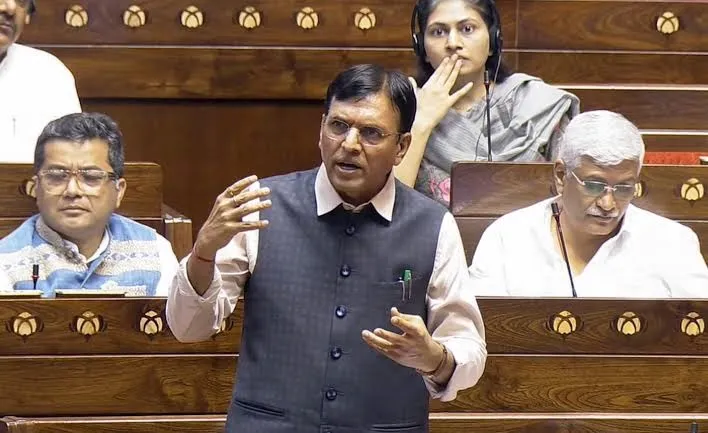
NEW DELHI, JUL 30 (PTI): Labour and Employment Minister Mansukh Mandaviya on Thursday asserted that the government will ensure social security for gig workers by implementing provisions in labour codes to protect their interests.
Replying to a supplementary query during the Question Hour in the Rajya Sabha, he said the gig worker system is a new and emerging system in India.
Mandaviya said there are 80 lakh gig workers in India as per a Niti Aayog report, and of them, around 10 lakh are registered on the ‘e-Shram portal’.
Under the Labour Codes, the minister said gig workers have been recognised and also provided legal status as part of the government’s efforts to protect their rights as employees. “Gig worker” means a person who performs work or participates in a work arrangement and earns from such activities outside of a traditional employer-employee relationship.
Mandaviya said the government has made provisions to provide social security to gig workers and protect their interests.
“I want to assure the House that social security of gig workers will be ensured through implementation of the provisions made in Labour Codes for safeguarding their interests,” the minister said.
Under the Modi government, around 101 crore people are covered under the various social security schemes.
In a written reply, Mandaviya noted that labour is a subject in the Concurrent List of the Constitution of India. Hence, both the central government and state governments are responsible for implementation and enforcement of labour laws within their respective jurisdictions.
The four Labour Codes, namely, the Code on Wages, 2019, the Industrial Relations Code, 2020, the Code on Social Security, 2020, and the Occupational Safety, Health and Working Conditions Code, 2020, came into force with effect from November 21, 2025.
The central government notified the corresponding Central Rules on May 8, 2026.
Mandaviya said the state governments are also in the process of notifying their respective rules under the Labour Codes within their respective jurisdictions.
“Under the Labour Codes, the Central Government and the State Governments take appropriate measures, within their respective jurisdictions, to safeguard the interests of workers and ensure compliance with the statutory provisions,” he added.
The Labour Codes contain several provisions to strengthen the protection available to workers.
These include the issuance of appointment letters; statutory safeguards relating to notice of termination, retrenchment compensation and preference in re-employment of retrenched workers; provisions for Fixed Term Employment; statutory recognition of Negotiating Unions and Negotiating Councils; provisions relating to statutory minimum wages and their timely payment; social security benefits; and measures relating to occupational safety, health, welfare and improved working conditions.
To a separate query, Mandaviya said the Code on Wages, 2019, empowers central and state governments to fix, review, revise and enforce the minimum rates of wages for establishments falling under their respective jurisdiction.
To take care of rising prices, he informed that the central government revises the Variable Dearness Allowance (VDA) on basic rates of minimum wages every six months, effective from April 1 and October 1 of every year, on the basis of the Consumer Price Index for Industrial Workers.
“The Code on Wages, 2019, which has been made effective from November 21, 2025, has made Floor Wage a statutory provision. The Code on Wages, 2019 stipulates that the minimum rates of wages fixed by the appropriate governments shall not be less than the floor wage,” Mandaviya said.