
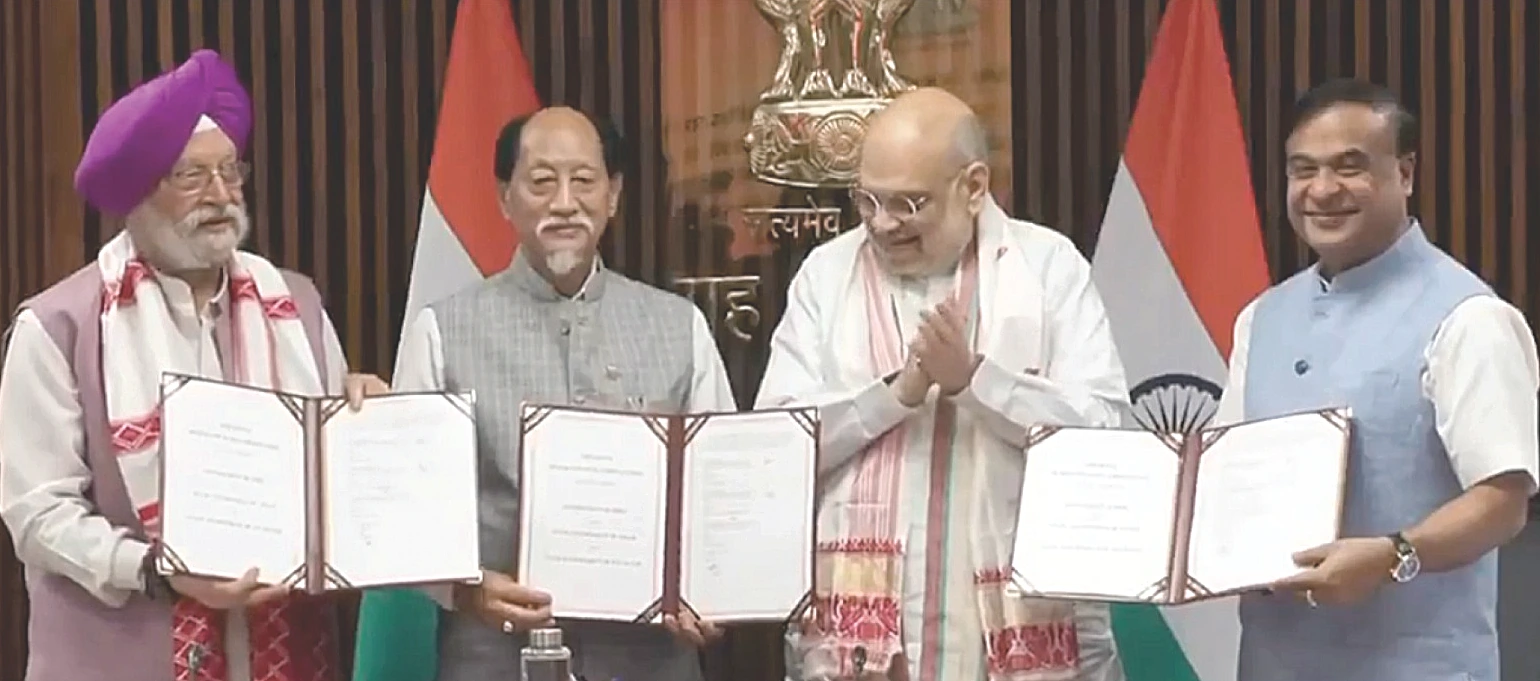
GoI, Assam, Nagaland sign MoU for oil, mineral exploration in border belt
DIMAPUR, JUN 11 (NPN): The Centre, Assam and Nagaland on Thursday signed a tripartite memorandum of understanding (MoU) to facilitate oil and mineral exploration in the disputed area belt (DAB) along the Assam-Nagaland border, ending a decades-long impasse that had stalled resource development in the region, reports PTI.
Describing the agreement as a “historic moment”, Union Home Minister Amit Shah said the MoU removed a major obstacle to Prime Minister Narendra Modi’s vision of a developed Northeast and would open new avenues for economic growth and mineral exploration. Exploration activities in the border belt had remained suspended for over three decades due to jurisdictional disputes and law-and-order concerns.
Shah said the region possessed not only oil and natural gas reserves but also significant mineral deposits that could not be tapped because of the long-standing dispute.
He claimed the agreement could substantially increase crude oil production, stating that extraction capacity of 1,000 to 1,500 barrels per day could rise nearly tenfold following implementation of the pact.
“In one field alone, there are possibilities of recovery worth more than Rs 15,000 crore,” Shah said, adding that the exploitation of oil reserves across Nagaland could contribute towards reducing India’s dependence on imported crude oil.
“The development of both Assam and Nagaland remained hampered for a long time because a consensus could not be reached for an MoU. The avenue that opened today will open doors for development for both states. It is the best example of cooperative federalism,” he said.
Highlighting broader developments in the Northeast, Shah said the region had witnessed significant improvements in peace and stability in recent years. He noted that 12 peace accords had been signed since 2019, contributing to an estimated 80% decline in violent incidents.
Shah also said the shrinking areas under Armed Forces (Special Powers) Act reflected the improving security situation in the region and expressed confidence that the law would be withdrawn from most Northeastern states by next year. “I am confident that barring one or two states, we will withdraw AFSPA from the entire Northeast next year,” he said.
Nagaland chief minister Dr. Neiphiu Rio described the signing of the tripartite memorandum of understanding as a historic day. Nagaland is considered a prolific hydrocarbon-bearing region with the Nagaland Schuppen Belt estimated to contain 555 million metric tonnes of oil equivalent (MMTOE) of oil and oil equivalent gas (O+OEG) prognosticated resources.
Of this, only 17.05 MMTOE falls under the established reserves category, accounting for just 3% of the state’s reserves compared to 65% in neighbouring Assam.
Oil and Natural Gas Corporation (ONGC) had started production in Wokha district during 1980-81, but operations were suspended from May 1994 following directives from the government. Based on a resource conversion rate of 13% from prognosticated to in-place category, around 72 MMTOE of O+OEG is estimated to come under the in-place category in Nagaland.
Sources said the Nagaland government is in the process of formulating a revised oil exploration framework in line with Central guidelines.