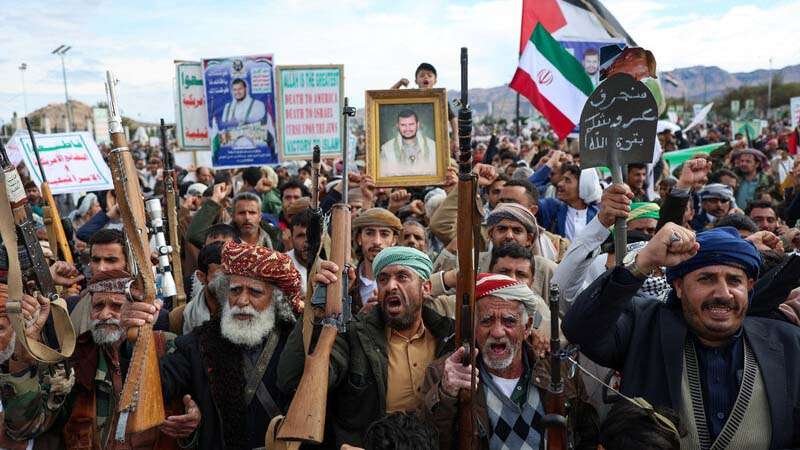
Iranian-backed Houthi rebels entered the month-old war in the Middle East on Saturday by claiming a missile launch that Israel said it intercepted. Pakistan said regional powers plan to meet Sunday on how to end the war, while Iran expressed skepticism about the diplomatic efforts.
The war has threatened global supplies of oil, natural gas and fertilizer and disrupted air travel. Iran’s grip on the strategic Strait of Hormuz has shaken markets and prices. The United States and Israel continue to strike Iran, whose retaliatory attacks have targeted Israel and neighboring Gulf Arab states.
The Houthis’ entry could further hurt global shipping if they again target vessels in the Bab el-Mandeb Strait off the Red Sea.
There could be limited relief in sight after Iran on Friday agreed to allow humanitarian aid and agricultural shipments through the Strait of Hormuz following a request from the United Nations.
Israeli airstrikes continued Saturday. Associated Press footage showed smoke rising from northeastern Tehran. Iran fired missiles toward Israel, and Israeli rescue service Magen David Adom said 11 people were lightly wounded in a town near Jerusalem.
Houthi involvement could further complicate the war
Houthi Brig. Gen. Yahya Saree said on the rebels’ Al-Masirah satellite television station that they launched a barrage of ballistic missiles toward what he described as “sensitive Israeli military sites” in southern Israel.
Sirens went off around Beer Sheba and near Israel’s main nuclear research center as Iran. The Lebanon-based Hezbollah militants also fired on Israel overnight.
If the Houthis increase attacks on commercial shipping, as they have in the past, it would further push up oil prices and destabilize “all of maritime security,” said Ahmed Nagi, a senior Yemen analyst at the International Crisis Group. “The impact would not be limited to the energy market.”
Countries have scrambled for alternative routes to the Strait of Hormuz. Bab el-Mandeb, at the southern tip of the Arabian Peninsula, is crucial for vessels heading to the Suez Canal through the Red Sea and Saudi Arabia has been sending millions of barrels of crude oil a day through it because the Strait of Hormuz is effectively closed.
Attempts at diplomacy as US sends more troops to the region
US President Donald Trump has given Iran until April 6 to reopen the Strait of Hormuz. Iran says it has not engaged in any negotiations.
Pakistan said Saturday that Saudi Arabia, Turkey and Egypt will send top diplomats to Islamabad for talks aimed at ending the war, arriving Sunday for a two-day visit for “in-depth discussions on a range of issues, including efforts to de-escalate tensions in the region.” Pakistan’s Prime Minister Shehbaz Sharif said he and Iranian President Masoud Pezeshkian held “extensive discussions” on regional hostilities and efforts to end the war.
But the Iranian foreign minister, Abbas Araghchi, told his Turkish counterpart by phone that Tehran was skeptical about recent diplomatic efforts. Iranian state-run media said Araghchi accused the United States of making “unreasonable demands” and exhibiting “contradictory actions.”
US troops suffer casualties at Saudi base, AP sources say
More than two dozen US troops have been wounded in Iranian attacks on Saudi Arabia’s Prince Sultan Air Base in the past week, according to two people who have been briefed on the matter and spoke on the condition of anonymity because they were not authorized to comment publicly.
Iran fired six ballistic missiles and 29 drones at the base Friday, injuring at least 15 troops, including five seriously, they said.
The base, about 96 kilometers (60 miles) from the Saudi capital of Riyadh, came under attack twice earlier in the week, including a strike that wounded 14
Death toll climbs
Iranian authorities say more than 1,900 people have been killed in the Islamic Republic, while 19 have been reported dead in Israel.