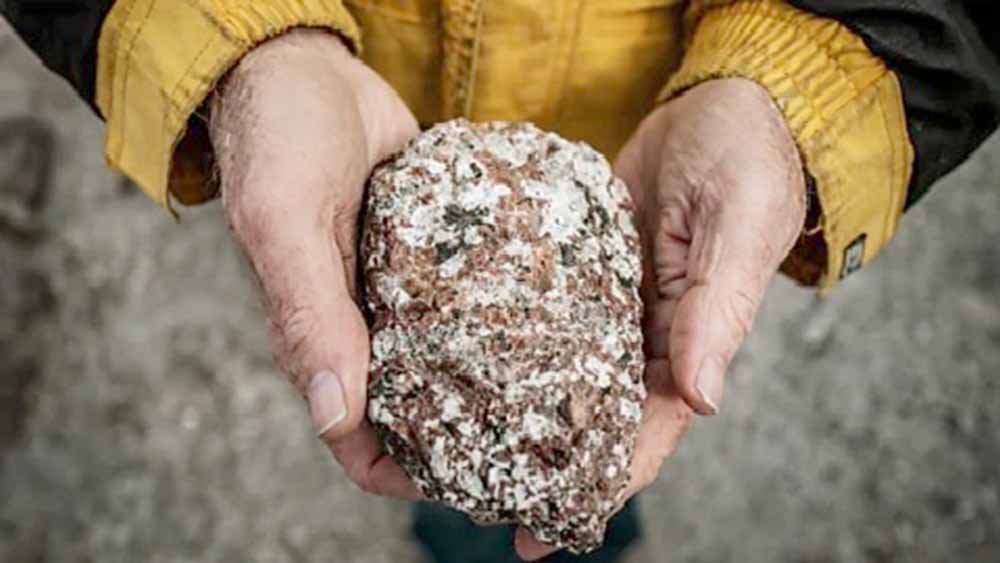
As nations posture over access to rare earth deposits, scientists say these coveted materials are hiding in plain sight – and can be harvested without any conventional mining at all.
In a lab in Austria, two scientists are watching a fungus grow. Developing fungi form sprawling microscopic networks called mycelia, inserting themselves into nooks and crannies all around. Searching, spreading, feeding. It’s through the mycelium’s millions of tiny, root-like strands that the fungus draws up nutrients. But some fungi soak up other things, too. Things that humans want.
The lab fungus, at the University of Vienna, is growing in a petri dish and some clear plastic bags, across a special clay that has been purposely laced with rare earth elements. These sought-after elements are used in batteries, magnets, renewable energy devices and other tech. The scientists want to see whether the fungus can extract the rare earths for them. “You might be able, actually, to recover resources,” says Alexander Bismarck, head of the polymer and composite engineering group at the institution.
Rare earths are a group of 17 metallic elements, all chemically very similar to one another. They include dysprosium, yttrium and scandium, to name a few. Despite the name “rare earths”, they’re not actually very rare but scattered almost everywhere around the Earth. It’s just that these elements tend to be in fairly low concentrations in most places, which makes extracting a high volume of them difficult.
Given the usefulness of rare earths, interest in them is growing. US President Donald Trump, for one, says the US will spend $12bn (£8.8bn) on creating a “strategic reserve” of rare earths, and lately he has bullishly sought access to rare earth deposits in Ukraine and Greenland. Currently, China dominates the rare earths industry, with roughly 70% of rare earths mining and 90% of processing occurring within the country.
Researchers around the world are working on new ways of obtaining these elements – from harnessing the power of fungi, to developing techniques for separating rare earths out from gigantic piles of industrial waste. All developed economies require rare earths to some extent and it might actually be possible for many countries, including the US, to harvest more of the rare earths they need at home, reducing or perhaps even eliminating the need to tussle for these elements internationally.
It takes several weeks for the fungus in the University of Vienna lab to grow, says Bismarck. He and his colleague Mitchell Jones, a materials scientist, envisage using fungi on a much larger scale one day, for example to recover rare earths from land that has been contaminated by industry. “We really could do this over large areas and quite easily collect that biomass using existing agricultural machinery,” says Jones, though he admits that’s a long way off. “This is all a little bit speculative.”
Fundamentally, though, it is an attempt to repurpose fungi. While fungi play important roles in ecosystems, they can also cause illnesses or other problems – including contamination of containers and samples in labs. Getting a fungus to work for you might be a good idea, though, because these organisms are tough and can survive in the dark. They also grow much faster than most plants, which could make them a particularly good choice for cleaning up industrial sites. It’s a process called bioremediation but, in this case, it would also involve recovery of useful minerals. Bismarck and Jones call it “mycomining”. They published a paper in 2024 describing the concept.
Once harvested, the fungi could be processed to produce biogas, and burned as a fuel, with the rare earths later separated from the ash produced. Bismarck and Jones stress that this way of recovering rare earths might only ever be “supplemental”. For example, the concentration of cerium in dissolved e-waste (old computers and other tech) could be nearly 5,500 parts per billion – but in fungi, the concentration of cerium might only reach roughly 350 parts per billion. Plus, there could be environmental risks associated with growing fungi on a large scale. “Are you actually altering the natural biome there, and is that OK or not?” says Jones. He and Bismarck are not the only ones working with fungi, though. Oona Snoeyenbos-West at the University of Arizona says she plans to launch a start-up company that will explore using fungi for bioremediation and bio-recovery of critical minerals, especially rare earths and copper. She says the fungi could be sourced from industrial and contaminated sites because such fungi might already be genetically adapted to soak up relatively high concentrations of rare earths. (BBC)