Cats and dogs can be allergic to pollen, but getting a diagnosis is a lengthy process.
You’ve been sneezing all week and your eyes are streaming. It’s allergy season. But you’re not the only one who’s suffering. Your pet has been unusually itchy lately – scratching all night, keeping you awake, eyes teary and gummed up. They seem as miserable as you are. Could your cat or dog also be struggling with the pollen?
Our four legged friends are not exempt from suffering with hay fever – or seasonal allergies as it is known in North America. But it is only one possibility among myriad allergies, including some you might not expect. The path to finding out what’s really plaguing our pets can be complicated. But it is getting easier.
What are the signs my pet might have an allergy?
Allergies happen when our immune system decides to suddenly attack a substance we’re exposed to in our environment, whether that’s pollen newly saturating the air or a fragrance we’ve been using for years.
We humans may be tipped off to our allergies by sneezing and sniffling, but these symptoms are less common in cats and dogs. Increased eye discharge and a runny nose can be present in pets, along with asthma in cats, and ear infections or head shaking in dogs. Their allergies mostly manifest on the skin as atopic dermatitis.
The persistent itching leads animals to obsessively lick, chew or bite their feet or other spots on their body. These can form “hot spots”, reddened areas on the body that can turn into “terrible lesions in a matter of hours”, says Brian Collins, a veterinarian at the Cornell University College of Veterinary Medicine in New York. You want to prevent this from progressing, because bacteria or yeast will take advantage of a chronic hot spot to create a painful infection.
Is it definitely an allergy?
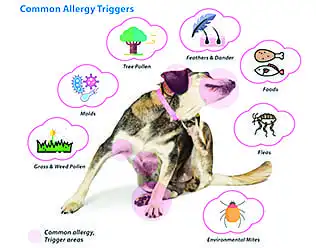
Anything humans can be allergic to, pets can develop allergies to as well: pollen, grass, pests, food, dust mites, a perfume.
You might be tempted to try commercially available allergy tests for pets, often advertised on social media, that are said to identify the culprit. Jacqueline Boyd, a senior lecturer in animal science at Nottingham Trent University, warns that they don’t work, however. (In one test, they showed the same results when given swabs from the fur of a plush toy.) And under no circumstances should you administer antihistamines from your own medicine cabinet. That’s because a lot of things that look like an allergy aren’t. “A lot of the work is ruling out the obvious things,” she says.
“The first thing we always look for is skin infection,” says Collins. If the treatment gets rid of the itch, that answers the question.
The next step is to check for mites or fleas, whose bites may be aggravating for several reasons. You may protest that your dog has been treated for fleas, but fleas can be crafty, lurking on other pets (particularly cats) or in your house.
“It’s more common than you think,” says Boyd. While these may not be able to infest dogs, they’re happy to hitch a ride on your hound for a quick bite before decamping back to their usual host, and some dogs can become sensitised to flea saliva. Complicating matters, some flea species are also seasonal, which may cause you to mistake the cause for pollen.
In rare cases, itchy skin, particularly in older cats or dogs, may hint at more serious causes including cancer or metabolic disease.
If you and your vet have eliminated these possibilities, and the animal is still itching, the real detective work gets underway. (BBC)