
Staff Reporter
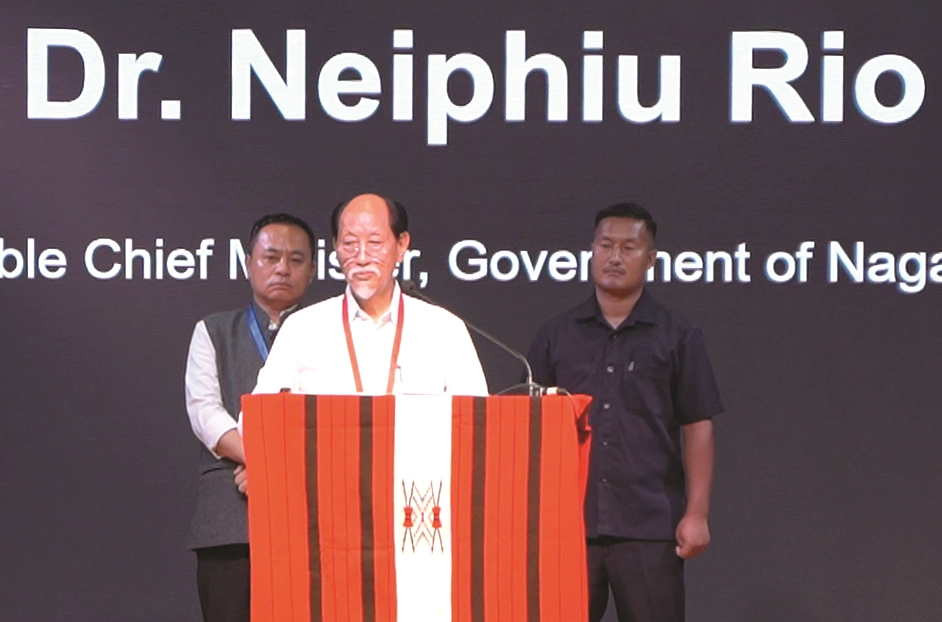
DIMAPUR, AUG 29 (NPN): Nagaland chief minister Neiphiu Rio has called for a balanced and humane implementation of the Inner Line Permit (ILP) system, asserting that the Bengal Eastern Frontier Regulation (BEFR), 1873 should safeguard Naga identity, land, culture and indigenous rights while allowing legitimate economic activities, investment and development in the State.
Addressing the concluding day of the national seminar on the Bengal Eastern Frontier Regulation (BEFR), 1873, organised by the Inner Line Regulation Commission-Naga Students’ Federation (ILRC-NSF) in Dimapur, Rio said the law remained relevant to Nagaland but stressed that it must be properly regulated and not misused or abused.
“I feel that BEFR is still required in Nagaland. But we have to properly regulate it,” Rio said while addressing the culmination programme of the two-day national seminar on the BEFR, 1873 organised by the Naga Students’ Federation (NSF) and coordinated by the Inner Line Regulation Commission (ILRC-NSF) at Town Hall, Dimapur, on Saturday.
He appreciated the NSF for organising the seminar and senior advocates, professors and other participants for sharing their knowledge and perspectives on the historical, constitutional and contemporary dimensions of the BEFR and ILP.
Historical basis of BEFR: Recalling the historical context, Rio said British expeditions into the Naga Hills began in 1832, with around 10 military expeditions undertaken to secure routes and tea plantations in the foothills. He said the Nagas resisted British incursions for several decades.
He referred to the first recorded British contact with Naga tribes in 1832, led by Captain Francis Jenkins and Lieutenant Robert Pemberton, and recalled the battles at Pangti and Kikruma, besides the Khonoma war of 1879-80 and the subsequent establishment of British administrative structures in the Naga Hills.
Rio said the BEFR, 1873 subsequently provided a mechanism to regulate entry and protect indigenous communities from external economic and demographic pressures.
He said protection of minorities was particularly important in a democracy, noting that tribal communities required safeguards because they constituted a minority within the larger Indian population. Referring to provisions concerning land and immovable property, Rio said the BEFR restricted outsiders from purchasing immovable property and contained provisions relating to traditional artefacts and antiques.
However, he cautioned that such provisions should be applied judiciously and not in a manner that could ultimately harm the State.
1963 cut-off and Dimapur: Referring to the 16-Point Agreement, Rio said continuation of the BEFR, 1873 in Nagaland was specifically sought by the State’s founding leaders. He linked this with constitutional safeguards under Article 371A concerning customary laws, land and its resources, and religious and social practices.
On the ILP system, Rio said Nagaland’s situation was more complicated than that of Mizoram due to its diverse tribal composition and historical settlement patterns. He said the State had to protect indigenous interests while ensuring that Indian citizens who had legally settled in Nagaland were not harassed.
Rio said the government had adopted 1963 as a cut-off year in relation to indigenous status, while Dimapur required separate consideration as it was declared a tribal belt only in 1979. He pointed out that Dimapur had been a railway head since 1903 and had consequently attracted people from different communities over the decades. The situation therefore needed to be handled carefully, particularly because indigenous certificates had been issued to non-Nagas in the past.
ILP extension upheld by High Court: Rio also referred to the extension of ILP to Dimapur, Chümoukedima and Niuland in 2024. According to Rio, the decision was challenged before the Gauhati High Court, which on June 16, 2026 upheld the State government’s decision to extend the ILP to the three districts.
He described the verdict as a significant development for Nagas and said the judgment also highlighted the constitutional significance of Article 371A.
Rio stressed that ILP should not be viewed as a tool for isolating Nagaland from the rest of the country.
Referring to the views expressed by Senior Advocate Prashant Bhushan during the seminar, he said Nagaland needed to remain open to economic cooperation while ensuring transparency and protection of indigenous interests.
He expressed concern over benami businesses operating using Naga names, saying such practices could lead to tax evasion and undermine the State’s economy.
Rio said outside investors were welcome in Nagaland but businesses should operate transparently and within the law.
Need to utilise natural resources: The chief minister also urged stakeholders to reconsider the State’s approach to its natural resources, particularly petroleum, natural gas and minerals.
He said Nagaland had substantial natural resources but remained unable to fully exploit them due to unresolved issues.
Rio said Nagaland needed to “open our mind” and work together rather than remain isolated. He also advocated dialogue among all stakeholders, saying his government had followed a policy of “equi-closeness” by engaging with different groups rather than maintaining distance from them.
Development, connectivity must accompany protection: Turning to development and connectivity, Rio said economic growth should receive as much attention as political issues.
Referring to the proposed foothill road, he said improved connectivity was essential for the State’s economic development.
He appealed to tribal organisations and landowners to cooperate with development projects, stressing that improved roads would increase the economic value of land and create opportunities for local communities.
Rio said the seminar should result in practical and forward-looking recommendations, with the ultimate objective of developing an ILP policy that protects identity, land, culture and indigenous rights while promoting legitimate economic activities, development and opportunities.
“The inner line should remain not merely as a regulatory mechanism, but an effective instrument for protecting identity while enabling Nagaland to move forward, progress and prosperity,” he said.
Earlier, Prof. Lallianchhunga of the Department of Political Science, Mizoram University, spoke on “Enforcement of the BEFR, 1873 in Mizoram: A Success Story”.
Prof. Shomona Khanna spoke on “The BEFR, 1873: Protection and Safeguarding the Rights of the Hill Tribes”.
Prof. Shantanu Chakravarty, Dean, School of Humanities & Social Sciences, Girijananda Chowdhury University and former Head of Department of Political Science, Cotton University, Assam, spoke on “The BEFR, 1873: A Mainland Indian Perspective vis-à-vis the Constitutional Safeguards of Indigenous Peoples, with Special Reference to Nagaland”.
The seminar also featured discussion sessions during which queries raised by participants were addressed.