
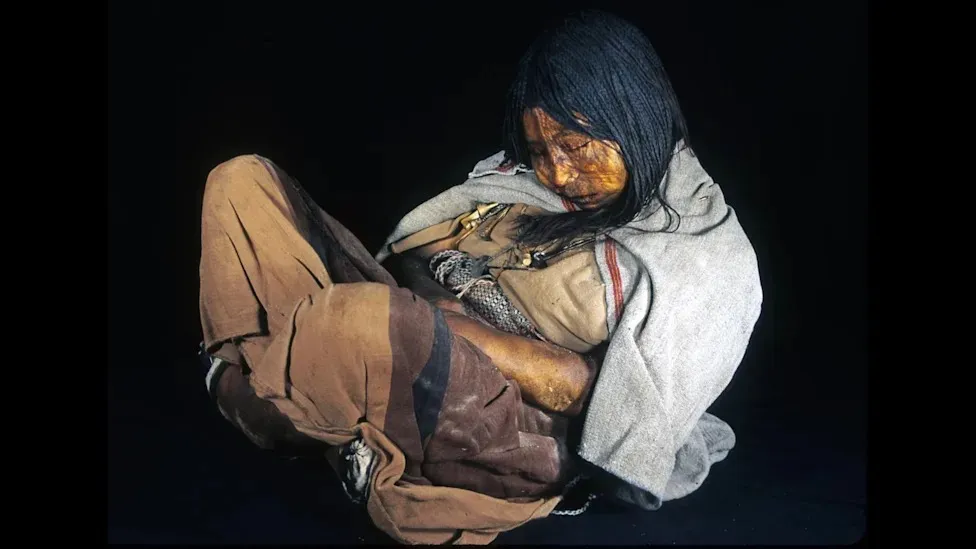
They could almost have closed their eyes and slipped beyond the boundary between life and death yesterday; so perfect is their preservation.
Yet the children whose bodies were uncovered on frozen mountaintops in Argentina and Peru died hundreds of years ago – and no natural death, either.
They were sacrificed by their people, the Inca, to serve as messengers for the gods in a ritual known as capacocha, their small bodies laid to rest with honor and care.
And the time leading up to their deaths may have been tended with just as much care. According to a new analysis of their bodies, eight children sacrificed as part of capacocha rites were plied with a variety of drugs in the months to weeks before they died – possibly to ease the ordeal that lay ahead.
“The children were considered sacred messengers who would continue to play an important role after death,” archaeologist Dagmara Socha of the University of Warsaw told ScienceAlert.
“Their preparation may therefore have been intended to help them endure the journey and reach their final destination in the best possible condition.
Capacocha was among the most important religious ceremonies of the Inca Empire, performed to mark significant events such as the death or accession of a ruler, major festivals or celebrations, or to appease the gods in times of natural disaster.
Children were selected for sacrifice based upon qualities such as exceptional beauty and physical purity, from across the four corners of the Inca Empire.
They were often taken to the imperial capital of Cusco, where they participated in elaborate ceremonies before being sent to sacred sites throughout the empire. These processions could take months, traversing vast distances and difficult terrain before reaching their destinations.
Some of the most sacred sites were high in the Andean mountains, where the children were buried with fine textiles, pottery, and precious figurines as offerings to the gods.
It’s long been known that these children were given drugs before they died, with traces of substances such as cocaine and alcohol found on multiple mummies.
“Our main question was which psychoactive substances were given to children during the capacocha ritual and what purpose they served,” Socha explained.
“We wanted to understand whether they were used for medicinal reasons, to improve the children’s wellbeing, or as part of religious practices involving altered states of consciousness.”
The answers, if there were any to be found, were most likely to be locked away in the bodies of the sacrificed children, mummified in the cold, low-oxygen environment in the Andean peaks
The researchers collected hair and nail samples from eight such mummies, dating to around 500 years ago. Keratin-rich tissues preserve chemical traces of substances consumed during life. As they grow, these traces become locked inside, allowing researchers to reconstruct aspects of a person’s drug use in the weeks or months before death.
The researchers tested the samples for a range of psychoactive compounds, including stimulants, hallucinogens, and substances associated with medicinal plants. (Yahoo News)
Coca use was widespread – which is perhaps not a huge surprise. The researchers detected cocaine and its metabolite benzoylecgonine in all six hair samples, consistent with the consumption of coca leaves – a practice deeply embedded in Andean culture.
Chewing coca leaves can help suppress hunger and fatigue, and may have helped the children endure the physical demands of their journeys through the mountains.
The researchers also detected cocaethylene in samples from some of the children. This compound is produced by the liver when cocaine and alcohol are present in the body at the same time – suggesting that these children had consumed both.