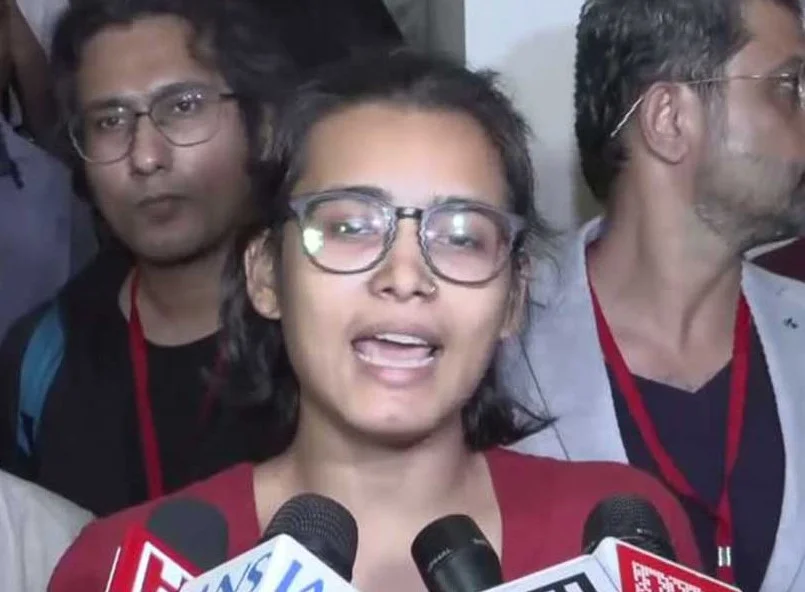
MUMBAI, AUG 25 (PTI): All India Students’ Association (AISA) president Neha Bora on Tuesday said education is a key common factor behind the progress of societies and countries, and keeping a major section of the population out of the learning system only ensures they lag behind.
During an interaction at the Mumbai Press Club organised by the Network of Women in Media, India, (NWMi), she noted that several studies comparing societies and countries on parameters such as mortality as well as infant mortality rates, literacy, happiness and press freedom have found education to be a common factor influencing progress. “One common factor is education. If you are trying to hold on to disparities and trying to keep a major section of your society out of education, you are also ensuring that you keep staying behind,” insisted Bora.
The AISA chief, who was on a hunger strike for 23 days along with climate activist Sonam Wangchuk in Delhi over the NEET paper leaks in July, claimed that barring Left parties, other political outfits do not give priority to education. The JNU PhD scholar, whose Left-wing student outfit is affiliated with the CPI (Marxist-Leninist) Liberation, questioned the tendency to ask why the country is lagging while simultaneously denying a large section of society access to education.
Bora, who also took part in the protest against the alleged recruitment exam irregularities in Jharkhand, emphasised that inclusive access to education is essential for reducing disparities and ensuring broader social development.
Education is for people’s good and the government has a responsibility to ensure quality education for all, she said.
“The dream was to build a country based on equality. Democracy is, at its heart, about equality. We must honour our ancestors who fought for this ideal and carry their vision forward. Equality is a beautiful thing, and it is the foundation of a just society,” Bora said.
“The problems we see today have been building up for years as education has steadily given way to privatisation. What is needed is a comprehensive overhaul of the system based on practical solutions,” the AISA president argued.
Speaking on the occasion, model Riya Ahir, who gained nationwide fame after blocking a Mumbai police van to stop the detention of student protesters last month, said politics had always been a part of her life and that she had been vocal about social and political issues.
About her participation in student protests, she emphasised standing up for pupils did not feel like an act of courage or bravery to her.
“It is something that comes very naturally to me,” she said.
Recalling the protests in Mumbai, held in solidarity with the CJP-led stir in Delhi, Ahir said she had initially sent emails to the UN, the National Human Rights Commission, the Supreme Court and the Bombay High Court after witnessing what had happened to students.
However, the model-activist stressed she was not satisfied with simply sending emails and subsequently joined the protests independently.
Ahir insisted criticism of the government is a democratic right of citizens and does not mean people do not love their country.
“Our parents criticise us because they want us to do better. They criticise us because they love us. In the same way, questioning and criticising the government does not mean we do not love our country. It is our democratic right and comes from our concern for the country’s future,” she opined.
Both Bora and Ahir said their Army background have taught them importance of community living.
To a question on whether she supports “azaadi” slogans in Kashmir, Bora replied, “I support aspirations of Kashmiris. The BJP says Kashmiris are happy under its regime.”
The AISA president praised Congress MP Rahul Gandhi for supporting the aspirations of youth.