
On the eve of the 77th Republic Day, President Droupadi Murmu emphasized India’s role as a messenger of peace amid escalating global conflicts, calling it essential for securing the future of humanity.
Addressing the nation, she highlighted India’s ancient civilisational commitment to universal harmony. “In our tradition, we have been offering prayers for peace to prevail in the entire universe. The future of humanity can remain secure only if there is peace in the whole world,” she said. She added that India continues to spread the message of peace despite conflicts worldwide.
National security and Operation Sindoor: The President underscored India’s firm commitment to national security, citing Operation Sindoor, a precision strike that dismantled terror infrastructure across the border. “Last year, our country launched precision strikes against terror infrastructure… terror centres were destroyed, and many terrorists met their end,” she said, linking the success to India’s self-reliance in defence.
Reflecting on the strength of the Armed Forces, she recounted visits to Siachen Base Camp, sorties in Sukhoi and Rafale aircraft, and the submarine INS Vaghsheer, noting that the public has complete trust in India’s military preparedness, which enables the country to advocate for peace from a position of strength.
Nari Shakti: President Murmu hailed the rise of “nari shakti” (women power) as central to India’s journey toward becoming a developed nation by 2047. She emphasized that the active participation of women is vital for national development, noting that women across rural self-help groups, defence, space, and entrepreneurship are increasingly shaping modern India.
Over 10 crore women associated with self-help groups are redefining the grassroots economy. Women now comprise nearly 46% of Panchayati Raj representatives, and the Nari Shakti Vandan Adhiniyam is expected to take political empowerment to unprecedented heights.
The past year was described as a “golden chapter” for Indian women globally, citing victories in the ICC Women’s Cricket World Cup and Blind Women’s T20 World Cup. She also credited the Beti Bachao, Beti Padhao campaign for promoting girls’ education and highlighted women’s growing participation in the Armed Forces, space research, and entrepreneurship, emphasizing that no field remains stereotypically male.
“With increasing contribution by women, our country will set an example of an inclusive Republic based on gender equality,” the President said, linking women empowerment directly to the vision of a Viksit Bharat.
Poverty alleviation and inclusive growth: President Murmu highlighted India’s progress in poverty reduction, noting that millions who struggled for decades have been lifted above the poverty line. She emphasized the government’s focus on preventing citizens from falling back into poverty, stating that nearly 81 crore beneficiaries currently receive support through central schemes.
She stressed that a Viksit Bharat must be inclusive, with special attention to tribal and marginalized communities. “Such efforts for the welfare of the poor give concrete shape to Mahatma Gandhi’s ideal of Sarvodaya [progress for all],” she said.
Citizen-based governance: President Murmu announced that the Constitution of India is now available in all 22 Eighth Schedule languages, aiming to foster constitutional nationalism and facilitate citizen engagement. She highlighted a broader shift toward good governance, with technology and legislative reforms narrowing the gap between the government and citizens, removing bureaucratic hurdles, repealing unnecessary rules, and simplifying compliance.
Public participation has transformed government campaigns into mass movements, with India now a global leader in the digital economy, accounting for over half of the world’s digital transactions. The President called for local institutions to act as instruments of progressive change, emphasizing that building a Viksit Bharat is a shared responsibility.
Cultural decolonisation and traditional knowledge: Murmu stressed the importance of cultural self-reliance, noting government efforts to remove vestiges of colonial mindset and reaffirm India’s glorious traditions. She highlighted the promotion of Indian languages and indigenous knowledge systems, providing a distinct cultural foundation for India’s pursuit of total self-reliance.
Economic growth and GST: The President hailed India as the world’s fastest-growing major economy, attributing growth to structural reforms and self-reliance. “Despite global economic uncertainty, India is on track to become the world’s third-largest economy,” she said.
She described the Goods and Services Tax (GST) as the most significant step toward economic integration since Independence. Murmu emphasized that India’s journey toward the third-largest economy is guided by atmanirbharta and swadeshi, with focus on world-class infrastructure, labour reforms, and enterprise development.
150 years of Vande Mataram: President Murmu also highlighted celebrations marking 150 years of ‘Vande Mataram’, emphasizing how the song transcended linguistic barriers to unite the masses during the freedom struggle. Translations into various Indian languages have reinforced it as a universal symbol of oneness. She noted, “From north to south and from east to west, the fabric of our ancient cultural unity was woven by our ancestors. Every effort to promote this spirit of oneness through ‘Vande Mataram’ is highly commendable.”
In conclusion, President Murmu’s address intertwined peace, national security, women empowerment, inclusive development, citizen-centric governance, cultural pride, and economic growth, emphasizing India’s vision for a resilient, self-reliant, and united Viksit Bharat.
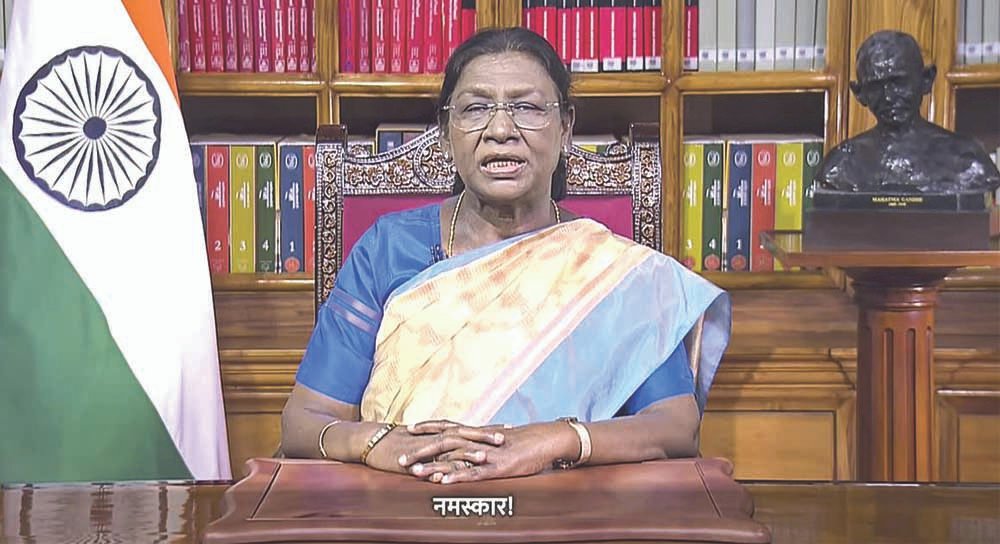
India a messenger of peace in conflict-ridden world: Murmu
NEW DELHI, JAN 25 (PTI)