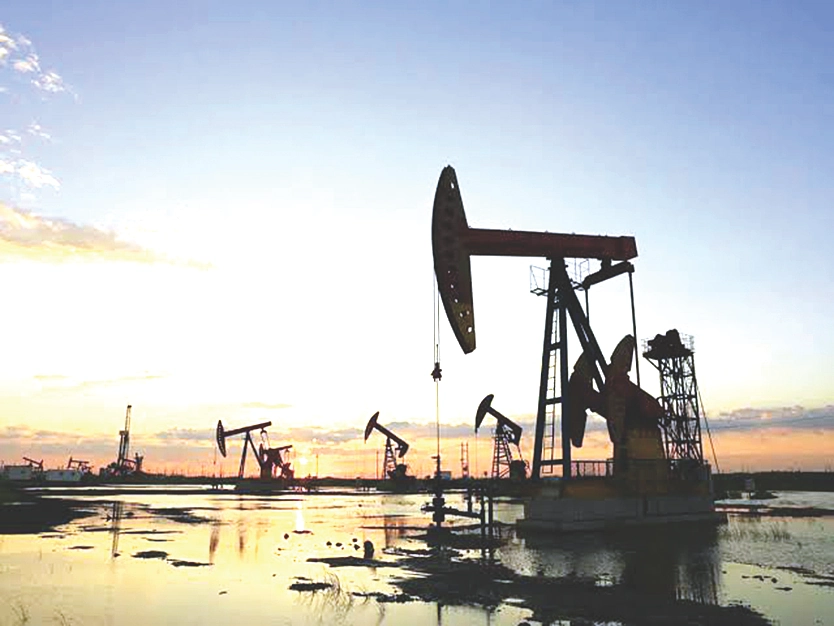
NEW DELHI, JUL 5 (AFP/AGENCIES): Hit by the biggest energy supply shock in decades during the Middle East war, import-dependent India is expanding domestic crude exploration, its oil minister says.
It may be recalled that the Centre, Assam and Nagaland on June 11, 2026 signed a tripartite memorandum of understanding (MoU) to facilitate oil and mineral exploration in the disputed area belt (DAB) along the Assam-Nagaland border.
Exploration activities in the border belt had remained suspended for over three decades due to jurisdictional disputes and law-and-order concerns.
Union home minister Amit Shah said the region possessed not only oil and natural gas reserves but also significant mineral deposits that could not be tapped because of the long-standing dispute.
He claimed the agreement could substantially increase crude oil production, stating that extraction capacity of 1,000 to 1,500 barrels per day could rise nearly tenfold following implementation of the pact.
India, the world’s third-largest importer of oil and the second-largest buyer of liquefied petroleum gas, faced major disruptions due to restrictions on the Strait of Hormuz during the conflict between the United States and Iran.
With a temporary US-Iran deal in place to pause hostilities, oil and gas shipments are flowing through the Gulf waterway again, and restrictions and price hikes in India are being rolled back.
But Minister of Petroleum and Natural Gas Hardeep Singh Puri said the energy crunch provided fresh impetus for India’s expansion of domestic supplies. India is a modest producer in global terms.
Domestic crude production in 2025-2026 was 25.98 million metric tonnes, according to the oil ministry.
That meets just 10 percent of India’s crude needs, equivalent to roughly 522,000 barrels per day (bpd) — a figure well below its production peak of just more than 900,000 bpd in 2011.
India survived the energy crunch by expanding its crude suppliers from 27 to 41 countries, including Iran, Venezuela, greater purchases from Russia and several African nations.
New Delhi has previously been criticised by both the United States and Europe for its purchase of Russian oil, with critics arguing that it bankrolled Moscow’s war against Kyiv.
But Puri said India had a “pragmatic approach” that put its energy needs above “ideological considerations”.
The country’s domestic crude production is concentrated in the west — in its Mumbai offshore fields, Rajasthan and Gujarat — as well as the North Eastern state of Assam.
But Puri has hailed what he calls an “ocean of energy opportunities” off India’s Andaman and Nicobar archipelago, an 800-kilometre-long (500-mile) chain of environmentally sensitive islands in the seas bordering Thailand and Indonesia. The vast Andaman Basin is geologically similar to hydrocarbon-bearing basins in Southeast Asia.
Puri posted a video on social media in June of a gas flare at an exploratory well drilled in the Andaman Sea by stateowned OilIndia.
“Large number of deepwater and ultra-deepwater exploration wells are planned in our offshore basins to fully exploit our hydrocarbon reserves,” Puri said when he released the video.
New Delhi is working with “deepwater exploration experts” including Petrobras, TotalEnergies, BP, Shell and ExxonMobil, he said.
In the same Andaman Sea, India is readying a $9 billion Great Nicobar Island Project to build a megaport, airport and city, creating a strategic base on what is, for now, a far-flung island covered in pristine forests and home to one of Earth’s most isolated peoples.
Prime Minister Narendra Modi launched the “Samudra Manthan” mission during a speech marking Independence Day in August 2025.
The name refers to a central event in Hindu mythology meaning the “churning of the ocean”.
“We want to work in a mission mode towards finding oil reserves, gas reserves under the sea and hence India is going to start the National Deep Water Exploration Mission,” Modi said at the time.
But India’s bid to reduce dependence faces challenges.
Domestic demand in the world’s most populous nation of 1.4 billion people is growing rapidly — even as the government vows to achieve carbon neutrality by 2070.
India is also ramping up investments in renewables, nuclear energy and blending petrol with ethanol.