
India ushered in its 77th Republic Day on Monday with a grand display of its cultural heritage, economic growth and military might that included warplanes, indigenously-built missiles, newly-raised units and lethal weapons used during Operation Sindoor.
President of the European Council Antonio Costa and President of the European Commission Ursula von der Leyen graced the celebrations as chief guests, marking a significant diplomatic moment alongside the military display.
The annual military parade reflected India’s strategic autonomy and diverse sourcing of its defence hardware with Russian-origin platforms showcased alongside US-manufactured ones.
Although the overarching theme of the event was 150 years of ‘Vande Mataram’, the Indian military’s Operation Sindoor too found prominence at the parade on the Kartavya Path, the centrepiece boulevard of the national capital.
The parade commenced with the President Droupadi Murmu taking the salute shortly after she, Costa and von der Leyen, flanked by the Indian president’s bodyguards, arrived at the Kartavya Path in a traditional buggy.
Prime Minister Narendra Modi, Defence Minister Rajnath Singh, several other Union ministers, the country’s top military brass, foreign diplomats and senior officials were among the spectators.
The major weapon systems displayed at the parade included BrahMos supersonic missiles and Akash weapon systems, ‘Suryastra’ universal rocket launcher system, Main Battle Tank Arjun, Dhanush artillery guns and Divyastra battery.
Before the commencement of the parade, President Murmu conferred India’s highest peacetime gallantry award, Ashoka Chakra, to Group Captain Shubhanshu Shukla, who created history by becoming the first Indian to set foot on the International Space Station (ISS) in June last year.
Around 100 artistes heralded the parade on the theme ‘Vividata Mein Ekta (Unity in Diversity)’ that featured a grand presentation of musical instruments, demonstrating the nation’s unity and rich cultural diversity.
The parade was led by Parade Commander Lt General Bhavnish Kumar, General Officer Commanding, Delhi Area, a second-generation officer.
A tri-services tableau showcasing replicas of major weapon systems deployed by the Indian military during Operation Sindoor in early May was a major attraction.
For the first time, the parade showcased a phased ‘Battle Array Format’ of the Indian Army, including its aerial component. The recce element consisted of the 61 Cavalry in active combat uniform. It was followed by a high mobility reconnaissance vehicle. Providing aerial support was the indigenous Dhruv Advanced Light Helicopter and its armed version, Rudra, in Prahar formation, demonstrating battlefield shaping.
A military contingent from the EU, carrying the military staff flag and flags of Operations Atalanta and Aspides, the naval operations of the grouping, also featured at the parade. It was the EU’s first participation in such an event outside of Europe.
A total of 30 tableaux — 17 of states and Union Territories and 13 of various ministries and departments — rolled down the Kartavya Path. The tableaux showcased a unique mix of 150 years of the national song Vande Mataram and the nation’s rapid progress.
Approximately 10,000 special guests from different walks of life were invited to witness the parade. This year, the enclosures for the parade were named after the rivers flowing across the nation.
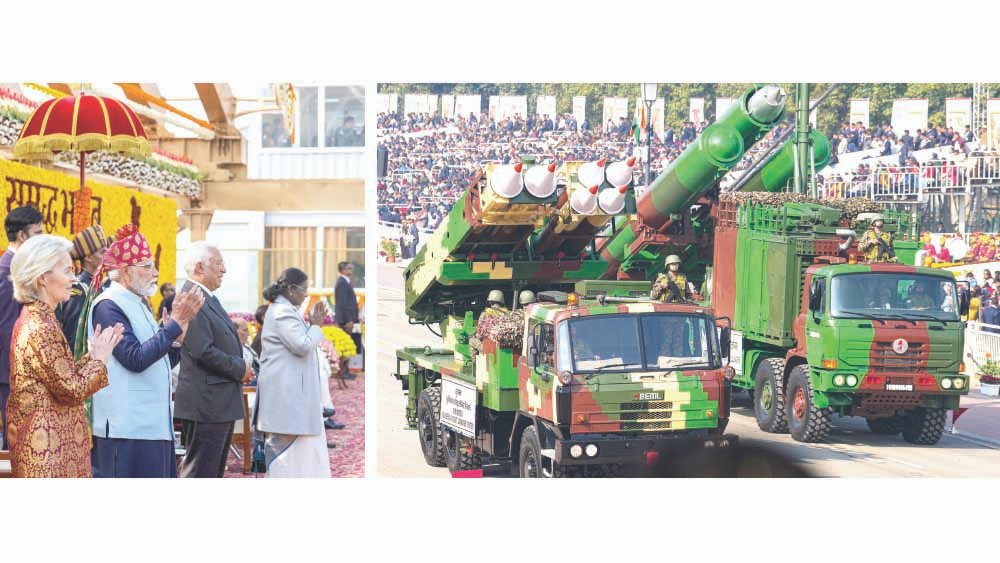
India flaunts military might at 77th Republic Day
NEW DELHI, JAN 26 (PTI)