
Wangpang voices concern over crimes against women and children; urges investigating agencies to ensure justice
Correspondents
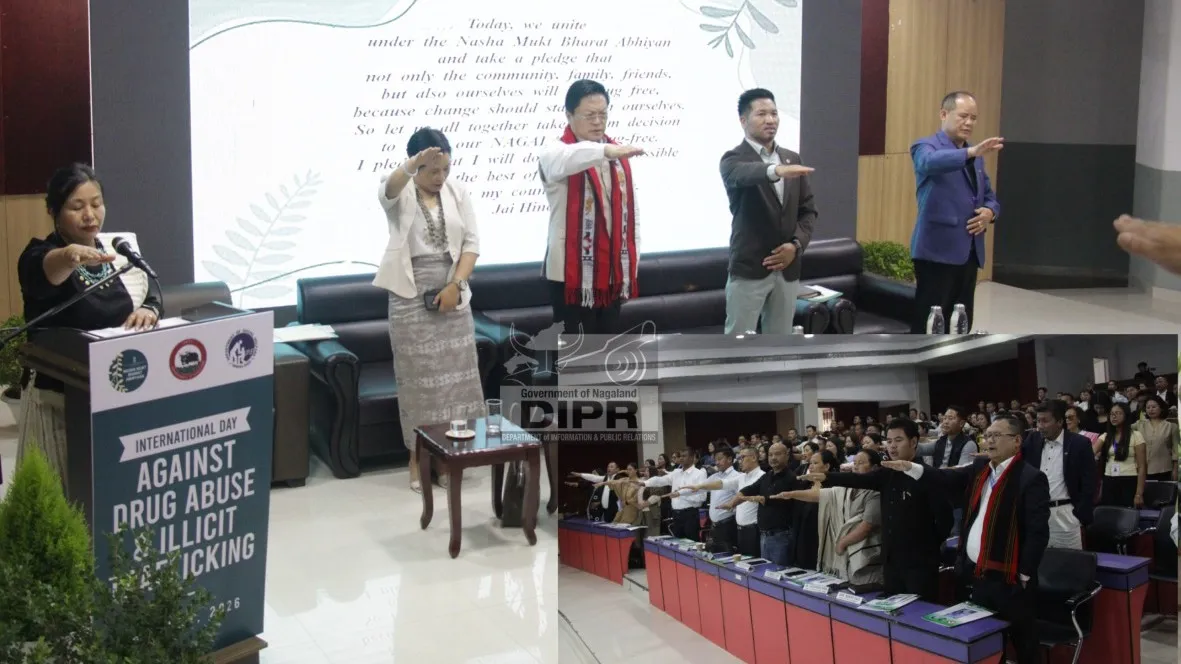
KOHIMA/WOKHA/DIMAPUR, JUN 26 (NPN): Nagaland joined the global community in observing the International Day Against Drug Abuse and Illicit Trafficking on June 26 with programmes organised across the state under the theme “World Drug Problem: Persisting Issues, New Challenges, Innovative Responses.”
The state-level observance was held at the Capital Convention Centre, Kohima, with advisor for Social Welfare, Wangpang Konyak, as special guest. Expressing concern over crimes against women and children in Nagaland, he urged investigating agencies to ensure justice without delay, describing such offences as grave violations of human dignity and rights.
Speaking on the theme, Wangpang noted that traditional narcotics have evolved into more dangerous synthetic drugs, while technology-driven trafficking networks increasingly target youth through smartphones and digital platforms. He described drug abuse as not merely an individual problem but a systemic threat to public health, productivity and security. Highlighting Nagaland’s vulnerability due to its proximity to international border routes, he said generations of youth have fallen victim to substance dependence.
He pointed out that the Government of India, through the Nasha Mukt Bharat Abhiyaan (NMBA), has shifted focus from punitive measures to demand reduction via grassroots counselling, rehabilitation, hotspot mapping and community participation. He added that district-level NMBA committees in Nagaland continue to conduct awareness campaigns while strengthening enforcement of the NDPS Act, enhancing border surveillance and expanding de addiction centres. Stressing that law enforcement alone cannot overcome the challenge, he appealed to churches, mothers’ associations, youth organisations and educators to play transformative roles in awareness, counselling and rehabilitation.
President of NNagaDAO, Ketho Angami, shared his personal journey of overcoming addiction 23 years ago and spoke on current trends and challenges of substance abuse. Recalling the situation during the 1980s, he said care for addicts has evolved significantly, with government programmes introduced to tackle the issue. He described addiction as a disease requiring compassion, care, outreach services and collective support for recovery rather than judgment.
Presenting findings from the ARK Foundation’s Rapid Need Assessment conducted in Kohima in 2022, Ketho said 42% of respondents were aged between 21–25 years, while 31% were in the 17–20 age group. Nearly half (49%) were unemployed, 25% were students and 14% were employed in the private sector. He highlighted widespread poly drug use, with sunflower (25%), alcohol (22%), marijuana (17%), dextropropoxyphene (13%), yaba (11%), heroin (10%) and codeine phosphate (2%) being the most commonly used substances.
According to the assessment, 55% of respondents first used drugs between ages 16–20, while 29% started between 11–15 years. All participants had a history of injecting drugs, with nearly half injecting daily. Twenty five per cent reported experiencing an overdose, while more than half were unaware of proper overdose management, with many holding misconceptions such as using salt and lemon. Ketho said counselling emerged as the most demanded service, followed by opioid substitution therapy (OST), methadone treatment, needle and syringe programmes, rehabilitation, HIV testing, naloxone, ART services and improved facilities for service users.
Delivering the keynote, Limawabang Jamir, secretary, Department of Social Welfare, said a “Viksit Bharat” cannot be realised without a drug free nation. He observed that Nagaland’s proximity to the Golden Triangle makes it vulnerable to trafficking, while limited access to prevention, rehabilitation and reintegration services, coupled with stigma, hinders recovery. He called for innovative responses including school based prevention, digital awareness in local dialects, tele counselling, online support groups and integration of mental health services. He urged society to replace stigma with compassion, punishment with rehabilitation and indifference with collective action.
Additional secretary Olemjungla Aier presented the Suposhit Gram Panchayat Abhiyaan Award to Mima Village. The event began with an invocation by Rev. Dr. Mar Pongener, General Secretary of NBCC, followed by a special presentation by staff of the Directorate of Social Welfare. The programme was chaired by Director Tosheli Zhimomi, while Joint Director T. Neingusalie delivered the vote of thanks. The observance concluded with a panel discussion on prevention, family impact and the role of faith based organisations.
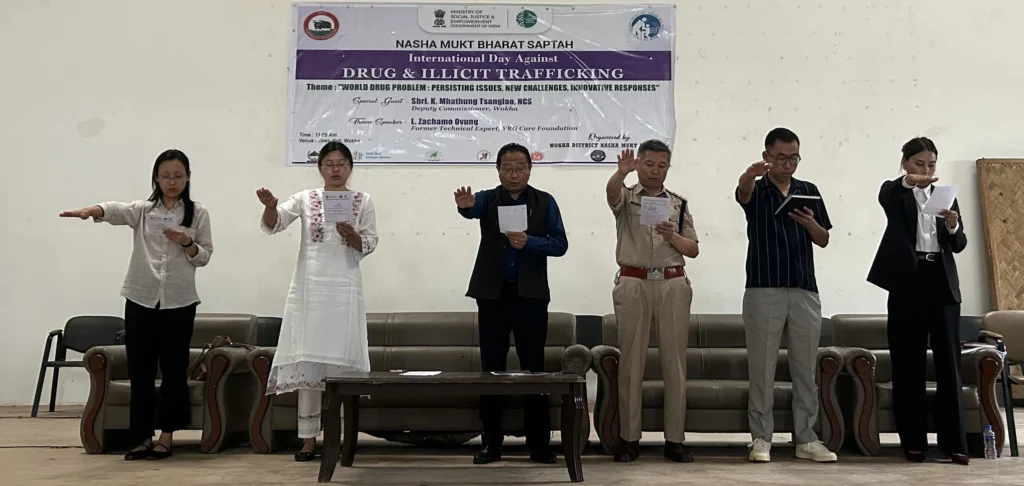
Wokha: At Town Hall, DC K. Mhathung Tsanglao highlighted the growing threat posed by drug abuse to society, families and youth. He stressed awareness and education at schools, churches and villages as preventive measures more effective than reactive approaches. He urged stronger coordination among law enforcement agencies and stakeholders, while calling upon the Lotha Youth Hoho and churches to adopt compassionate approaches, promote social acceptance and strengthen rehabilitation. Theme speaker L. Zachamo Ovung said enforcement alone was not enough, stressing the need to view substance abuse as a public health and social concern. WDLSA member Abigail Lotha presented on the HIV/AIDS Act, 2017, linking drug abuse to HIV transmission. Recovering addict Konathung Ezung shared his testimony and performed a special song. The programme was chaired by District Welfare Officer James Ezung, with students of Santsuo School presenting a short play. Earlier, a bike rally under the theme “Ride Against Drug Abuse and Trafficking: Step Up for a Drug Free Future” was flagged off from PWD Junction.
Kohima: The District NMBA Committee held a programme at the DC’s Conference Hall. DC B. Henok Buchem urged youth to become ambassadors against substance abuse, highlighting awareness activities carried out in schools, villages and offices. SSP Krodi Rhetso informed that Kohima Police had seized large quantities of narcotics in the past 18 months, registering 33 NDPS cases. He said policing alone could not solve the problem and urged parents, teachers and churches to protect youth. Director of Life Connect Nagaland, Sali Kez Ngully, spoke on “Women and Addiction,” proposing livelihood opportunities and rehabilitation centres for women. A recovering woman shared her testimony, and the DC released an awareness video “Voice of Hope.”
Noklak: At White Hall, EAC Apuloka H. Sumi urged collective commitment against drug abuse. Theme speaker Chubainla Longchar of NSACS highlighted stigma and discrimination faced by drug users, while Counsellor Onokesenu Kera stressed that recovery is possible with support. Local leaders described the situation as alarming, while Mongchon shared his testimony of overcoming addiction through OST.
Tseminyu: A rally against drugs culminated at Town Hall as part of Nasha Mukti Sapta. DC Japheth Woch urged civil society organisations to strongly oppose substance abuse. Talks on stress management, peer pressure and substance abuse were delivered, followed by a mass signature campaign reinforcing community commitment.
Mon: At Town Council Hall, SP Kanchan Kumar Kanpal stressed awareness as the key to reducing addiction and urged cooperation with police. Dr. Tingthong, MO, DH Mon, highlighted the availability of opium, ganja, sunflower and black market OST in the district, warning of chronic illness and infectious diseases. Leaders of Konyak Union and Konyak Students’ Union also spoke. Awareness talks, songs and pledges marked the event.
Pungro: Yimkhiung Youth Organisation, in collaboration with district administration, police, Assam Rifles and civil society groups, organised a rally from Traffic Point to Six Star Junction. Speakers highlighted the ill effects of drugs and the need for persistent fight against trafficking. Testimonies and prayers concluded the programme.
Mokokchung: The culmination of Nasha Mukt Bharat Saptah was held at the DC’s Conference Hall. DC Ajit Kumar Verma said NMBA was a key pillar of Viksit Bharat and urged churches to provide awareness and rehabilitation support. SSP Vesupra Kezo briefed on the NDPS Act and warned of the severe impacts of drugs. The programme featured speeches, songs and student presentations on youth roles in building a drug free society. Prizes and certificates were distributed, and concluded with a collective pledge.