
Iran’s Assembly of Experts is nearing consensus on the next Supreme Leader following Ayatollah Ali Khamenei’s death, though procedural issues delay formal announcement. The selection reflects the late leader’s criteria amid ongoing conflict and political tension, reports India Today.
Iran’s powerful Assembly of Experts has almost reached a majority consensus on the country’s next Supreme Leader following the killing of Ayatollah Ali Khamenei, though procedural hurdles still stand in the way of a formal announcement.
Assembly member Ayatollah Mohammadmehdi Mirbaqeri said on Sunday that the clerical body responsible for selecting Iran’s top authority had largely agreed on a candidate to succeed the slain leader.
Iran’s Mehr news agency quoted him as saying that while a majority view had emerged, “some obstacles” still needed to be resolved before the decision could be finalised.
A senior cleric from the 88-member Assembly of Experts had earlier said on Saturday that members would meet “within one day” to choose the next leader of the Islamic Republic. Iranian media reports indicated that the clerical panel had a minor dispute over the procedure required to formalise the appointment.
Some members believe a formal in-person meeting is necessary, while others favour issuing the deci-sion without such a gathering due to security concerns.
Ayatollah Mohsen Heidari Alekasir said an in-person session was currently not possible. In a video re-leased by Nournews on Sunday, he said the extraordinary situation made a plenary meeting impracti-cal. “This is an extraordinary situation; the assembly cannot meet in a plenary,” he said.
He added that attempts to target the clerical body would only benefit Iran’s enemies and “harm the revolution”.
Since the war began on February 28, Israeli and US strikes have killed dozens of Iranian officials and military commanders, including Khamenei.
Iranian media reported earlier in the week that air strikes had flattened an auxiliary building linked to the Assembly of Experts in the city of Qom.
Two members of the panel, Ayatollah Mohsen Heidari Alekasir and Ahmad Alamolhoda, were quoted by Iranian media as saying the assembly had already selected a successor.
According to Alamolhoda, the head of the assembly’s secretariat, Ayatollah Hashem Hosseini Bushehri, would be responsible for publicly announcing the decision.
Heidari Alekasir said the chosen candidate matched the late leader’s advice about the qualities required for Iran’s top position.
“The candidate had been picked based on the late supreme leader’s advice that Iran’s top leader should ‘be hated by the enemy’ instead of praised by it,” he said.
“Even the Great Satan (US) has mentioned his name,” he added.
His remark came days after Donald Trump suggested that Khamenei’s son, Mojtaba Khamenei, could be the most likely successor but warned he would reject such an outcome.
According to a report by Axios cited by Trump on Thursday, the younger Khamenei was considered a leading candidate, though Trump said he would oppose that option and wanted to be personally involved in the process of selecting Iran’s next leader.
Mojtaba Khamenei, 56, was not in Tehran when his father was killed in air strikes early in the conflict, an Iranian source told Reuters on Wednesday.
A mid-ranking hardline cleric, he maintains close ties with Iran’s elite Revolutionary Guards and is wide-ly regarded as one of the most influential figures in the country’s clerical establishment.
His influence largely stems from the role he played behind the scenes and his position as a key gate-keeper in his father’s office.
Despite never holding an official government post beyond working in the Supreme Leader’s office, Mojtaba has for years been viewed as a possible successor to his father.
His name also surfaced prominently during nationwide protests in 2022 following the death of a young woman in police custody after she was arrested for allegedly violating the Islamic Republic’s strict dress codes.
During the unrest, demonstrators frequently criticised Mojtaba, who is believed to wield significant influence over Iran’s security apparatus that has been used to suppress waves of protests in recent years.
Ali Khamenei had ruled Iran since 1989 after previously serving nearly eight years as president, making him one of the longest-serving leaders in the region before his death.
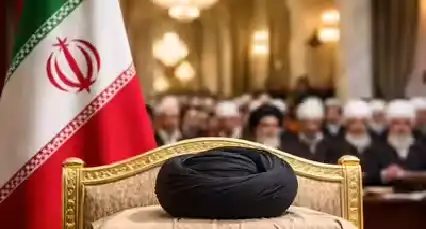
Iran chooses successor to Khamenei, name not yet revealed
TEHRAN, MAR 8 (AGENCIES):