
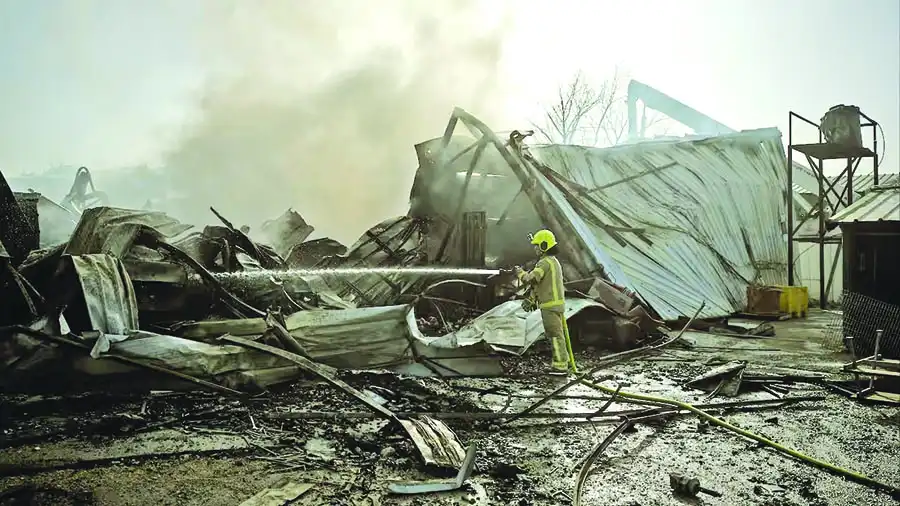
Iran intensified its attacks on oil and natural gas facilities around the Gulf on Thursday, raising the stakes in a war that is sending shock waves through the global economy.
The strikes, in retaliation for an Israeli attack on a key Iranian gas field, sent fuel prices soaring and risked drawing Iran’s Arab neighbours directly into the conflict. Tehran’s targeting of energy production further stressed global supplies already under pressure because of Iran’s stranglehold on the Strait of Hormuz, a strategic waterway through which a fifth of the world’s oil is transported.
Since the US and Israel launched the war on Feb 28, Iran’s top leaders have been killed in airstrikes and the country’s military capabilities have been severely degraded. Still, Iran — now led by the son of the supreme leader killed in the war’s opening salvo — remains capable of missile and drone attacks rattling its Gulf Arab neighbours and a global economy dependent on the energy they produce.
Underscoring the danger to ships in the region, a vessel was set ablaze off the coast of the United Arab Emirates and another damaged off Qatar. But efforts to bypass the strait were also under pressure: An Iranian drone hit a Saudi refinery on the Red Sea, which the country had been hoping to use as an alternative exit route.
Brent crude oil, the international standard, spiked to as high as USD 118 a barrel, up more than 60 per cent since Israel and the United States started the war. The European benchmark for natural gas prices rose 17 per cent on Thursday and has doubled in the past month.
Qatar, Saudi Arabia and the UAE denounced the Iranian attacks. Arab League Secretary-General Ahmed Aboul Gheit called them a “dangerous escalation.”
But Iran showed no signs of backing down. Saudi Arabia said its SAMREF refinery in the Red Sea port city of Yanbu was hit. Saudi Arabia had begun pumping large volumes of oil west toward the Red Sea to avoid the Strait of Hormuz.
Qatar, a key source of natural gas for world markets, said extensive damage was caused by Iranian missiles hitting the Ras Laffan LNG facility, where production had already been halted after earlier attacks. Damage to the facility could delay Qatar’s ability to get supplies to the market even after the war ends.
Two refineries in Kuwait and gas operations in Abu Dhabi also were targeted by Iran, local authorities said.
In Israel, more than a half-dozen waves of Iranian attacks targeting large parts of the country sent millions of people to shelters. The strikes caused damage to buildings but no significant casualties were reported.
In Washington, Defence Secretary Pete Hegseth told reporters that the US military “controls the fate” of Iran.
“Iran has the ability to make the right choices,” he said, adding that Tehran “should not, going forward, target Arab allies, Arab countries, trying to create pain, the pain that they created themselves.”
The Trump administration has cited various war objectives, including degrading Iran’s missile capabilities and its nuclear program. Killing senior leaders has also been a priority for the US and Israel.
Hegseth on Thursday implied Thursday that more leaders could be targeted, referring specifically to the Islamic Revolutionary Guard Corps and Basij force, a powerful internal security unit whose leader was killed by Israel earlier this week.
“The last job anyone in the world wants right now, senior leader for the IRGC or Basij, temp jobs, all of them,” Hegseth said.
Among the Iranian energy facilities hit in recent days was the Bushehr nuclear power plant complex. There were no injuries and the plant suffered no damage, the International Atomic Energy Agency said.
Gen. Dan Caine, the chairman of the Joint Chiefs of Staff, said Thursday that US forces continue to attack deeper into Iranian territory, with warplanes hunting Iranian boats in the Strait of Hormuz and helicopters striking Iranian drones. Caine said the US military has also dropped 5,000-pound bombs on underground weapon-storage facilities.
Israel said Thursday it struck Iranian targets in the Caspian Sea for the first time. Israeli military spokesman Lt. Col. Nadav Shoshani said the strikes hit dozens of targets, including ships, a shipyard and a command centre.
The Pentagon is seeking USD 200 billion in additional funds for the Iran war, a senior administration official says. The department sent the request to the White House, according to the official, who spoke on condition of anonymity to discuss the private information.
Iran stepped up its attacks on Gulf energy facilities after Israel hit South Pars, the Iranian part of the world’s largest gas field, which is located offshore in the Persian Gulf and owned jointly with Qatar.
With some 80 per cent of all power generated in Iran coming from natural gas, according to the International Energy Agency, the attack directly threatens the country’s electricity supplies. Natural gas is also used to supply household heating and cooking across the Islamic Republic.
“Israel’s target selection in this war has heavily focused on the institutions, leaders and infrastructure,” the New York-based Soufan Centre said in a research note. “It now seeks to inflict additional pressure on the regime by making the living conditions for civilians intolerable.”
Iran condemned the strike on South Pars, with President Masoud Pezeshkian warning of “uncontrollable consequences” that “could engulf the entire world.”
In Washington, President Donald Trump said that Israel would not attack South Pars again. But he warned on social media that if Iran continued striking Qatar’s energy infrastructure, the US would retaliate and “massively blow up the entirety” of the field.
“I do not want to authorise this level of violence and destruction because of the long term implications that it will have on the future of Iran,” Trump said on social media.
More than 1,300 people in Iran have been killed during the war. Israeli strikes against the Iranian-backed Hezbollah militant group in Lebanon have displaced more than 1 million people — roughly 20 per cent of the population — according to the Lebanese government, which says more than 1,000 people have been killed. Israel says it has killed more than 500 Hezbollah militants.
In Israel, 15 people have been killed by Iranian missile fire. Four people were also killed in the occupied West Bank overnight by an Iranian missile strike, according to officials.
At least 13 US military members have been killed.
Iran announced the execution of three men detained in January’s nationwide protests, the first such sentences known to have been carried out, the judiciary’s Mizan news agency reported.
Strikes hit world’s largest natural gas field in Iran, and Tehran retaliates with more attacks
The United Arab Emirates early Thursday denounced Iran’s attacks targeting its Habshan gas facility and Bab field as a “dangerous escalation” as Israel and the United States escalate their war on the Islamic Republic.
Authorities in Abu Dhabi say the gas operations had been shut down after interceptions over the sites.
Iran also had attacked gas facilities in Qatar after Israel launched an attack against Iran’s South Pars offshore natural gas field in the Persian Gulf that it shares with Doha. Israel killed Iran’s intelligence minister as it kept up its campaign against the Islamic Republic’s top leadership and reportedly attacked an Iranian offshore natural gas field Wednesday, as the war escalated pressure on the region’s economic lifeblood: energy.
Iran condemned the strike on its massive South Pars natural gas field, with Iranian President Masoud Pezeshkian warning of “uncontrollable consequences” that “could engulf the entire world.” Iran hit a major natural gas facility in Qatar, keeping up attacks on its Persian Gulf neighbors’ energy facilities as it continued to squeeze the Strait of Hormuz shipping channel — through which one-fifth of the world’s oil travels.
The price of oil surged another 5 per cent to over USD 108 a barrel on international markets, increasing the price of gasoline and other goods. The price of Brent crude, the international benchmark for oil, is now up close to 50 per cent since the start of the war.
As the Trump administration looks for ways to boost oil supplies, the Treasury Department eased sanctions on Venezuela Wednesday, saying U.S. companies will be allowed to do business with the country’s state-owned oil and gas company. Israeli Defense Minister Israel Katz promised “significant surprises” to come after Iran’s intelligence minister, Esmail Khatib, was killed in an overnight strike. A day earlier, Israel killed top Iranian security official Ali Larijani and the head of the paramilitary Revolutionary Guard’s Basij force, Gen. Gholam Reza Soleimani.
Iran retaliated by unleashing missile strikes against Israel. Israel said an Iranian missile hit the occupied West Bank, marking the territory’s first fatalities during the Iran war, though missile debris has damaged homes and businesses.
Iran also attacked Saudi Arabia’s vast Eastern Province, home to many of its oil fields, as well as Kuwait, Bahrain and the United Arab Emirates.
The United States was informed about Israel’s plans to strike Iran’s massive South Pars natural gas field, but did not take part in it, according to a person familiar with the matter. The person, who was not authorized to comment publicly and spoke on condition of anonymity, would not say if the Trump administration agreed with the Israeli decision to attack the gas field — part of the world’s largest such resource and a pillar of Iran’s energy supplies.
First fatalities reported in West Bank during Iran war
The Palestinian Red Crescent said at least three people were killed in the occupied West Bank town of Beit Awa as Iran fired missiles toward Israel. At least 13 others were injured. Earlier authorities said at least four people had died, but they adjusted the number as crew assessed the scene.
The Israeli military told The Associated Press an Iranian missile — not shrapnel from an interception — hit in the West Bank. Officials described it as a cluster munition that got past Israel’s air defense system.
Iran keeps up strikes on Gulf countries’ oil facilities
QatarEnergy said on X that a missile hit its massive Ras Laffan liquefied natural gas facility, sparking a fire that caused “extensive” damage before it was extinguished. The company had already halted production there because of Iranian attacks.
Since the war started, a small number of ships from Iran, Turkey, India and elsewhere have gotten through the Strait of Hormuz, which leads from the Persian Gulf to the open ocean. Iran insists the waterway is open, just not to the U.S. or its allies.
U.S. President Donald Trump expressed growing frustration that no allies have offered to help open the strait, posting on social media: “WE DON’T NEED THE HELP OF ANYONE!”
A top British military official, Armed Forces Minister Al Carns, said that any reopening of the strait is a long way off because of threats that include mines, attack boats and drones.
Iran launches multiple-warhead missiles at Israel
Responding to the killing of Larijani, the paramilitary Revolutionary Guard said Wednesday it had attacked central Israel with multiple-warhead missiles that have a better chance of evading defense systems. Footage filmed by The Associated Press showed at least one missile releasing a cluster of munitions over Israel.
Larijani was a senior policy adviser to the late Supreme Leader Ali Khamenei on strategy in nuclear talks with the Trump administration. He was sanctioned by the U.S. Treasury in January for his role “coordinating” Iran’s violent suppression of nationwide protests. Gen. Soleimani was also sanctioned by the U.S. and other nations for his role in suppressing dissent for years.
Iranian Supreme Leader Ayatollah Mojtaba Khamenei expressed condolences for the slaying of Larijani, according to a written statement published in Iranian media. “Undoubtedly, the assassination of such a person shows the extent of his importance and the hatred of the enemies of Islam towards him,” the statement said.
The younger Khamenei has not made a public appearance since his father was killed in the war’s opening salvos during which he reportedly was also wounded.
Renewed strikes in Iran
The Iranian judiciary’s Mizan news agency said an airstrike hit a courthouse complex in Larestan in southern Iran, and that at least eight people were killed. More than 1,300 people have been killed in Iran since the conflict started, according to the Iranian Red Crescent.
Mizan also reported that Iran executed a man on charges of spying for Israel’s Mossad intelligence agency. It identified him as Kourosh Keyvani and alleged he “provided images and information on sensitive locations” to Israel.
Sweden’s Foreign Ministry condemned what it said was the execution in Iran of a Swedish citizen arrested last year. Additional details were not available.
Israel pressures Hezbollah in Lebanon
Keeping up pressure on Iran-backed Hezbollah militants, Israeli strikes hit multiple apartment buildings in Beirut, killing at least a dozen people.
Israel flattened an apartment building in central Beirut about an hour after issuing an evacuation notice — the fourth time the building was targeted. Israel’s military claimed it was being used by Hezbollah to store “millions of dollars intended to finance its activities,” without providing evidence.
Israeli strikes have displaced more than 1 million Lebanese — roughly 20 per cent of the population — according to the Lebanese government, which says 968 people have been killed.
In Israel, 14 people have been killed by Iranian missile fire. At least 13 U.S. military members have been killed.
Trump paid his respects Wednesday at Dover Air Force Base in Delaware, where the remains of six U.S. service members killed in the crash of a refueling aircraft were returned to their families, marking the second time he has attended the solemn military ritual since the war started.