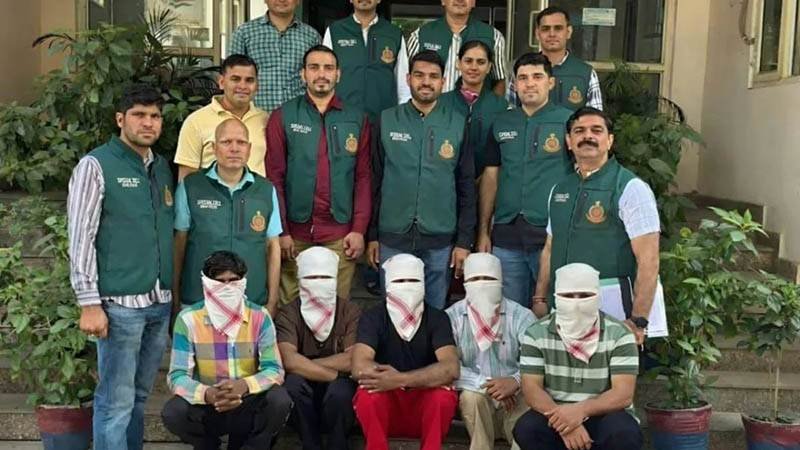
An espionage network with direct links to Pakistan has been unearthed, revealing how handlers across the border were remotely monitoring real-time movement of Indian Army personnel through a covert grid of solar-powered CCTV cameras installed at strategically sensitive locations across northern India, an official said on Friday.
The surveillance network spanned key cities including Kapurthala, Jalandhar, Pathankot, Patiala and Moga in Punjab, Ambala in Haryana, Kathua in Jammu and Kashmir, and Bikaner and Alwar in Rajasthan — all of which are crucial due to the presence of Army cantonments, proximity to the international border and their role as major troop movement and logistics corridors. According to police, the cameras were deliberately positioned to capture activities near military installations, highways used for troop mobilisation and border-linked infrastructure.
What makes the operation particularly alarming is that these devices were transmitting live footage directly to Pakistan-based handlers, allowing them to “sit across the border and watch Indian Army movements unfold in real time”.
The module, busted by the Special Cell of the Delhi Police in a coordinated operation, led to the arrest of 11 accused involved in espionage, arms smuggling and reconnaissance activities.
The accused have been identified as Manpreet Singh, a resident of Tarn Taran in Punjab; Anmol and Sahil of Firozpur in Punjab; Atul Rathee, Rohit and Ajay from Delhi; Gurjeet of Kapurthala; Rimpledeep of Fazilka; Salwinder alias Kalu and Boota Singh of Fazilka in Punjab; and Harpreet of Moga in Punjab. Investigators said the network was operating under instructions from Pakistan’s intelligence agency, with operatives on the ground tasked with installing surveillance equipment and relaying sensitive visuals. The use of solar-powered CCTV cameras ensured uninterrupted surveillance even in remote or low-access areas, making detection difficult and allowing the network to function continuously without relying on conventional power sources. “The cameras were fitted with SIM cards procured using fake identities and were linked to mobile applications, enabling seamless real-time transmission of footage across the border,” Additional Commissioner of Police (Special Cell) Pramod Singh Kushwah said.
The police said the accused had conducted detailed reconnaissance before installing the devices, carefully selecting vantage points that offered clear visibility of Army cantonments, border roads and movement routes of security forces. The footage was then analysed by handlers in Pakistan to map patterns, assess vulnerabilities and potentially plan further activities.
“The intention was not just passive surveillance but strategic monitoring of defence movement patterns over a period of time,” the officer said, adding that such inputs could have been used for planning terror strikes or facilitating cross-border operations.
“The crackdown was carried out in two phases. In the first operation, six accused were arrested from Punjab and Delhi, with the recovery of nine CCTV cameras, four pistols, including three foreign-made weapons, and 24 live cartridges. The second phase, based on inputs from military intelligence, led to the arrest of five more operatives actively involved in reconnaissance and data sharing,” the Additional CP said.
“One of the key accused, Manpreet Singh from Punjab, was found to be in direct contact with Pakistan-based handlers and played a central role in coordinating communication and facilitating the movement of illegal arms. Others, including field operatives, were responsible for physically installing the cameras and maintaining the network on the ground,” the officer said.
The police said the bust has potentially averted a major security threat, as inputs suggest that the module was also exploring plans to target security establishments using explosives and other means. The integration of espionage with arms trafficking and terror planning points to a larger and well-coordinated conspiracy backed by external elements.
Security agencies are now analysing digital evidence, including mobile phones and data retrieved from the CCTV systems, to identify further links, handlers and sleeper cells.
The probe is ongoing, with officials not ruling out more arrests in the coming days.
Sharing the profile of the accused, the officer said that Manpreet Singh has completed BCA. He came in contact with the Pak handlers through an encrypted app.
Anmol, a 10th pass, is engaged in wallpaper pasting work. He installed CCTV cameras at nine locations with the help of his associate Sahil.
Sahil is a 12th pass, engaged in wallpaper pasting work. He assisted Anmol in fixing cameras.
Atul Rathee, with a master’s degree in business from New Zealand, received four foreign-made pistols from Manpreet and three country-made pistols from an arms trafficker.
Rohit holds a master’s degree in business. He accompanied Atul Rathee to receive arms from Punjab.
Ajay, a graduate, received a country-made pistol from Rohit.
Gurjeet Singh, who has studied up to the 12th standard, established contact with Pak-based handlers through his cousin who was engaged in cross-border narco smuggling. He conducted reconnaissance of Army Cantt and shared photos and videos with the Pak handler.
Rimpledeep Singh, who has studied up to the 12th standard, collected and shared sensitive information, including images and videos of Army and BSF Camps.
Harpreet Singh alias Happy, who completed his education up to 10th standard, acted on the instructions of the Pak handler to facilitate drug trafficking across the international border and planned installations of the solar-powered CCTV cameras.
Salwinder Singh alias Kalu, who has studied up to the 10th standard, is presently working as a DJ operator. He accompanied Rimpledeep Singh in conducting reconnaissance and assisting in sharing photos and videos of the Army and paramilitary installations.
Boota Singh has passed 12th and was involved in cross-border smuggling of narcotics.