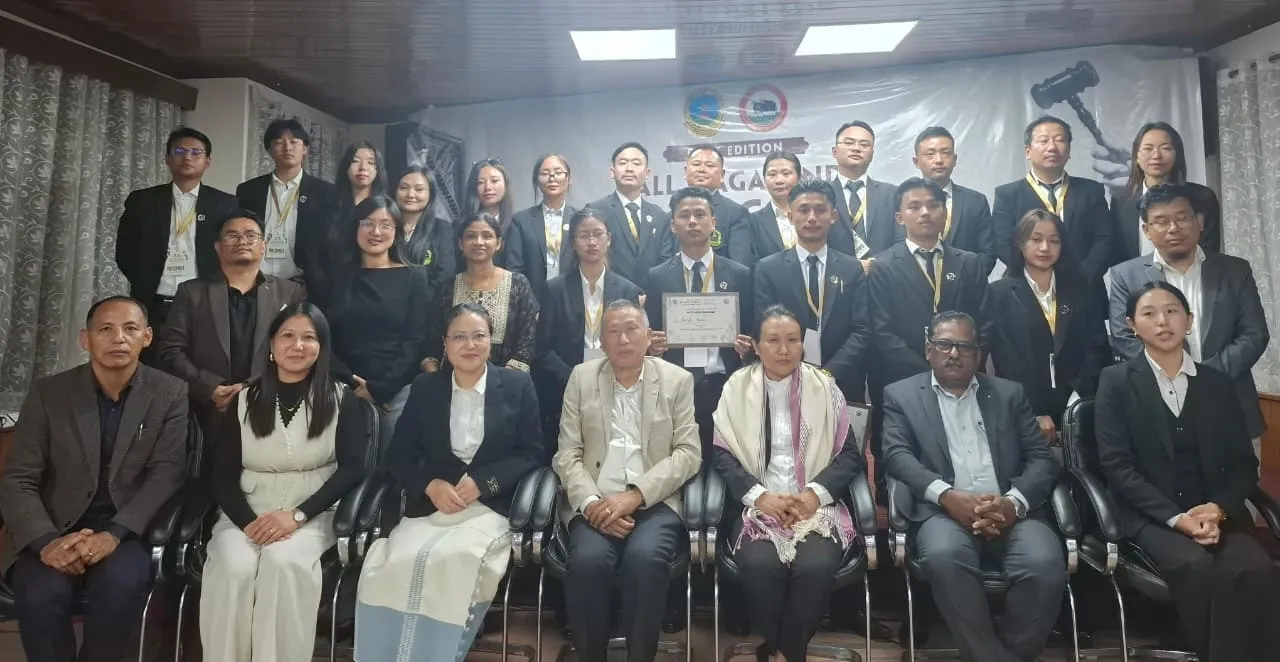
DIMAPUR: Kohima Law College (KLC), in collaboration with Department of Law & Justice, organised First Edition of All Nagaland Moot Court Competition 2026 on November 6 at the Red Cross Conference Hall, Kohima. The inaugural competition brought together aspiring legal professionals from different institutions, providing them with a platform to demonstrate their legal knowledge, research abilities, advocacy skills and courtroom presentation.
A press release KLC stated that the competition was aimed at bridging gap between theoretical legal education and practical courtroom experience by encouraging students to engage in legal research, construct arguments, interpret constitutional provisions and develop confidence in presenting submissions before a judicial bench.
The event witnessed participation from students of Kohima Law College and postgraduate law students (LL.M.) from Nagaland University, Lumami, while representatives from City Law College were also present to witness proceedings.
The valedictory programme was attended by distinguished personalities from legal and academic fraternity, including ITS, Principal Secretary, Department of Law & Justice, Dr. K. D. Vizo, who attended as the Special Guest and Observer, while Assistant Professor, Nagaland University, Lumami, Dr. Sentikumla, and Principal District & Sessions Judge, Kohima, Mezivolu T. Therie, served as judges for the competition.
Dr Vizo, in his address, described the inaugural competition as an important initiative towards strengthening legal education and developing next generation of legal professionals in the State, and also expressed his appreciation on the partnership between Department of Law & Justice and Kohima Law College, stating that the initiative was intended to create rigorous platform connecting classroom instruction with practical advocacy.
Highlighting legal issues involved in moot proposition, he referred to contemporary questions concerning legislative authority, international treaties, regional autonomy and indigenous rights.
He particularly drew attention to Article 371A of the Constitution of India, which provides special constitutional protection to Naga customary laws, social practices, and the ownership and transfer of land and its resources, and also referred to Article 21 and the importance of balancing commercial livelihoods, traditional practices and fundamental right to a clean environment.
Dr. Vizo commended participants for engaging with complex legal questions and presenting arguments with intellectual discipline and an understanding of Nagaland’s unique socio-cultural and constitutional context.
He also encouraged students to view advocacy as a responsibility rather than merely an instrument for winning arguments, emphasising that the legal profession must be guided by integrity, empathy, wisdom and a commitment to protecting the vulnerable and upholding the rule of law.
Meanwhile, in her remarks, Mezivolu T Therie reflected on the performances witnessed during the final round and emphasised that effective advocacy depends not on volume of words spoken but on clarity of reasoning and ability to identify and address legal issues. She stressed the importance of thorough preparation, explaining that confidence in the courtroom was built long before an advocate enters it.
She also highlighted the need for legal practitioners to remain composed when questioned by judges, possess thorough understanding of their case briefs and maintain professional courtesy and discipline. She reminded aspiring lawyers that advocates were not merely expected to win arguments but must assist court in pursuit of justice and uphold rule of law.
Dr. Sentikumla, in her address, also emphasised the importance of preparation, research and professional conduct in legal profession. Drawing from her observations of the competition, she noted that moot court exercises were essential in preparing law students for actual courtroom proceedings, and highlighted several important aspects of advocacy, including knowledge of law, depth of research, application of legal principles to facts, responsiveness to questions from the bench, courtroom management, time management, originality and persuasiveness.
She particularly encouraged students to become attentive listeners, stating that effective advocacy requires not only the ability to speak but also the ability to listen carefully, understand questions and respond precisely.
She further advised aspiring lawyers never to compromise on preparation and to maintain composure even when confronted with difficult questions in court.
The release added that first prize, carrying a cash award of Rs. 25,000, was secured by the Third Semester team comprising of Monglon H., Khekalu Jakhalu and Mharhutolu, second prize, carrying a cash award of Rs. 5,000, was awarded to Ketholeto Sophie of the Fifth Semester, who also received the Best Speaker recognition, while the third prize, carrying a cash award of Rs. 5,000, was awarded to Jinenle Wanth of the Fifth Semester, who was also recognised as the Best Researcher.