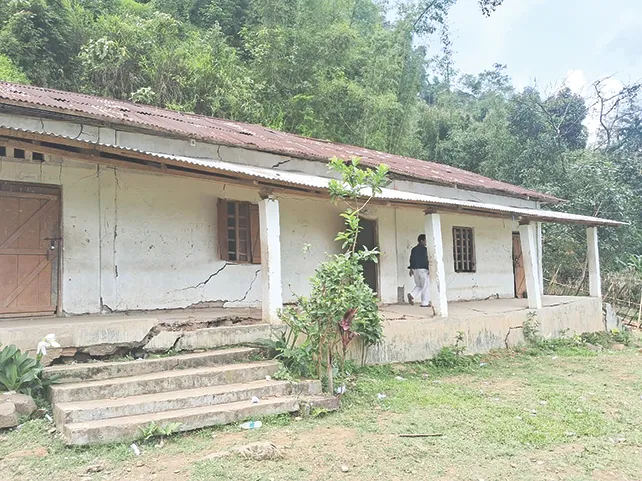
DIMAPUR, MAY 26 (NPN): Konyak Students’ Union (KSU) has expressed concern over what it described as a serious educational crisis in Mon district following its “Education Wheel Tour– Phase III” conducted from May 11 to 20, 2026 across the district.
In a press release, KSU president Temwang and education secretary Yeihtai Konyak said the survey covered 209 institutions, including 117 Government Primary Schools (GPS), 70 Government Middle Schools (GMS), 15 Government High Schools (GHS), and seven Government Higher Secondary Schools (GHSS), with a total enrolment of 19,765 students.
KSU said the findings also reflected a “profound structural crisis” undermining the educational future of students in Mon district.
According to the union, only one GPS out of 117 surveyed had an English teacher, three schools had Mathematics teachers, and one school had a Science teacher. It also stated that six GPS were being run by a single teacher, 13 by two teachers, and 24 by three teachers.
KSU stated that such circumstances fundamentally compromised the quality of education and placed students from rural and remote communities at a severe academic disadvantage from the beginning of their educational journey.
The union further stated that 27 GMS were functioning without Mathematics teachers, 34 without Science teachers, and 42 without English teachers. It said several schools also lacked UGHT teachers and other essential academic personnel, compelling teachers to handle multiple subjects beyond their expertise.
At the secondary and higher secondary levels, KSU said several schools were operating without adequate Graduate Teachers (GTs) and Post Graduate Teachers (PGTs) in subjects such as English, Political Science, Sociology, Economics, Mathematics, and Sciences.
This, KSU said severly limits academic competitiveness and deprive students of quality preparation for higher education and competitive exams.
KSU also pointed out that GHSS Mon Town ‘C’, upgraded in 2024, has been functioning without a single government-appointed PGT. The union stated that it had arranged five local PGTs since 2024 and was paying monthly stipends to them.
On infrastructure, KSU said many schools were functioning under dilapidated and unsafe conditions and lacked adequate classrooms, libraries, laboratories, staff rooms, and other essential facilities. It stated that in many remote schools, the absence of basic educational infrastructure had created an environment unconducive to meaningful teaching and learning.
Stating that educational inequality ultimately translated into social and economic inequality, KSU said students from Mon district should not be compelled to suffer academic disadvantages due to geographical remoteness or prolonged administrative neglect.
KSU asserted that access to quality education is not a privilege but a fundamental right.
The union appealed to the government and Department of School Education to undertake immediate intervention through rational deployment of teachers, appointment of qualified subject teachers, infrastructural renovation, and equitable distribution of educational resources throughout Mon district.
KSU also stressed that educational development could not be achieved through policy declarations alone, but required sustained administrative commitment, institutional accountability, and timely implementation of corrective measures.
The union reiterated its commitment towards educational justice, institutional reform, and equal academic opportunities for students across Mon district.