
Nzano Humtsoe
DIMAPUR, NOV 1 (NPN): Despite issuing environmental guidelines and conducting water quality assessments during Durga Puja idol immersion, the Nagaland Pollution Control Board (NPCB) has admitted that it has no coordination with district administration and municipal authorities to ensure compliance with pollution control measures.
In response to queries from Nagaland Post, NPCB disclosed that while it had circulated the Central Pollution Control Board’s (CPCB) Revised Guidelines for Idol Immersion to stakeholders and instructed Puja committees to use eco-friendly materials, no temporary artificial ponds or designated tanks had been provided as alternatives to immersion in natural water bodies.
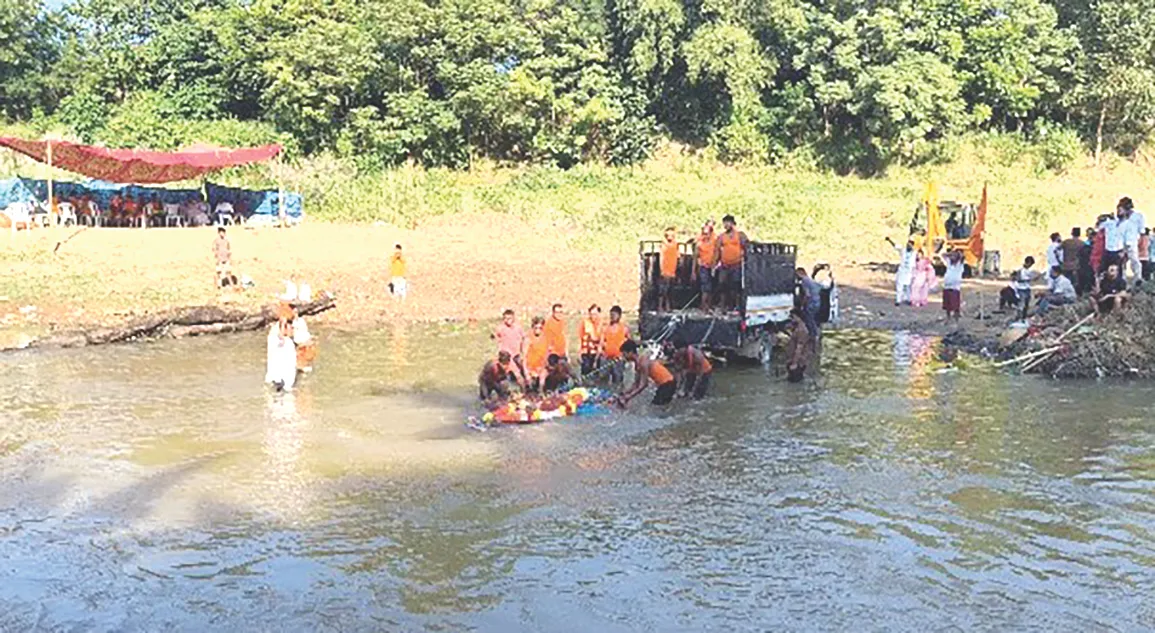
The Board also stated that it had not identified any rivers or water bodies particularly vulnerable to pollution during the immersion period. In Dimapur, idols are immersed at the designated Immersion Ghat in River Dhansiri, with the approval of the deputy commissioner.
The absence of alternative facilities raises questions over the implementation of environmental safeguards, particularly as idol immersion continues in a natural river system despite the risks associated with Plaster of Paris (POP), chemical paints, plastics and other non-biodegradable materials.
NPCB said it had circulated the revised guidelines to all stakeholders and inspected an idol manufacturer in Dimapur, directing it to use eco-friendly products. However, it acknowledged that most idols were manufactured at Lahorijan and Khatkhati in Assam.
The Board said the guidelines were published in local print media in 2023, while directions were issued from time to time to Nagaland Bhojpuri Samaj and Hindu Seva Samiti, Dimapur.
According to NPCB, POP contains chemicals such as gypsum, sulphur, phosphorus and magnesium, while dyes used to colour idols may contain mercury, cadmium, arsenic, lead and carbon. These materials are non-biodegradable and can become toxic when immersed in water bodies.
The revised CPCB guidelines, developed in 2020, emphasise restricting single-use plastics in idol-making, using naturally occurring colours, regulating idol sizes and constructing temporary synthetic-lined ponds of adequate capacity.
The Board said Puja committees, manufacturers and other stakeholders had been instructed to use natural clay and non-toxic colours. Organisers were also advised to remove flowers, clothes and decorations before immersion, segregate waste and deploy volunteers downstream to collect floating debris.
NPCB cautioned that improper immersion could increase suspended solids and chemical concentrations, affecting turbidity, pH levels, biological oxygen demand (BOD), chemical oxygen demand (COD) and total dissolved solids (TDS).
It also warned that heavy metals from paints could harm aquatic organisms, cause gill damage and respiratory stress in fish, reduce oxygen levels and lead to fish mortality. Persistent pollutants could accumulate in sediments and enter the aquatic food chain, affecting biodiversity and the wider ecosystem.
Water quality assessment: NPCB said it had been assessing water quality in River Dhansiri at three stages– pre-immersion, during immersion and post-immersion– for several years.
For the 2026 Durga Puja immersion, samples were collected at Nagarjan Bridge, Purana Bazar and Nagaland-Assam border on October 18 (pre-immersion), October 21 (during immersion) and October 25 (post-immersion).
While the Board maintained that previous assessments had shown no significant change in overall water quality, the 2026 data recorded fluctuations in several parameters at all three locations.
At Nagarjan Bridge, BOD increased from 1.9 mg/L before immersion to 2 mg/L during immersion and 2.5 mg/L after immersion. Conductivity rose from 124 to 136 and 178 μmho/cm, while TDS increased from 62 to 68 and 89 mg/L.
At Purana Bazar, BOD rose from 1.6 mg/L before immersion to 2.1 mg/L during immersion and 3.0 mg/L after immersion. Conductivity increased from 144 to 174 and 196 μmho/cm, while TDS rose from 72 to 87 and 98 mg/L.
At the Nagaland-Assam border, BOD increased from 3.4 mg/L before and during immersion to 3.8 mg/L after immersion. Conductivity rose from 180 to 200 and 224 μmho/cm, while TDS increased from 90 to 100 mg/L during immersion before declining slightly to 98 mg/L post-immersion.
The readings indicate variations in water quality parameters during the assessment period, although the Board maintained that the overall changes were not significant.
On disposal of flowers, clothes, decorations and other Puja materials, the NPCB said Hindu Seva Samiti and Nagaland Bhojpuri Samaj had been asked to follow the revised CPCB guidelines. It said a third party was engaged to clear solid waste on the day after immersion.
While municipal and town councils are responsible for cleaning waste from immersion sites, the Board said Hindu Seva Samiti was presently assigning a third party to collect solid waste and idol remains from the site.
On enforcement, NPCB cited Rule 9 of the Nagaland Prevention and Control of Water Pollution (Procedure for Immersion of Idols after Pujas) Rules, 2019. Under the provision, a Puja committee violating the rules may be penalised Rs.3,000 in village areas and Rs.5,000 within municipal areas.
The Board said it conducts stakeholder meetings and publishes environmental guidelines in local dailies from time to time to create awareness.
It urged Puja organisers and the public to celebrate religious festivals with devotion while ensuring that traditions do not harm the environment. The NPCB called for the use of natural clay idols and non-toxic, biodegradable colours, avoidance of POP, plastics, thermocol and toxic paints, proper segregation of Puja waste and use of designated immersion facilities.
However, the absence of temporary artificial immersion ponds, lack of coordination with district and municipal authorities and continued reliance on a natural river for immersion highlight the gap between prescribed environmental safeguards and their implementation on the ground.