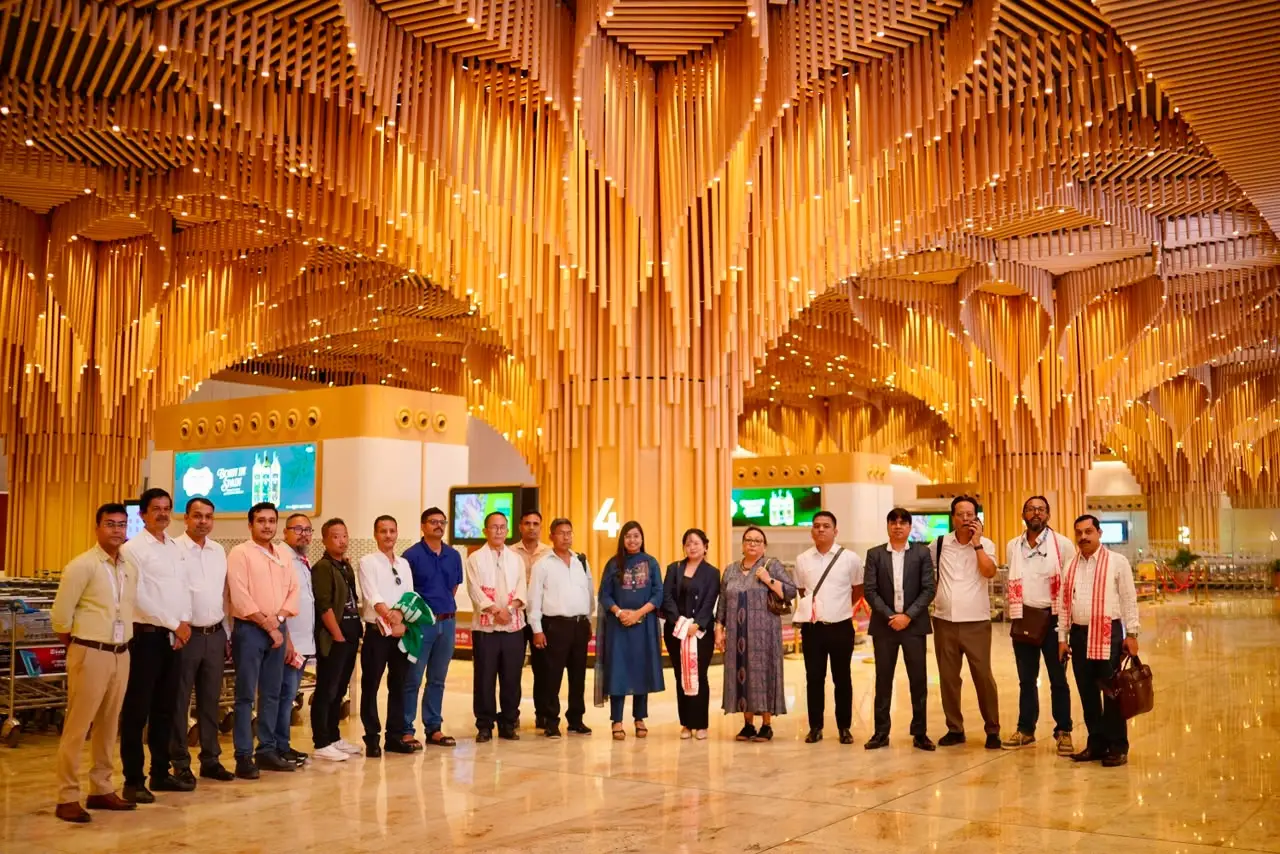
Lokpriya Gopinath Bordoloi International (LGBI) Airport in Guwahati stands as the premier aviation gateway to India’s North East. Nestled against the scenic backdrop of the Rani Reserve Forest, the airport blends ultra-modern infrastructure with the rich cultural identity and natural green landscape of the region. It is managed and operated by Adani Airport Holdings Limited (AAHL).
“Terminal 2 of Lokpriya Gopinath Bordoloi International Airport, Guwahati, has been named among the world’s seven most beautiful airports for 2026 by Prix Versailles, recognising its architecture, sustainability and passenger-focused design.”
Media Familiarisation Trip to T2, LGBI Airport, Guwahati was organized for Journalists of North East states from September 21–23, 2026. LGBI Airport is managed by Sunila Kumar Bhadoria, Head, Guwahati Airport while Rahul Bhatkoti is the Chief Airport Officer (CAO), Guwahati International Airport Ltd. The entire media programme was conducted by Dr. Jyotisha Saikia, Head, Corporate Communications, LGBI Airport.
LGBI Airport is not merely the gateway to the Northeast; it is also the gateway through which the Northeast connects with the rest of India and the world. As the region’s principal aviation hub, LGBI Airport is poised to play an increasingly catalytic role in promoting tourism, trade, investment and the broader economic progress of the Northeast.
The opening of its new integrated terminal-dubbed the “Bamboo Orchids” terminal-has elevated LGBI Airport into a high-capacity, world-class hub designed to compete with the top international airports in the country.
Act East Strategic Gateway: Positions Guwahati as a direct international air link to Southeast Asian markets. Weather Disruptions: Dense seasonal fog in the Brahmaputra valley still poses operational delays despite instrument landing upgrades.
LGBI Airport has successfully transformed from a congested regional transit point into an international-grade aviation facility. By combining high-density passenger architecture with local identity and modern digital processing, it serves as a robust catalyst for tourism, trade, and economic growth across the North East.
Capacity & Scale Upgrades
Passenger Volume: The new terminal increases total handling capacity to 13.1 million passengers per annum (MPPA), up from its legacy operational limit of around 6 million.
Terminal Footprint: Spanning over 1,40,000 square meters, the new structure expands the physical size of the airport nearly sevenfold.
Aircraft Movement: Designed to manage over 130 flight movements daily, connecting to 21 domestic routes and expanded international corridors including Bangkok, Paro, and Singapore.
Helpful Staff
For passengers arriving at or departing from LGBI Airport, this human touch can make a significant difference. The willingness of airport employees to assist, guide and reassure passengers creates an atmosphere that is welcoming rather than merely functional. It gives travellers the feeling that they are being looked after, rather than simply processed through an airport.
An airport is often the first and last point of contact for travellers, and its employees therefore become unofficial ambassadors of the place they serve. At LGBI Airport, the courteous and caring approach of the staff reinforces the image of the Northeast as a region that welcomes visitors with openness and warmth.
Flights:
Terminal 1: Handles most domestic and some international flights.
Terminal 2 (“The Bamboo Orchids”): Inaugurated in 2026, serves Akasa Air, SpiceJet, Alliance Air, Air India, and Air India Express.happyfares+1
LGBI Airport has 88 flights per week to Delhi, 114 monthly flights to Kolkata, 82 monthly flights to Bengaluru, 48 monthly flights to Mumbai, 48 monthly flights to Chennai and 32 monthly flights to Hyderabad.
LGBI Airport operates regional connection to Imphal, Dimapur, Agartala, Aizawl, Itanagar, Dibrugarh, Silchar and Pasighat.
LGBI will connect Bangkok, Thailand – Suvarnabhumi (IndiGo, from Oct 27, 2026) and Don Mueang (Thai AirAsia). Currently LGBI airport operates flights to:
Singapore – Changi (Druk Air); Kuala Lumpur, Malaysia – (Druk Air); Paro, Bhutan – (Druk Air); Abu Dhabi, UAE – (Air India Express) and Dubai, UAE – International (Air India Express)
Passenger Facilities
Indigenous Architectural Design: Designed around the concept of “Bamboo Orchids,” the terminal incorporates over 140 metric tonnes of locally sourced bamboo, drawing inspiration from Assam’s Kopou Phool (foxtail orchid) and traditional regional weaving techniques.
DigiYatra & Smart Processing: Seamless paperless entry via biometric DigiYatra gates, integrated self-baggage drops (SBD), and high-throughput automated security screening check lanes reduce processing times significantly.
Shopping :
The airport’s official shopping directory lists outlets such as Ajmal, Apollo Pharmacy, Cococart, Colorbar, DA Milano and Eternity Lifestyles (Opium). The current T2 shopping directory also lists Zephyrus Fashion, Toyshire, TechnOspree, Pravasi, Bon Voyage, Goodwyn, Repose and House of Elixir. LGBI offers Curated Regional & Global Retail with multi-brand duty-free and retail boulevard showcasing authentic North Eastern handlooms, local tea brands, and GI-tagged handicrafts alongside premium international outlets. Art & Cultural Forecourt offers an interactive arrivals plaza designed as an amphitheater that hosts live traditional performances and showcases native art installations to give incoming travelers an immediate cultural immersion.
Integrated Cargo Hub: Dedicated domestic and international air cargo terminals designed to boost regional trade, supporting perishable agricultural goods, organic exports, and logistics across the North Eastern states.
Premium Executive Lounges: World-class dining and lounge services catering to business travelers and international transit passengers. The new Terminal 2 of Lokpriya Gopinath Bordoloi International Airport (LGBI), Guwahati has been operational since 22 February 2026. It has an amphitheatre-style arrivals forecourt and a large integrated passenger terminal.