
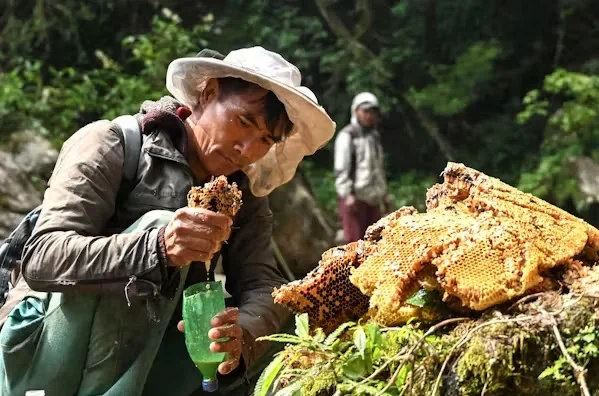
A few months ago, a friend of mine told me that his father-in-law had been rushed to the hospital after eating some wild honey brought back from the hills of Nepal.
Within about 30 minutes, his heart rate had dropped dangerously low and his blood pressure had collapsed. He recovered, but the episode was terrifying for the whole family.
As a chemical ecologist from Nepal, I knew immediately what had happened. My friend’s father-in-law had eaten wild honey, known locally as “bhir mauri ko maha,” from the Himalayan cliff bee.
These bees forage on rhododendron flowers that carry a natural toxin called grayanotoxin. As bees collect the nectar, the toxin ends up concentrated in the honey. This is what’s now popularized worldwide as “mad honey.”
Eat a teaspoonful and you might feel pleasantly warm and slightly light-headed. Eat more than a few tablespoons and your heart rate can drop to life-threatening levels. The exact amount that causes harm varies by batch, season and location.
The indigenous Gurung people of Nepal have built up knowledge of safe doses over generations. But that knowledge is being lost as wild Himalayan honey has begun to be sold on major international online platforms.
For over a decade, I have studied how insects and plants fight each other using chemistry. Plants make toxic compounds, insects figure out ways to store or use those toxins, and the whole arms race plays out over millions of years. This fascinating world of insects and plants usually stays far from human lives.
But this mad honey is bringing toxic compounds into contact with humans, creating a public health problem. When I investigated, I found that doctors were publishing individual case reports, but no one had looked at the bigger picture. That gap struck me. I wanted to find out more about where exactly these poisonings are happening, to whom and why?
I wanted to trace the whole chain, from the flower to the bee to the honey to the hospital. So I teamed up with two medical doctors who had published a case report of poisoned patients.
The Himalayan cliff bee, Apis laboriosa, is the world’s largest honeybee. It lives only in the high Himalayas, nesting and building enormous exposed combs on sheer cliff faces at altitudes of up to 13,000 feet (4,000 meters).
In spring, when rhododendron flowers peak, the bees forage heavily on their blooms. The nectar contains grayanotoxin, a chemical the plant likely evolved to deter insects that steal nectar without pollinating the flower. The bees collect the nectar anyway and concentrate it in their honey. Scientists do not know how the bees tolerate a compound that can floor a human in a tablespoon, but they appear unaffected. For insects feeding on toxic plants, such tolerance rarely comes without a cost, though for Apis laboriosa, we do not yet know what that may be.
The Gurung people of Nepal’s Gandaki Province have harvested this honey safely for centuries. Wild honey hunting is a sacred tradition for them, embedded in ritual and passed down through generations.
What mad honey does to the human body
When a human eats more than about a teaspoon of this honey, the toxin interferes with how the heart muscle generates its electrical signals. This causes the heart rate to slow to dangerously low levels, leading the blood pressure to crash. Without immediate treatment, the situation can become life-threatening. Most patients feel dizzy, nauseated and weak within 30 to 60 minutes.
Fortunately, there have been no reported deaths in Nepal from eating this honey. Doctors treat patients with intravenous fluids and a drug called atropine, which restores a normal heart rhythm. Most recover within a day or two.
My colleagues and I searched records from 1976 to 2026. We found and reviewed 27 published papers documenting the cases of 68 patients from 2009 onward. These papers painted a surprisingly consistent picture.
About 72% of patients are middle-aged men. And it turns out that most of them ate the honey deliberately, not accidentally. They were using it as a home remedy for high blood pressure or to improve sexual function, traditions that go back generations in Himalayan communities. There is actually some experimental support for the blood pressure effect, with studies in rat models showing that small amounts do lower blood pressure. The problem is that the gap between a medicinal dose and a toxic dose is very small and varies from one batch to the next.
We also found that the harvest seasons and hospital admissions follow the same calendar. Poisonings cluster sharply in spring, when rhododendron flowers are at full bloom and the main honey harvest takes place. Spring honey carries the highest toxin concentrations of the year.
A smaller wave of cases appears in autumn during the secondary harvest. One case in our review involved two patients in Nepal who arrived at the same hospital on the same day in late October, both having eaten honey from the same batch. (Yahoo News)