
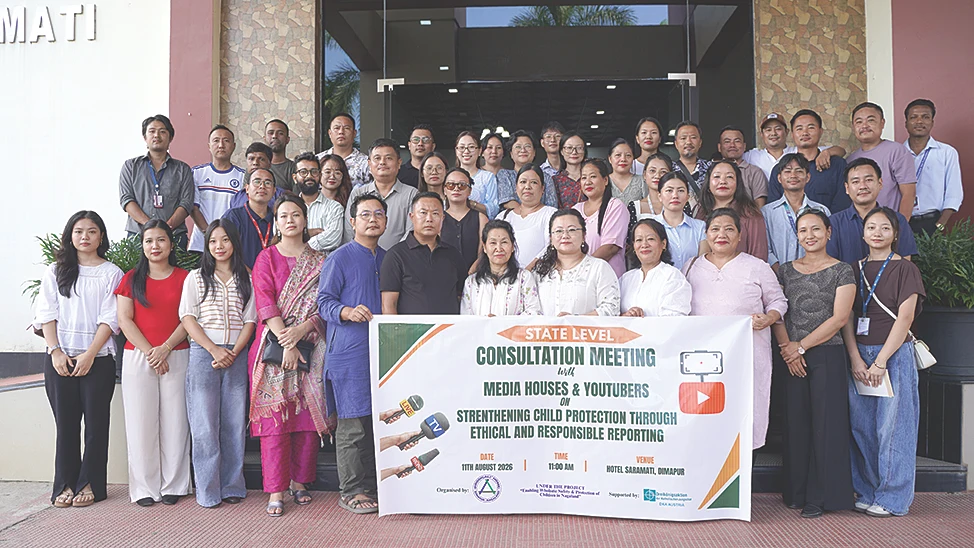
DIMAPUR, AUG 11 (NPN): Media houses and digital content creators have been urged to exercise greater responsibility and caution while reporting cases involving children, particularly to protect their identity, privacy and dignity.
The call was made at a state-level consultation on “Strengthening Child Protection through Ethical and Responsible Reporting” organised by Prodigals’ Home, Dimapur, with support from DKA Austria, at Hotel Saramati, Dimapur, on Tuesday.
The consultation sought to build a shared understanding among media houses, content creators and child protection stakeholders on ethical, child-friendly and legally compliant reporting of cases involving children. It also aimed to strengthen coordination between the media and child protection mechanisms for timely intervention and protection.
A presentation on “Protecting Child Rights & Identity: From Law to Newsroom Practice”, was delivered by The Morung Express associate editor Dr Moalemba Jamir, who highlighted legal, ethical and practical challenges involved in reporting cases concerning children.
Dr Moalemba stressed that withholding a child’s name does not necessarily guarantee anonymity, particularly in a closely knit society such as Nagaland. Details including a school, locality, village, family relationship, age, clan or other distinctive information can collectively reveal a child’s identity.
He said Nagaland had a “tight information ecosystem” where information could quickly move between police and other official sources, community bodies, student and tribal organisations, churches and social media. Information published by one source could therefore be combined with details from another to identify a child.
He cautioned newsrooms against reproducing condemnation statements and press releases issued by organisations without proper editorial scrutiny, stressing that responsibility could not be avoided merely because identifying information had been supplied by another organisation.
He Jamir suggested a “three readers” test before publishing reports involving children. The first question is whether someone from the child’s family or immediate circle could identify the child. The second is whether a local resident could identify the child from details such as the locality, school, village or family connections. The third is whether an online search could identify the child by combining published details with information available elsewhere.
If the answer to any of these questions is yes, he said, the information should be removed, generalised or reframed.
He also called for anonymity to be protected for life, stressing that a child’s identity should not later be revealed simply because the person had reached adulthood. Journalists were urged to avoid sensationalism, particularly in cases involving sexual offences against children, and instead focus on institutional action, legal proceedings, accountability and broader child protection concerns.
“Protect identity, protect privacy and dignity, do not sensationalise and verify before publishing,” were among the principles highlighted by Dr Jamir. He also stressed that being first should not take precedence over accuracy and ethical reporting.
On photographs and videos, he cautioned that visuals could reveal a child’s identity even when the face had been blurred.
He also highlighted the distinction between a Child in Need of Care and Protection (CNCP) and a Child in Conflict with Law (CCL) under the Juvenile Justice Act, stressing that both categories required protection and that reporting should not result in stigma or secondary victimisation.
He further drew attention to child labour and informal guardianship arrangements in Nagaland, where children may be brought into households ostensibly for education or care but could potentially face exploitation or child domestic labour.
Sharing newsroom experiences, Eastern Mirror sub-editor Prasanjit Dutta said gathering information on cases involving children in conflict with law or underage victims was increasingly difficult outside Dimapur and Kohima because of fear and stigma. He also pointed to difficulties in accessing child protection offices in some districts and obtaining updated district-wise data on crimes against children.
Dutta stressed the importance of the newsroom desk, particularly as journalists new to the profession may not have adequate knowledge of laws governing child protection and reporting.
Nagaland TV senior reporter Musaraf Ali highlighted field-level challenges, including pressure from families, civil society organisations and influential individuals. He said reporters were sometimes pressured to disclose details about accused persons without considering whether such disclosures could indirectly identify the child involved.
Musaraf also expressed concern over the growing number of people producing news content without adequate knowledge of journalism or child protection laws. He urged YouTubers and digital content creators to exercise responsibility, saying mistakes in field reporting could expose children and affect the wider media fraternity.
The consultation also discussed the need for stronger coordination between media houses and child protection stakeholders, including District Child Protection Units, Child Welfare Committees, Special Juvenile Police Units, police, civil society organisations and child helpline services.
The open-house discussion was moderated by The Morung Foundation’s Tushimenla Imlong.
Prodigals’ Home programme manager Lozua Kape chaired the programme, which was organised under the organisation’s initiative for holistic safety and protection of children in Nagaland.
The programme concluded with closing remarks and a vote of thanks by Prodigals’ Home director K. Ela, while the closing prayer was offered by BYFD general secretary Thuiolu Dem.