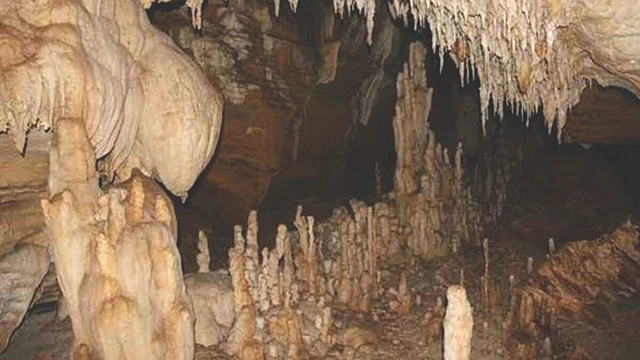
A 6,000-year climate record preserved in a stalagmite in Meghalaya’s Mawsmai Cave has provided evidence of long-term changes in monsoon intensity in northeastern India, with researchers identifying links between ancient rainfall patterns, global climate systems and solar variations, officials said on Wednesday.
The study, led by Yachna Verma and Anil K Gupta of IIT Kharagpur, along with Prasanta Sanyal of IISER Kolkata and co-authors Priyantan Gupta, Som Dutt, Pankaj Kumar and Abhijit Mukherjee, examined changes in the Indian Summer Monsoon (ISM) between 11,807 and 5,622 years ago.
Published in the international journal Palaeogeography, Palaeoclimatology, Palaeoecology earlier this year, the research found that the monsoon was significantly stronger during the early Holocene, followed by a gradual weakening during the middle Holocene. Holocene is the current geological period, which began about 11,700 years ago after the last Ice Age.
Titled ‘Deciphering Holocene monsoon dynamics in northeastern India’, the research is based on the analysis of a stalagmite recovered from Mawsmai Cave, about 60 km south of Shillong in Meghalaya’s East Khasi Hills district.
The researchers analysed the stable oxygen isotope composition of the stalagmite, along with its petrographic and mineralogical characteristics, to reconstruct past rainfall and monsoon conditions.
The findings indicate that the ISM was particularly strong between approximately 11,807 and 7,700 years ago, with lower oxygen isotope values pointing to intensified monsoon activity.
However, the period between 7,700 and 5,622 years ago witnessed a gradual weakening of the monsoon, reflected in higher oxygen isotope values.
The study also identified several fluctuations in monsoon intensity over periods spanning hundreds of years, suggesting that rainfall patterns in northeastern India were influenced by climate changes extending well beyond the Indian subcontinent.
These variations corresponded with a series of North Atlantic climate events, known as Bond events 8, 7, 6, 5b, 5a and 4, indicating possible links between North Atlantic climate variability and the Indian monsoon through changes in the Atlantic Meridional Overturning Circulation (AMOC), a major system of ocean currents that transports heat across the Atlantic. (PTI)