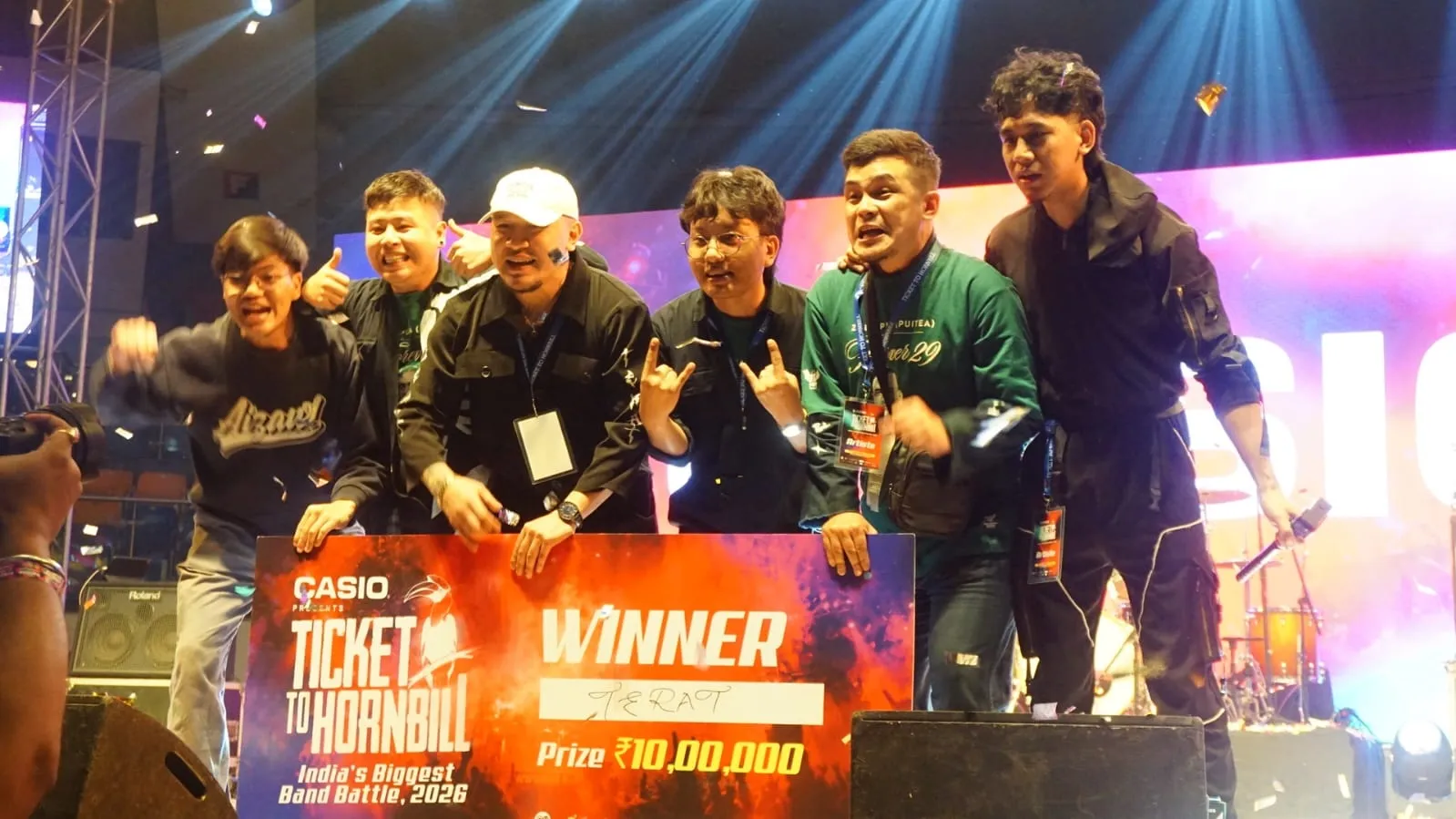
Terat band from Mizoram emerged as the winner of the third edition of ‘Ticket to Hornbill 2026’, held at Talkatora Stadium, New Delhi, on November 6, securing the opportunity to perform at the upcoming Hornbill Music Festival in Nagaland.
Terat emerged victorious among 221 bands that auditioned for the contest, billed as ‘India’s Biggest Band Battle’. Twelve bands qualified for the preliminary round, which was eventually narrowed down to five finalists competing for the top three positions.
Steel Falcon from Bengaluru secured the first runners-up position, while Nchanter from Uttarakhand finished as the second runners-up. The top three bands will perform at the Hornbill Music Festival 2026, scheduled to be held at Kisama from December 1 to 10.
The winner received a cash prize of Rs. 10 lakh, while the first and second runners-up received Rs. 6 lakh and Rs. 4 lakh respectively. Additional prizes worth Rs. 5 lakh, sponsored by Furtados and Sennheiser, were awarded to winners in individual categories. Casio India sponsored this year’s winners of ‘Ticket to Hornbill’. Now in its third edition, the event was held outside Nagaland for the first time. Explaining the decision to host the competition in Delhi, Task Force for Music and Arts (TaFMA) chairman Theja Meru said the national capital was chosen to highlight Nagaland’s thriving music scene and provide better accessibility, affordability and a band-friendly environment, besides having a sizeable Naga community.
The event was organised by the Tourism Department, Government of Nagaland, in collaboration with TaFMA and supported by the Ministry of Tourism, Government of India.
The judging panel comprised Subir Malik, founder of Parikrama; Arpito Gope, chief consultant to TaFMA; and Mayank Mittal, frontman of KAPOW, India’s first comic rock band.
Addressing the event, Secretary, Tourism, Government of Nagaland, Nchumbemo Lotha highlighted the significant place music occupies in the social and cultural life of the Naga people. He said music was more than entertainment, serving as a medium of storytelling, preservation of history, expression of identity and an integral part of community life.
He observed that traditional folk songs, indigenous instruments and rhythmic performances had been passed down through generations, reflecting the experiences, values and collective memories of the community. Over the years, this rich musical foundation had evolved into a contemporary music culture that brought Nagaland considerable recognition.
Highlighting the growing significance of the Hornbill Festival as one of India’s recognised cultural and tourism events, Nchumbemo said it had evolved into an important platform for showcasing Nagaland’s cultural heritage and bringing all tribes together under one roof. The festival also provides visitors an opportunity to experience the state’s traditions, cuisine, handicrafts and way of life.
He said the state government aspired to extend the spirit of Hornbill beyond the 10-day festival and establish Nagaland as a destination that visitors would want to experience throughout the year. He emphasised that promoting tourism required collective participation from creative artists, entrepreneurs, the hospitality sector, local communities and private partners.
Describing ‘Ticket to Hornbill’ as an important initiative in this direction, he said the platform represented the state’s efforts to take Nagaland’s cultural and creative identity to a wider national audience while building connections between music, youth, entertainment and tourism.
He added that bringing together talented bands from different parts of the country encouraged cultural exchange and collaboration among musicians, while providing emerging artists with a national platform to showcase their talents and introducing the spirit of Nagaland to audiences beyond the state.