
The eighth edition of state-level mock exercise on earthquake and extreme weather disasters, along with “Operation Night Guard,” was conducted across Nagaland on Thursday under the Nagaland Emergency Preparedness Exercise (NEPEx) 2026.
The exercise was organised by the Nagaland State Disaster Management Authority (NSDMA), Home Department, and district disaster management authorities in collaboration with the National Disaster Management Authority (NDMA), Ministry of Home Affairs.
Addressing the media, Home Commissioner Abhijit Sinha said the drill was designed to test preparedness for a major earthquake scenario, often termed the “mother of disasters.” The exercise began with a siren simulating a massive earthquake, triggering activation of emergency operations centres at the state and district levels.
Sinha said actions were guided by the Incident Response System (IRS), with step-by-step measures implemented as per laid-down protocols. Stressing the importance of information flow and inter-agency coordination, he said the exercise assessed coordination among departments and the effectiveness of communication channels—both critical in disaster response.
Sinha said community participation was integral, as first responders were often local residents. Observers from central agencies and other stakeholders were present, and feedback was being collected to identify gaps. He added that the findings would be used to strengthen preparedness and response mechanisms.
Lead Consultant (ME & IRS), NDMA, Maj Gen K.J. Bahl said this year’s drill was impact-based, with district-specific scenarios including estimated casualties and resource needs such as hospital beds and ambulances.
He said scenarios included landslides disrupting surface communication, damage to Dimapur airport, possible impact on infrastructure including the Doyang dam and hospitals, and building collapses causing casualties. While responses were generally satisfactory, he stressed the need for continuous improvement.
Bahl highlighted communication failure during earthquakes as a key concern, noting mobile networks could be disrupted. He called for stronger redundancy measures, including satellite communication and coordination with telecom service providers. He also emphasised coordination among the Roads and Bridges (R&B) department, Border Roads Organisation (BRO) and National Highways & Infrastructure Development Corporation Limited (NHIDCL) to restore critical lifeline routes.
Further, he flagged fire risks at petrol pumps during earthquakes, underscoring the need for robust fire response plans and coordination with nearby establishments for evacuation and traffic management.
Taking note of school safety being addressed, he said greater emphasis would be beneficial.
Bahl described the coordinated response of multiple agencies—including NDRF, central armed police forces, the Army and Assam Rifles—as a key positive outcome.
Director General of Police (SGP) Nagaland, Rupin Sharma, stressed the importance of public feedback as ordinary citizens might face challenges during disasters that authorities may not immediately perceive. He urged people to share experiences and suggestions to improve response systems.
Sharma also called for greater seriousness in conducting such drills, warning that lack of preparedness could lead to chaos in real situations. He clarified that volunteers acting as casualties should not be misreported as actual victims.
In the evening, a Civil Defence air raid and blackout exercise, “Operation Night Guard,” was conducted from 6:30 pm to 6:45 pm. It began with a three-minute wailing siren, during which residents switched off lights, moved indoors or to shelters, and halted vehicles, followed by a 15-minute blackout.
During the “raid in progress” phase, residents remained under cover while emergency services stayed on alert. The drill concluded with a two-minute “all clear” siren, after which normal activities resumed. Authorities reiterated the exercise was aimed at enhancing preparedness.
In Kohima, key sites included a staging area at Indira Gandhi Stadium; a petrol pump scenario at RK Petrol Pump in the New Secretariat area; Mewi Higher Secondary School, Khikha Rüleizou; and the Directorate of Fisheries and Aquatic Resources along IG Stadium Road. Other locations included KL Market, Themezie; a landslide site along NH-2 between Kohima and Wokha at Tsiesema Basa; and a bridge site at Sanuorü below NBCC Hall.
A real-life emergency occurred at IG Stadium when a volunteer fainted and was given immediate medical attention by health personnel who were taking part in the drill.
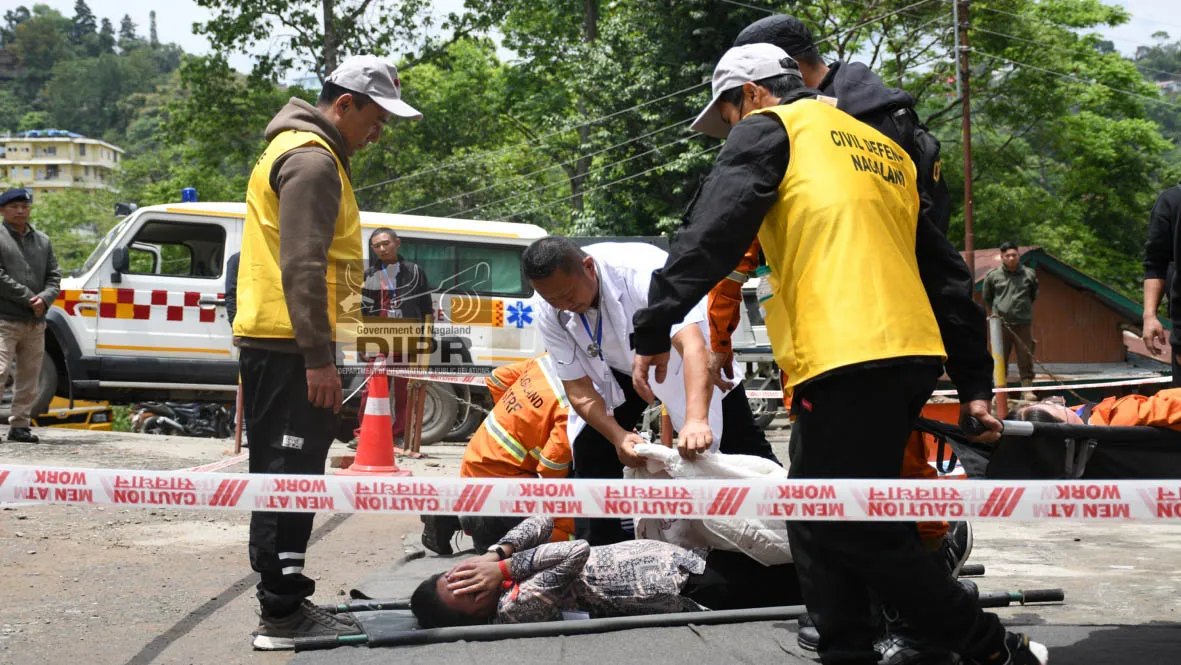
Mock drill simulates earthquake, extreme weather
Correspondent