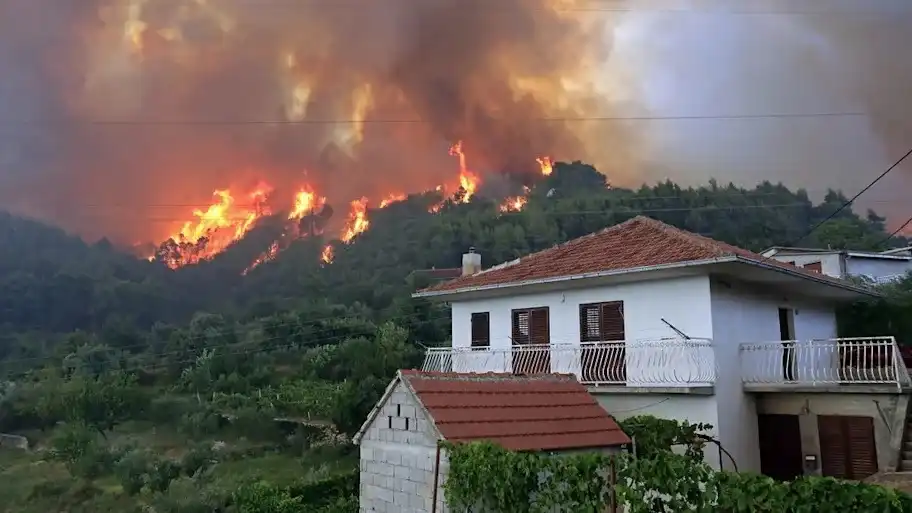
Wildfires are among the most economically costly natural disasters and are becoming more severe and frequent due to global warming. The United Nations Office for Disaster Risk Reduction estimates that global damage from wildfires was on average $106 billion per year between 2014 and 2023. The US is especially prone: the 10 most costly wildfires since 1970 all happened there, with the 2025 wildfires around Los Angeles topping the charts at $53 billion. Worldwide, wildfires destroyed 3.9 million km2 in 2025.
One way to limit the risk and severity of wildfires is forest thinning, where foresters shred and mulch small trees, shrubs, and dense understory brush, create gaps between tree crowns, and remove those species least resistant to fire. This can simultaneously promote biodiversity by admitting light into the understory and increase habitat complexity.
But now, researchers in the US have shown with observational data in Frontiers in Forests and Global Change that the benefits of forest thinning don’t end there.
“Here we show that forest treatments used to reduce wildfire risk also help recover snow storage that has been diminished by forest change and a warming climate, with stronger effects on north-facing slopes than on south-facing slopes,” said corresponding author Dr. Cassie Lumbrazo, a research scientist at the University of Washington and the University of Alaska Southeast.
“These treatments recovered about 12.3 acre-feet of snow-stored water per 100 acres on north-facing slopes, equivalent to roughly 15 Olympic swimming pools per square kilometer, compared to about 5.1 acre-feet per 100 acres, or about six swimming pools per square kilometer, on south-facing slopes.”
The researchers studied the effect of forest thinning on Cle Elum Ridge in the state of Washington. The area is a regional hotspot for wildfire risk reduction actions, as well as at high risk of drought. It is typical of mid- to high-elevation forests spanning the dry eastern flanks of the Cascade Mountain range in Washington and Oregon, as well as parts of the Blue Mountains in northeastern Oregon and northeastern Washington’s Colville National Forest. In Washington, wildfires are most common between July and October, as moisture from winter and spring precipitation dries up.
But this protective snowpack has declined over the last century due to global warming, and is projected to decrease by a further 50% by the end of the century. This is worrisome, because seasonal snow yields between 53 and 78% of the water for human use in the region. Between 2021 and 2023, Lumbrazo and colleagues used LIDAR and time-lapse photography to study the evolution of the snowpack in 12 plots of 100 sq meter located on either the north or south side of the Cle Elum Ridge. Each plot was located within a forest unit—between 809 and 40,469 m2 in area—which was experimentally thinned to a different density and arrangement of trees.
Using modern tools, the thinning method was inspired by ancient fire-adapted forests, which were shaped via indigenous burning and wildfire. The techniques used in this study were developed in consultation with the Tapash Sustainable Forest Collaborative, a group of decision-makers from the Yakama Nation, the Nature Conservancy, the Okanogan Wenatchee Forest Service, the Washington Department of Fish and Wildlife, and the Washington State Department of Natural Resources. Four additional plots remained untreated and served as comparison.
(Phys Org)
The results showed that thinning led to a deeper snowpack in winter: The depth and storage of snow increased by 30% on north-facing slopes and 16% on south-facing slopes. The amount of recovered water increased with increasing openness of the canopy and the number of small to mid-sized gaps (4 meters to 16 meters across) at ground level, but was not associated with traditional forestry measures such as the joint area taken up by tree trunks at breast height.
The authors concluded that managing a forest to improve its resistance to wildfire also promotes “hydrological resilience”—its ability to deliver a sustainable supply of clean water for nature and people in the face of changes in the climate and human activity.
But why was the effect so much stronger on north-facing slopes?
“On north-facing slopes in this part of the Eastern Cascades, forest structure strongly controls how much snow reaches the ground, because tree canopies intercept snowfall, and small gaps allow more snow to accumulate where sunlight is limited,” observed Lumbrazo.
“On south-facing slopes, where snowpacks are shallower and receive more sunlight, solar radiation and ground vegetation seem to play a larger role in how quickly snow melts.”
The authors counsel that recommendations for forest thinning, which typically focus on the more wildfire-prone southern slopes, should give equal attention to northern slopes to maximize the snowpack.
“Our research shows that ecological forest management can recover some of the water lost due to overstocked forests and climate change, thus helping to support aquatic ecosystems that are dependent upon snowpack,” said Dr. Emily Howe, the study’s second author and an ecologist at the Nature Conservancy of Washington in Seattle.