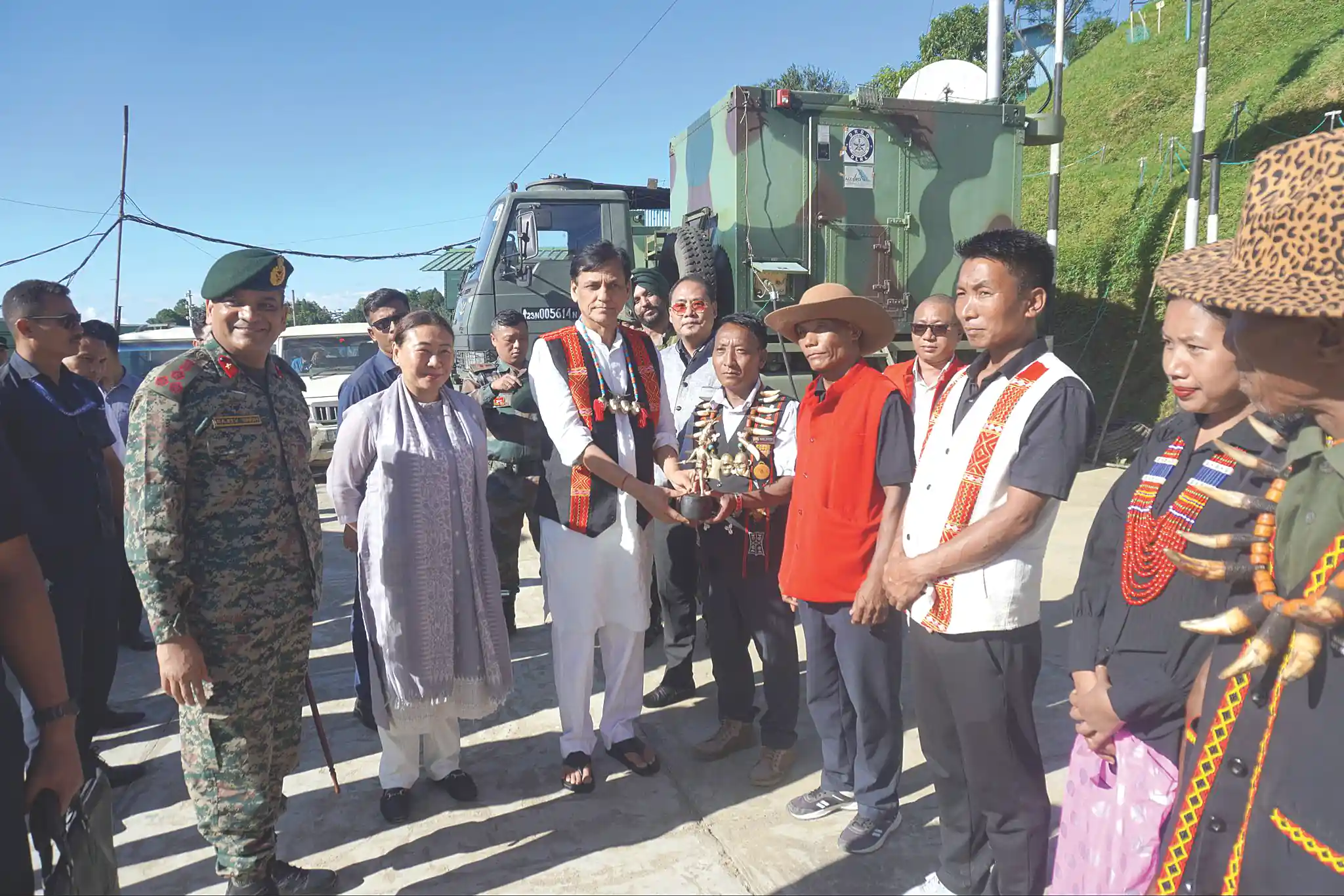
DIMAPUR, JUL 4 (NPN): Union Minister of State for Home Affairs Nityanand Rai visited Longwa village in Mon district on Saturday and interacted with residents, accompanied by Rajya Sabha MP S. Phangnon Konyak
In a post on X, Rai said he visited the border village of Longwa and met local citizens. He also visited the residence of Chief Angh of Longwa Tonyei Phawang and held what he described as a heartfelt interaction with villagers.
Referring to the Centre’s focus on the Northeast, Rai said Prime Minister Narendra Modi had honoured the region as “Ashtalakshmi” and placed it at the centre of India’s development journey.
The minister also said that under the guidance of Union Home Minister Amit Shah, the Assam Rifles was playing an important role in the service and security of the North Eastern region. During the visit, Rai also inspected the Tek Headquarters in Mon district, 42 Assam Rifles, and the company operating base E/42 Assam Rifles deployed along the India–Myanmar border.
Rai said he held discussions with Brig. Rajiv Singh and other officers, and interacted with the soldiers deployed along the border area.
LVC appeals against FMR withdrawal, border fencing
Meanwhile, Longwa Village Council (LVC) appealed to union minister of state for Home Affairs, Nityanand Rai, to reconsider the Centre’s decision to withdraw Free Movement Regime (FMR) and construct border fencing along the Indo-Myanmar border, citing the unique historical and geographical circumstances of Longwa village. In a memorandum submitted on July 4, Longwa village chief Angh Tonyei Phawang and chairman LVC Yanlang Konyak said Longwa, located in Mon district, is home to around 6,000 people residing across both India and Myanmar but united under one Anghship, one Church and one traditional administration.
It stated that the village has around 990 households, of which about 170, including the Chief Angh’s residence, a government primary school, church, morungs, shops and other public properties, lie directly on the international boundary. The village also has eight jhum farmlands and two forest reserves, with four jhum farmlands and one forest reserve located in Myanmar.
According to LVC, Longwa originated in the 16th century following migration from Pongchau in present-day Arunachal Pradesh. It said the international boundary was drawn through the middle of the village during the 1970-71 joint boundary demarcation between India and Myanmar without the informed consent of the villagers.
LVC stated that despite the international boundary, the people of Longwa have continued to live as one community, maintaining peaceful coexistence with relatives and fellow villagers across the border for generations without any significant border-related conflict. It said their shared history, culture, traditions and family ties have remained intact despite the political boundary.
Referring to the Centre’s January 20, 2024 decision to fence the India-Myanmar border and discontinue FMR, the council said the FMR had played a vital role in preserving the social, cultural and familial ties of border communities.
It expressed concern that the proposed border fencing and withdrawal of the FMR would severely affect the traditional way of life, separate families, restrict access to ancestral lands, and weaken the centuries-old cultural, social and family bonds of the people of Longwa.
In view of these circumstances, the council appealed to the minister to intervene and recommend reconsideration of the decision to discontinue the FMR and construct border fencing in areas affecting Longwa village.
It urged the Centre to give special consideration to the village’s unique historical, cultural and geographical circumstances while formulating policies relating to the India–Myanmar border, expressing hope that appropriate steps would be taken in the interest of justice and the welfare of the people of Longwa.